

Welcome to the new frontier of business. Digital transformation with AI isn't just another tech trend—it's a fundamental shift in how companies operate, innovate, and compete. This guide is designed to cut through the noise, offering a clear, actionable playbook for modernizing your business and building software applications that are truly designed to last.
Why Your AI Journey Starts Now
The conversation around artificial intelligence has moved past "if" and landed squarely on "how." For leaders in every industry, it's quickly becoming a make-or-break priority. This isn't about chasing the latest shiny object; it's about building a real, durable competitive advantage. A successful digital transformation with AI requires a unified strategy that delivers a tangible return on your investment.
Unfortunately, many AI initiatives stumble right out of the gate. We often see this happen because of disorganized AI prompts and a chaotic approach to managing different models. Without a solid foundation, even the most promising projects simply fail to scale. This is precisely why mastering your AI interactions from day one is so critical, especially when integrating AI into custom software applications. At Wonderment Apps, we've seen firsthand how a little organization goes a long way, which is why we developed a specialized prompt management system to help developers and entrepreneurs plug AI into their existing software and modernize it for the new era.
A centralized prompt management system is the command center for your entire AI operation. It lets your team version prompts, manage model parameters, and control costs—turning potential AI chaos into a streamlined, scalable, and successful initiative.
Think of it as the difference between a well-organized workshop and a cluttered garage. Both might be filled with powerful tools, but only one is set up for efficient, repeatable, and high-quality work. This is the core principle behind the administrative tools we build at Wonderment Apps, designed to bring order and control to your AI development lifecycle.
The Investment Imperative
The rush to adopt AI is being fueled by serious financial commitments from companies all over the world. The numbers paint a clear picture of a market that isn't just growing—it's accelerating at an incredible pace. Companies have moved beyond just experimenting with AI; they're weaving it into the very fabric of their operations.
By 2026, corporations worldwide are on track to double their AI spending to 1.7% of their total revenues. And this isn't just speculation; over 90% of leaders are committed to ramping up these investments, acknowledging that AI will completely redefine what success looks like by 2028. We're talking about entirely new business models and completely reshaped workflows.
But the path isn't smooth for everyone. Only organizations that achieve end-to-end integration see a remarkable 10.3x ROI, which completely dwarfs the 3.7x return for those lagging behind. You can read more about how CEOs are leading the AI investment surge on BCG.com.
Core Pillars of an AI-Powered Business
To build an AI-powered future that lasts, you need to focus on a few key pillars that form the foundation of your strategy. Each one plays a vital role in making sure your transformation is not only successful but sustainable for years to come.
- Strategic Alignment: Your AI goals have to directly support your core business objectives. Whether you want to improve customer retention, optimize supply chains, or automate internal processes, every AI initiative needs a clear purpose and a measurable outcome.
- Data Readiness: High-quality, accessible data is the fuel for any AI system. This means setting up robust data pipelines, ensuring solid data governance, and preparing your datasets to train and fine-tune models effectively.
- Scalable Architecture: Your tech infrastructure must be flexible enough to handle new AI integrations and scale with user demand. This often involves modernizing legacy systems and adopting an API-first design.
- Talent and Culture: A successful transformation needs a team with the right skills and a culture that embraces continuous learning. Fostering real collaboration between your business, data, and engineering teams is absolutely essential for innovation.
To make sense of how these pieces fit together, it helps to see them as the foundational elements of any major AI initiative.
Key Pillars of AI-Driven Digital Transformation
The table below summarizes the core components required for a successful AI transformation, showing how each pillar functions and the direct business impact it creates.
| Pillar | Core Function | Business Impact |
|---|---|---|
| Strategic Alignment | Connecting AI initiatives directly to measurable business objectives and KPIs. | Ensures AI projects deliver real value, improve ROI, and gain executive buy-in. |
| Data Readiness | Establishing clean, secure, and accessible data pipelines for model training and operation. | Powers accurate models, enables better decision-making, and prevents "garbage in, garbage out" scenarios. |
| Scalable Architecture | Building flexible, API-driven infrastructure that can support and grow with new AI tools. | Future-proofs the business, allowing for rapid integration of new models and technologies without a complete overhaul. |
| Talent & Culture | Cultivating a skilled workforce and an organizational mindset that embraces data-driven change. | Drives innovation from the ground up and ensures the organization can adapt to new AI-powered workflows. |
Ultimately, these four pillars aren't just a checklist; they represent a holistic approach. When they work in harmony, they create a powerful engine for sustained growth and innovation.
Building Your Strategic AI Transformation Roadmap
A successful digital transformation with AI doesn't happen by accident. It's built on a deliberate, well-thought-out strategy. Think of it like building a custom home. You wouldn't just start ordering lumber and pouring concrete without a detailed blueprint. Your AI roadmap is that blueprint—it turns a broad vision into a real, executable plan with clear, measurable milestones.
The whole journey starts with pinning down your core business objectives. Vague goals like "we want to use AI" are a recipe for going nowhere fast. You have to get specific. Are you trying to create hyper-personalized customer experiences to boost loyalty by 25%? Or maybe the goal is to untangle complex supply chains and cut operational costs by 15%?
Having clear, quantifiable goals gives you a North Star for the entire initiative. It makes sure every single decision, from technology choices to team hires, lines up with tangible business outcomes.
Conducting a Readiness Assessment
Once you know where you're going, you need to check if your vehicle is ready for the trip. This is where a readiness assessment comes in. It’s an honest look under the hood of your organization to see where you stand and pinpoint gaps in three critical areas:
- Data: Is your data clean, accessible, and properly structured? AI models are only as good as the data they eat, so getting this right is non-negotiable.
- Technology: Can your current infrastructure even handle AI integrations? Modernizing legacy systems is often the first, necessary step before you can do anything else.
- Talent: Do you have the right people on the bus? This isn't just about data scientists and engineers; you also need business leaders who get how to translate AI capabilities into real value.
This assessment isn't about pointing fingers or finding faults. It’s about spotting opportunities for improvement and making sure your foundation is rock-solid before you start building.
This simple flow chart really nails the core pillars of a well-managed AI journey, focusing on centralizing data, versioning models, and controlling deployment.
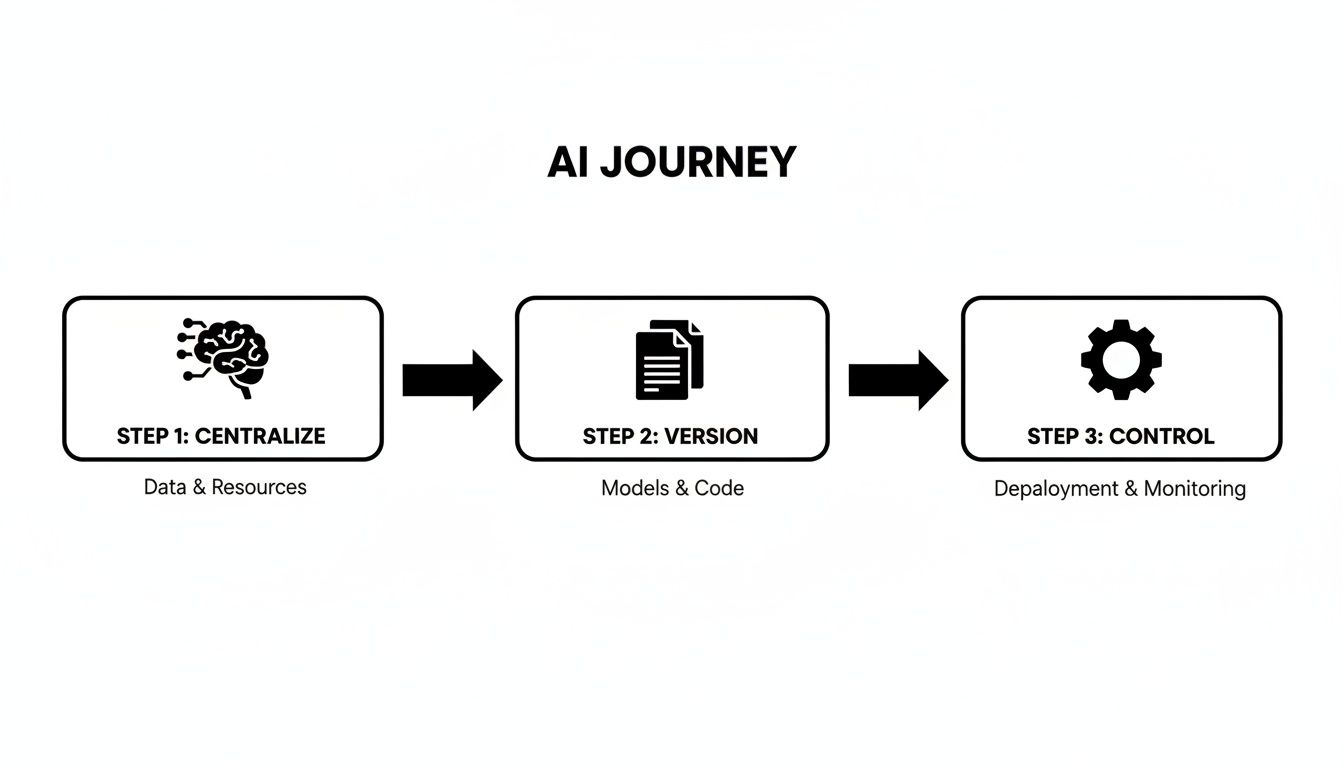
What this shows is that a winning strategy is about having organized, governed processes, not just powerful tech.
Prioritizing Your AI Initiatives
You can't boil the ocean. The secret to getting momentum is to prioritize your initiatives using a simple value-versus-complexity matrix. Just plot your potential projects on a chart with "Business Value" on one axis and "Implementation Complexity" on the other.
Your first move? Target the projects sitting in that sweet spot: the high-value, low-complexity quadrant. These "quick wins" are perfect for showing early ROI, which is absolutely critical for getting stakeholders on board and building excitement for the bigger transformation ahead. For a deeper dive, check out our guide on how to implement AI in your business.
When you focus on high-impact, achievable projects first, you create a powerful positive feedback loop. Success breeds confidence, and that confidence fuels more ambitious and impactful AI integrations down the line.
As you build out your roadmap, it's also crucial to weigh the pros and cons of different AI solutions. This could mean doing things like evaluating AI translation providers like OpenAI and Google Translate to make sure you’re picking the absolute best tools for your specific needs.
Assembling the Right Team
Finally, no roadmap gets you anywhere without the right crew. A digital transformation with AI is a team sport, and it demands a cross-functional approach. You have to break down those old-school silos and bring together experts from all corners of the organization.
Your core team should have:
- Business Leaders: To keep projects aligned with strategic goals and make sure they have the resources they need.
- Data Scientists & Analysts: To manage data pipelines, build the models, and make sense of the results.
- Engineers & Developers: To handle the nuts-and-bolts technical integration and build applications that can scale.
- UX/UI Designers: To make sure the final product is actually intuitive and solves real problems for real users.
When you bring all these different perspectives together, you create a dynamic team that can navigate both the big-picture strategic questions and the tricky technical challenges. This is how you ensure your roadmap leads to a destination of real, sustainable growth.
Navigating the Technical Landscape of AI Integration
This is where your strategic roadmap gets real—where it meets the code and infrastructure that will bring it to life. Weaving AI into your existing software can feel like a massive undertaking, but with the right architectural patterns, it becomes an entirely manageable, and incredibly powerful, process. A successful digital transformation with ai really boils down to making smart technical choices that ensure your applications are scalable, secure, and ready for what’s next.
Think of your current software as a city with established roads and buildings. You don't need to tear the whole thing down just to add a high-speed rail system (your AI). Instead, you build modern stations (APIs) and connecting tunnels (microservices) that let the new system work perfectly with the old one. This approach avoids a complete, disruptive overhaul while still unlocking powerful new capabilities.
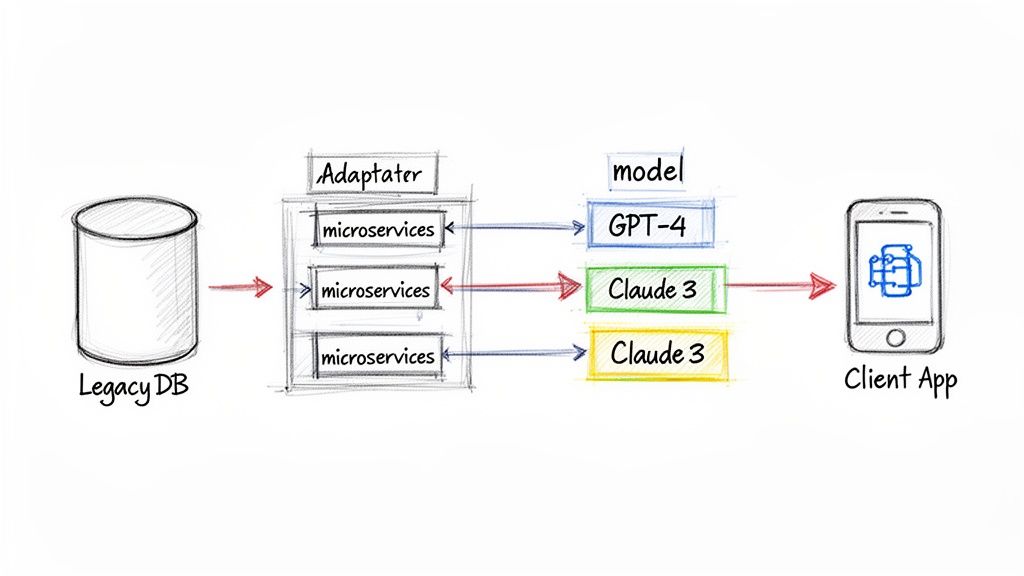
This diagram shows how a modern adapter layer can connect old and new systems, enabling powerful AI integrations without starting from scratch.
Choosing Your Architectural Approach
The foundation of your AI integration is its architecture. It's the blueprint dictating how all the different pieces of your software talk to each other. Getting this right from the start is critical; a modern architectural style creates a flexible system that can easily evolve with new AI models and user demands.
Here are a few core approaches that we’ve seen work exceptionally well:
- API-First Design: This strategy treats every part of your application as a service that communicates through well-defined Application Programming Interfaces (APIs). It’s like making sure every department in your company speaks a common language, which makes collaboration and adding new teams effortless. An API-first approach makes plugging in new AI models from providers like OpenAI or Anthropic so much simpler.
- Microservices: Instead of building one giant, monolithic application, you create a collection of small, independent services. Each one handles a specific business function—like user authentication or product recommendations—and can be updated or scaled on its own. This isolates failures and makes it far easier to assign a specific AI model to a specific task.
- Event-Driven Architecture: In this model, services communicate by broadcasting "events" when something important happens, like a "new order placed." Other services listen for these events and react accordingly. This decoupled approach is perfect for real-time AI applications like fraud detection, where the system has to respond instantly to new data.
For a deeper look into creating resilient systems, you can learn more about our software architecture best practices and how they apply to modern development.
Selecting the Right Models and Data Pipelines
Once your architecture is in place, it’s time to choose the right AI models for the job. The market is flooded with incredible options, but not every model is a fit for every task. A model like GPT-4 might be a genius at generating creative marketing copy, while Claude 3 could be better for summarizing dense technical documents. The key is to match the model’s strengths to your specific business need.
An AI model is a powerful engine, but it runs on data. Without a steady supply of clean, relevant, and high-quality data, even the most advanced AI will produce garbage results. This is why robust data pipelines are not just important—they are the lifeblood of your AI integration.
These pipelines are the automated processes that collect, clean, and format data from various sources—your CRM, user databases, or external feeds—and deliver it to your AI models in a usable format. A well-designed data pipeline ensures your AI has the fuel it needs to generate accurate insights and power intelligent features, day in and day out. This is the foundational work that makes a successful digital transformation with AI possible.
Real-World AI Transformation in Action
All the strategy and architecture diagrams in the world are great, but seeing AI solve real business problems is what makes its potential click. A digital transformation with AI isn’t just some abstract business school concept; it’s a set of practical tools that smart companies are using right now to get ahead. Let's step away from the theory and look at how AI is actively reshaping entire industries, one practical application at a time.
These stories aren’t just hypotheticals—they’re proof that AI delivers tangible value and a serious competitive edge. Businesses are already using some of the top AI tools for business to pull away from the pack. As you read through these examples, start thinking about how you could adapt similar approaches to your own unique challenges.

E-commerce Personalization at Scale
The e-commerce world is ruthless, and the current battle is being fought over personalization. Generic, one-size-fits-all shopping carts just don’t cut it anymore. This is where AI truly shines, sifting through mountains of user data to create individualized customer journeys that boost both sales and loyalty.
AI-powered recommendation engines are the most obvious example. These systems analyze a shopper's click history, past purchases, and even how long they hovered over an item to suggest products with almost spooky accuracy. This is miles beyond the old "people who bought this also bought…" widgets. Today's AI can anticipate future needs, suggest complementary items, and even rearrange the entire homepage for each visitor.
The end result feels less like a generic online store and more like a personal shopping assistant. This curated service doesn't just increase the average order value; it builds a genuine connection with the brand, turning casual buyers into repeat customers.
Fortifying Fintech with AI
In financial technology, everything comes down to speed, accuracy, and security. AI is making a huge impact by automating incredibly complex jobs and offering a level of oversight that no human team could ever match. Fraud detection and compliance are two areas where it's already a game-changer.
- Real-Time Fraud Detection: Old-school fraud systems relied on rigid rules that were slow and predictable, making them easy for criminals to outsmart. AI models, in contrast, can analyze thousands of data points from a single transaction in milliseconds. They spot the tiny, subtle patterns that scream "fraud" before the payment even goes through.
- Automated Compliance Checks: The web of financial regulations is dense and constantly changing. AI systems can automatically scan transactions, customer communications, and new regulatory updates to ensure the organization stays compliant, dramatically cutting the risk of massive fines and brand damage. You can find out more about how SaaS companies are using AI to solve these kinds of problems.
Enhancing Healthcare Engagement
In healthcare, the goal is to build digital products that patients actually want to use, leading to better health outcomes while navigating strict regulations like HIPAA. AI is closing the gap between patients and providers by powering smart, secure, and even empathetic digital tools.
For instance, AI-driven chatbots can give patients instant answers to common medical questions, help them book an appointment, or walk them through post-op care instructions. This frees up nurses and doctors to focus on more critical patient needs. AI can also personalize educational content, delivering vital health information in a way that’s easy for each person to grasp, which improves how well they stick to their treatment plans.
The explosive growth of AI is built on massive user adoption. More than 1 billion people now use standalone AI platforms like LLMs and GenAI every month, creating a huge foundation for its reach into every sector.
This tidal wave of users is fueling incredible investment. Spending on digital transformation hit $1.6 trillion in 2022 and is expected to unlock $100 trillion in value by 2025, with industries like e-commerce leading the charge. These examples aren't just about what AI can do—they show how it creates real, measurable value for businesses today.
Avoiding Common Pitfalls on Your Transformation Journey
Embarking on a digital transformation with AI is an exciting prospect, but the road is often filled with potholes that can derail even the most well-funded projects. The hard truth is that many initiatives don't fail because the tech is bad; they fail because predictable, avoidable challenges were never addressed.
If you know what these roadblocks are ahead of time, you can build a much smarter, more resilient strategy.
The numbers paint a stark picture: the global success rate for these projects is a measly 35%. It gets worse. Even though 78% of companies are bringing AI into the fold, a staggering 74% just can't get it to scale across the business. The number one reason? According to research from integrate.io, it's poor integration. A brilliant AI model is completely worthless if it can't talk to the rest of your systems.
The Integration Impasse
This is the big one. The single hurdle that trips up most companies is a failure to properly integrate new AI tools. Think of it like building a world-class engine but having no way to connect it to the wheels of the car. If your shiny new AI features can't pull data from or push insights to your core operational software, the whole project grinds to a halt.
This kind of disconnect creates frustrating data silos, forces your team into manual workarounds, and ultimately, means the project fails to deliver on its promise. Often, the first real step is modernizing legacy systems by wrapping them in APIs, giving your new AI a way to communicate with the rest of your business.
Navigating Security and Privacy
In an era of relentless cyber threats and iron-clad data privacy laws like GDPR and HIPAA, security can't be a feature you tack on at the end. Launching AI systems without a "secure by design" mindset is an open invitation for disaster—one that can lead to devastating data breaches, massive fines, and a loss of customer trust that's nearly impossible to win back.
A proactive security posture isn't just one thing; it's a combination of smart practices:
- Solid Data Governance: You need clear, enforceable rules about who can access what data and why. No exceptions.
- Compliance from Day One: Don't wait until the audit. Build compliance checks for regulations directly into your development sprints from the very beginning.
- Always-On Threat Monitoring: Implement systems that are constantly watching for suspicious activity and can help you respond in real-time.
A secure foundation isn't just about defense; it’s about building trust. When customers feel confident that their data is safe, they're much more willing to engage with the very AI features you've worked so hard to build.
Taming Uncontrolled Costs
Another pitfall that catches businesses by surprise is runaway spending. This is especially true with the token-based pricing models used by many powerful AI platforms. Every API call to a large language model costs a tiny amount, but those pennies add up alarmingly fast when you scale to thousands or millions of users.
Without a robust way to monitor this consumption, your budget can spiral out of control before you even realize it. This is why effective cost management is non-negotiable. You need a centralized tool that gives you a real-time dashboard of your cumulative spend across every AI service you use. By tracking usage and setting budget alerts, you can innovate without getting a nasty surprise on your monthly invoice. This is a core feature we built into our prompt management tools at Wonderment Apps, giving founders the financial control they need to grow responsibly.
Recognizing these challenges is half the battle. To help you prepare, we've put together a quick-reference table that breaks down the most common pitfalls we see and, more importantly, how to steer clear of them.
Common AI Transformation Pitfalls and Mitigation Strategies
| Common Pitfall | Potential Impact | Mitigation Strategy |
|---|---|---|
| Lack of Clear Business Goals | Projects drift without purpose, delivering features that don't solve a real problem or generate ROI. | Define specific, measurable KPIs before writing a single line of code. Tie every AI initiative directly to a core business objective. |
| Poor Data Quality | The "garbage in, garbage out" principle. Flawed data leads to inaccurate AI models, poor predictions, and bad business decisions. | Invest in data cleansing, validation, and governance. Implement a robust data pipeline that ensures data is clean and ready for AI consumption. |
| Talent and Skill Gaps | The team lacks the expertise in data science, ML engineering, or AI integration to successfully build and maintain the system. | Invest in upskilling your current team, hire key experts, or partner with a specialized firm to fill the gaps with managed, dedicated teams. |
| Ignoring Change Management | Employees resist or don't understand the new AI tools, leading to low adoption rates and a failure to realize the benefits. | Develop a clear communication plan. Involve end-users early in the design process and provide comprehensive training and support. |
| Ethical and Bias Concerns | The AI model produces biased or unfair outcomes, leading to reputational damage, legal trouble, and loss of customer trust. | Implement a "Responsible AI" framework. Regularly audit models for bias, ensure transparency in how decisions are made, and establish clear ethical guidelines. |
By anticipating these issues, you move from a reactive position to a proactive one. An effective AI transformation isn't just about adopting new technology; it's about building the strategic foresight to navigate the challenges that come with it.
Your Partner in AI-Powered Modernization
Starting a digital transformation with AI is a massive project, but it’s not a journey you have to take on your own. Having the right partner can be the difference between a project that stalls out and one that defines your market. This is where an experienced ally isn't just helpful—it's essential.
At Wonderment Apps, we specialize in helping businesses overhaul their legacy systems and plug in the best-fit AI models. The goal? To create smart, data-driven applications that actually work. We know that real success isn't just about picking a cool AI model; it’s about building a solid, manageable ecosystem around it. Our approach pairs expert development with our own powerful tools designed to give you back control.
Taming Complexity with an AI Command Center
A core piece of our strategy is our proprietary prompt management system—an admin toolkit we built from the ground up for developers and entrepreneurs. Think of it as the mission control for your entire AI operation. It takes the tangled mess of managing multiple models and prompts and turns it into a smooth, scalable process.
This toolkit gives you a level of control and visibility that’s hard to find elsewhere, thanks to a few key features:
- Prompt Vault with Versioning: Store, manage, and track every single change to your AI prompts in one secure place. This creates consistency and lets you roll back to previous versions, ending the chaos of trying to manage prompts in spreadsheets or documents.
- Parameter Manager: This is how you configure and control the way your AI models access your internal databases, and do it securely. It lets your AI pull in real-time, relevant information without ever compromising your strict security protocols.
- Comprehensive Logging System: Get a single, unified view of every interaction across every single AI you've integrated. This is absolutely critical for debugging, checking performance, and truly understanding how your models are being used in the wild.
- Cost Manager: Keep a running tab on your cumulative spend in real time. With token-based pricing on most models, costs can get out of hand fast. This tool gives you the financial oversight you need to actually stick to your budget.
Choosing a partner means you’re getting more than just a few extra developers. You're bringing on a strategic ally who’s invested in your long-term growth. It's about building a foundation that not only works today but is designed to adapt and thrive for years to come.
When you work with Wonderment Apps, you get a dedicated team of expert developers who come equipped with the tools to fast-track your AI journey. We take on the technical heavy lifting—from modernizing old systems and handling complex integrations to keeping your models updated—so you can stay focused on driving real business value. We’re here to help you build your AI-powered future, the right way.
Frequently Asked Questions
When you start digging into an AI-enabled digital transformation, a lot of practical questions come up. Business leaders rightfully want to know about budgets, timelines, and how to prove it's all worth it. Let's tackle some of the most common questions we hear from companies just starting this journey.
How Much Does an AI Transformation Typically Cost?
There’s no one-size-fits-all answer here; the cost really depends on how ambitious you want to be. For a focused pilot project, like wiring up an AI chatbot to your customer service app, you might be looking at a range of $50,000 to $150,000.
If you're aiming for something bigger, like overhauling an old e-commerce platform with a sophisticated, personalized recommendation engine, the investment could be anywhere from $250,000 to over $1 million.
A few key things drive that number:
- Data Readiness: How much work is needed to get your data cleaned up, organized, and ready for an AI model to actually use it.
- Integration Complexity: The heavy lifting required to get shiny new AI tools talking to your tried-and-true legacy systems.
- Model Selection: The costs of using proprietary models (think token fees for API calls) versus building on top of open-source alternatives.
What Is a Realistic Timeline for Seeing Results?
How long it takes depends on the project's scope, but the smart money is on a phased approach that delivers value early and often. A tightly defined pilot project can start showing real results and critical learnings in just three to six months. This early win is crucial for getting the momentum and stakeholder buy-in you need for the bigger, more complex phases.
A full-blown transformation that touches multiple parts of the business? That can easily take 12 to 24 months, sometimes longer. The real goal isn't a single "launch day" but creating a continuous rhythm of building, measuring, and learning.
The most successful AI initiatives don't try to boil the ocean. They start with a focused, high-value problem, deliver a tangible win, and then use that success to fund and fuel the next stage of the journey.
How Do We Measure the ROI of AI?
Figuring out the return on your AI investment means looking beyond just cutting costs. While making operations more efficient is a huge plus, the real magic often happens in metrics tied to growth and customer happiness.
To get a clear picture of your ROI, you'll want to track a mix of hard numbers and softer measures:
- Quantitative Metrics: Things you can count, like higher conversion rates, bigger average order values, lower customer churn, and of course, reduced operational costs.
- Qualitative Metrics: Things that measure experience, like better customer satisfaction scores (CSAT), getting new features to market faster, and seeing your team become more productive.
By locking these metrics in before the project even kicks off, you'll have a clear, undeniable way to show the business impact of your digital transformation with AI.
Ready to turn AI complexity into a streamlined, scalable operation? At Wonderment Apps, we provide the expert teams and proprietary tools to modernize your software and give you complete control over your AI initiatives. Schedule a demo to see how our prompt management system can accelerate your transformation journey.