


Finding the best framework for web application development feels like choosing the foundation for a skyscraper. It must be strong, scalable, and future-proof. Today, building for the future means preparing for artificial intelligence. Modern applications demand more than just slick user interfaces; they thrive on leveraging AI to deliver hyper-personalized experiences, automate complex workflows, and unlock unprecedented data insights. A crucial step in defining your digital foundation involves understanding how to choose a tech stack for your SaaS product, ensuring every layer supports your long-term goals.
However, integrating AI introduces significant new challenges, especially around managing the prompts that power these intelligent features. How do you version prompts effectively? How do you securely connect AI to your internal data? How do you control costs across different models? At Wonderment Apps, we built a solution to this exact problem: a powerful prompt management system designed for developers and entrepreneurs. It’s an administrative tool that plugs directly into your application, giving your team a centralized prompt vault with versioning, a parameter manager for secure database access, a universal logging system, and a cost manager to track cumulative AI spend.
This guide will break down the top frontend and backend frameworks, from React and Django to Next.js and ASP.NET Core. We'll explore their strengths, weaknesses, and most importantly, their readiness for an AI-powered world. Our goal is to help you select a framework that not only meets your current needs but also provides a solid launchpad for the intelligent, scalable applications of tomorrow. Let’s find the perfect fit for your project.
1. React: The Component-Driven UI Powerhouse
React, maintained by Meta, isn't a full framework in the traditional sense; it's a JavaScript library for building user interfaces. However, its component-based architecture and vast ecosystem have made it the de facto foundation for some of the most powerful web applications on the planet. Its core strength lies in its declarative approach, allowing developers to design simple views for each state in an application. React efficiently updates and renders just the right components when data changes, leading to fast, responsive UIs.
This modularity is particularly beneficial when integrating complex features like AI. For example, a developer can encapsulate AI logic, such as a call to a language model or a recommendation engine, within a single, reusable component. This makes managing the complexity of AI features far more straightforward. Tools like Wonderment Apps' prompt management system can be seamlessly integrated into these components, providing a centralized "prompt vault" with versioning and a cost manager to track API spend, simplifying the modernization of your app with AI.
Key Strengths and Features
React's flexibility is its defining characteristic. It doesn't lock you into a specific way of handling routing, state management, or data fetching. This allows teams to select the best tools for their specific needs, a crucial factor when deciding on the best framework for your web application.
- Vibrant Ecosystem: The community has produced thousands of libraries and tools. Popular choices include Redux or Zustand for state management, React Router for navigation, and powerful full-stack frameworks like Next.js or Remix built on top of React for server-side rendering (SSR) and static site generation (SSG).
- Component Reusability: Build encapsulated components that manage their own state, then compose them to make complex UIs. This promotes a clean, maintainable codebase that scales effectively.
- Performance: React's Virtual DOM provides a significant performance boost by minimizing direct manipulation of the actual DOM, which is often a bottleneck. Modern features like Server Components and streaming further enhance initial load times for a superior user experience.
| Feature | Description |
|---|---|
| Talent Pool | Massive global community and a large number of available developers, simplifying hiring. |
| Flexibility | Can be used to build anything from a small part of a page to a full-scale enterprise application. |
| Modern Tooling | Excellent developer experience with tools like Create React App, Vite, and extensive IDE support. |
| AI Integration | The component model is ideal for encapsulating AI-driven features and API calls cleanly. |
While its library-not-a-framework nature offers freedom, it also means your team must make more architectural decisions. This can be a double-edged sword, requiring a strong understanding of how to choose the right technology stack for your project. Additionally, staying on top of recent developments, like security advisories for React Server Components (RSC), is crucial for maintaining a secure application.
Website: https://react.dev
2. Angular: The Enterprise-Grade, Opinionated Framework
Angular, maintained by Google, is a comprehensive, "batteries-included" web framework. Unlike libraries that require you to piece together solutions for routing or state management, Angular provides an opinionated, end-to-end architecture out of the box. This makes it a powerful choice for large-scale, enterprise-level applications where consistency, long-term maintainability, and a clear upgrade path are paramount. Its strong foundation in TypeScript ensures type safety, which is critical for complex projects in sectors like fintech and healthcare.
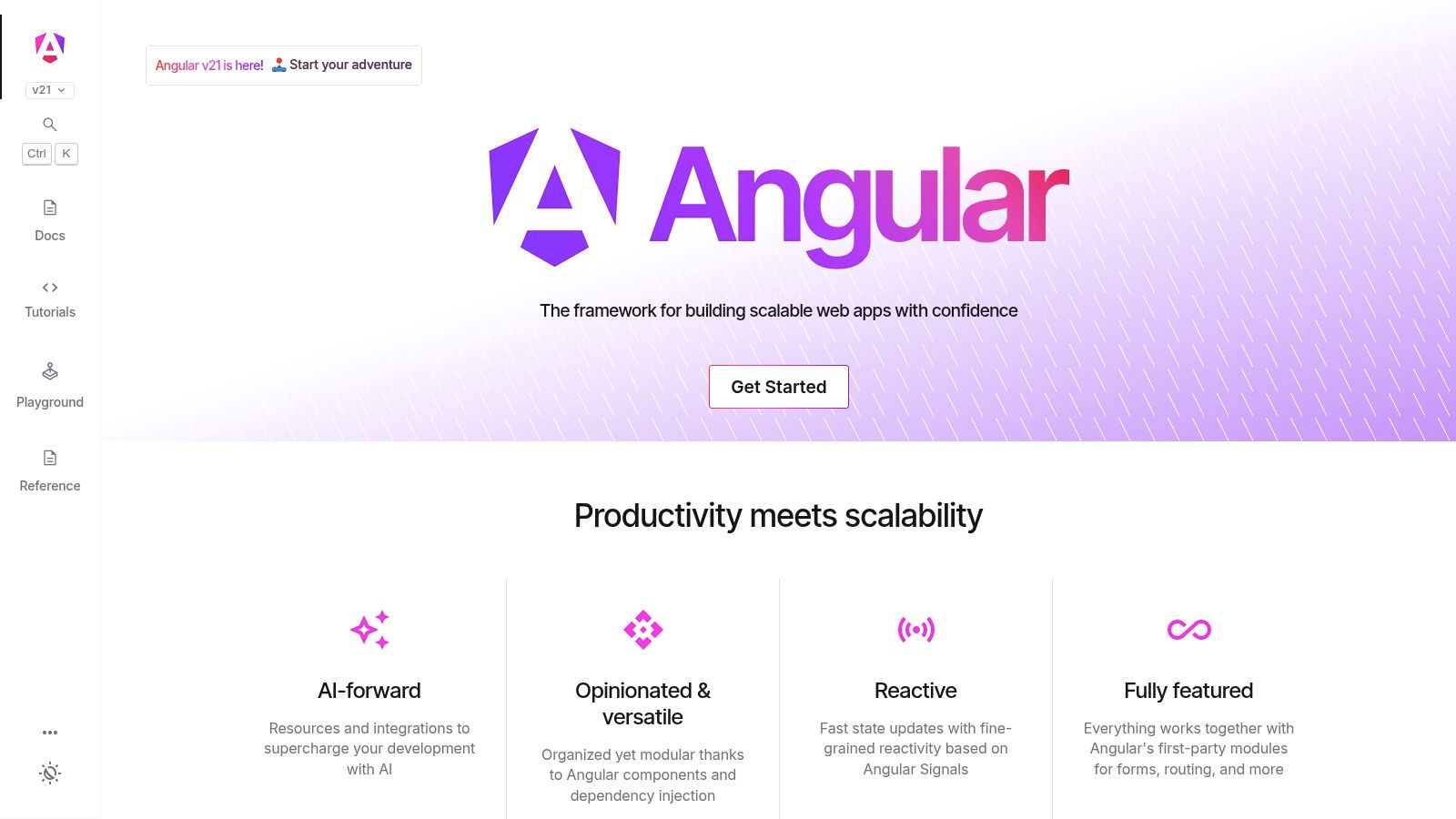
This all-in-one approach extends to modernizing applications with AI. The framework's dependency injection system makes it easy to manage services that communicate with AI models. For instance, you can create a dedicated service to handle API calls to a large language model. This service can be integrated with a tool like Wonderment Apps' prompt management system, giving developers a centralized place to manage, version, and deploy prompts without altering the core application logic, ensuring scalability and control over AI-driven features.
Key Strengths and Features
Angular's cohesive ecosystem is its biggest advantage. From a powerful Command Line Interface (CLI) that scaffolds entire features to built-in solutions for forms and routing, developers have a consistent and predictable toolset. This integrated experience helps large teams stay aligned and productive, making Angular a top contender for the best framework for your web application.
- Cohesive Tooling: The Angular CLI (
ng) automates component creation, builds, testing, and deployment. Theng updatecommand simplifies the process of migrating to new versions, a significant benefit for long-term projects. - Built for Enterprise: With features like dependency injection, a first-party router, and advanced forms handling, Angular is designed to build complex, maintainable applications that can be managed by large development teams.
- Modern Performance: Angular has evolved significantly, now offering server-side rendering (SSR), static site generation (SSG), and fine-grained reactivity through Signals. This simplifies state management and improves performance by reducing unnecessary re-renders.
| Feature | Description |
|---|---|
| Talent Pool | Strong availability of developers, especially in the enterprise space, backed by Google's support. |
| Opinionated Structure | Provides a clear, consistent architecture, reducing decision fatigue and ensuring best practices. |
| Modern Tooling | Powerful CLI, official router, forms module, and built-in support for SSR and hydration. |
| AI Integration | Dependency injection and a service-oriented architecture simplify the management of AI API clients. |
The prescriptive nature of Angular means there is a steeper learning curve compared to more flexible libraries like React. Teams must adopt the "Angular way" of doing things, which can be a hurdle for those unfamiliar with its architecture. However, for organizations that value stability and a unified toolset, this structure is a major asset. Gaining a solid understanding of its core concepts is crucial, which is why resources that break down essential front-end technologies can be invaluable for developers new to the framework.
Website: https://angular.dev
3. Vue.js: The Progressive and Approachable Framework
Vue.js, often described as the "Progressive Framework," carves a unique niche by blending the best aspects of its competitors into an approachable and incrementally adoptable package. Created by Evan You, Vue is designed to be flexible and easy to pick up, making it an excellent choice for teams who need to ramp up quickly or integrate modern reactivity into existing projects piece by piece. Its gentle learning curve doesn't compromise on power, offering a robust ecosystem for building sophisticated single-page applications from the ground up.
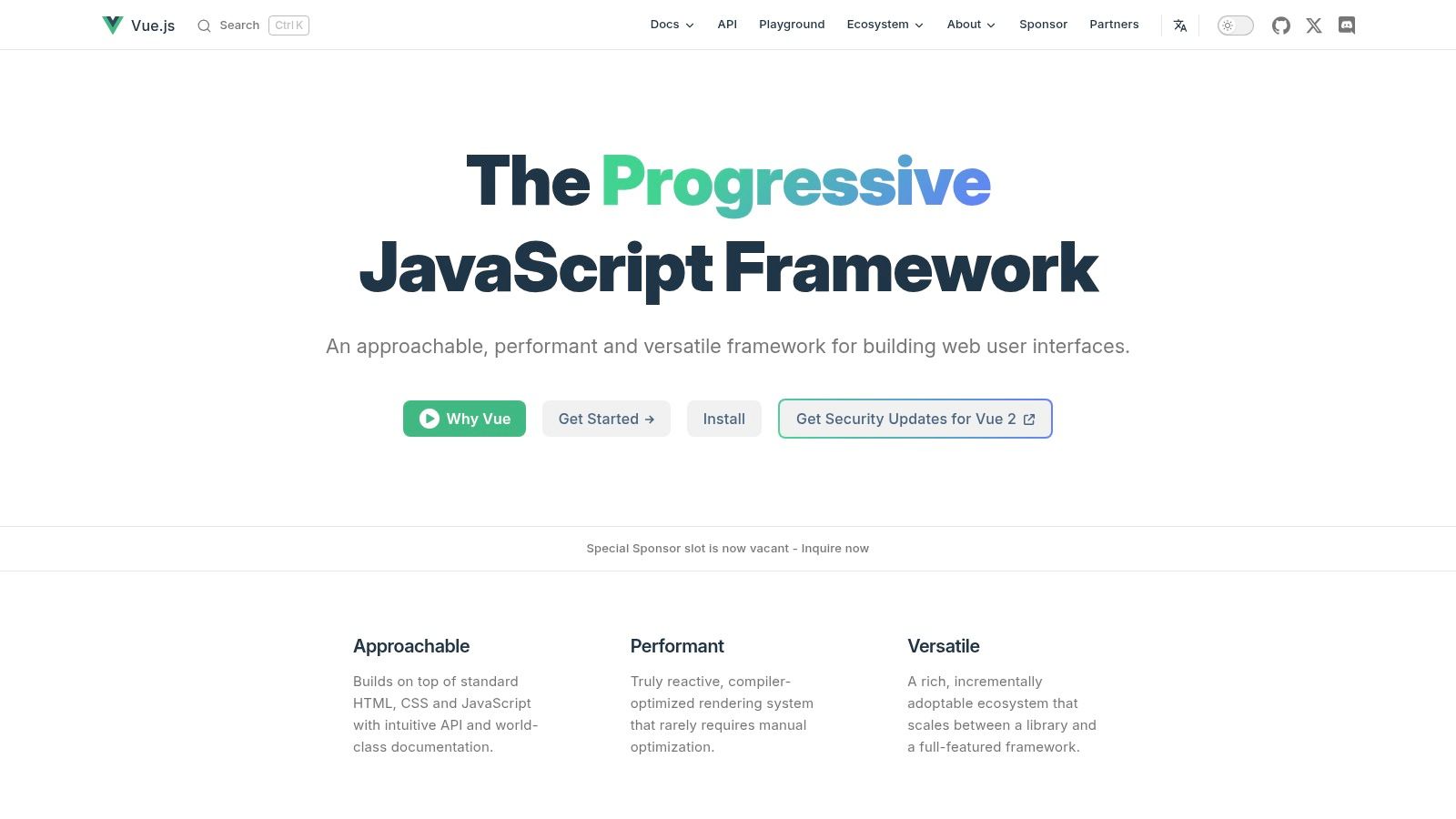
The framework's design philosophy shines in its world-class documentation and straightforward templating syntax, which feels familiar to developers with HTML and JavaScript backgrounds. For AI-driven applications, Vue’s component system simplifies encapsulating API interactions. A component can be designed to handle user input, send it to a large language model, and display the response, all while managing its own state. Integrating tools like Wonderment Apps' prompt management system into such a component is a clean process, enabling developers to version control prompts and monitor AI API costs without cluttering the core application logic.
Key Strengths and Features
Vue’s greatest asset is its developer experience. It hits a sweet spot between the prescriptive nature of Angular and the flexibility of React, providing a core library that is lean and easy to learn, supplemented by official, well-integrated libraries for routing (Vue Router) and state management (Pinia). This makes it a strong contender when evaluating the best framework for your web application, especially for small to medium-sized projects.
- Compiler-Optimized Performance: Vue uses a highly optimized virtual DOM and a compiler that can perform ahead-of-time optimizations, resulting in fast rendering and a small memory footprint.
- Incrementally Adoptable: You can use Vue to enhance a single part of an existing application just as easily as you can use it to build a complex, full-scale enterprise app.
- Single-File Components: The
.vuefile format encapsulates a component's template, logic, and styling in one place, which promotes organization and maintainability as projects grow.
| Feature | Description |
|---|---|
| Learning Curve | Extremely gentle, with excellent documentation that makes it one of the easiest frameworks to learn. |
| Official Ecosystem | Core libraries for routing and state management are officially maintained, ensuring seamless integration. |
| Developer Productivity | Simple APIs and helpful tooling like the Vue Devtools lead to rapid development cycles. |
| AI Integration | Its component-based architecture is well-suited for modularizing and managing AI service integrations. |
While Vue is incredibly versatile and powerful, its enterprise adoption in certain regions, particularly North America, lags behind React. This can sometimes mean a smaller pool of available senior developers and fewer third-party libraries specifically tailored for large-scale corporate needs. However, its vibrant community and strong official support make it a formidable and reliable choice for building modern, high-performance web applications.
Website: https://vuejs.org
4. Next.js + Vercel: The Production-Ready React Framework
Next.js, created by Vercel, has rapidly become the go-to meta-framework for building production-grade React applications. While React provides the UI-building blocks, Next.js offers a comprehensive structure with built-in features like server-side rendering (SSR), static site generation (SSG), and an intuitive App Router. This combination, especially when deployed on the Vercel platform, provides a seamless development-to-deployment workflow, making it a top contender for the best framework for web application development, particularly for high-traffic sites.
The framework's opinionated structure simplifies complex tasks, from routing to data fetching, allowing developers to focus on features rather than configuration. This is particularly advantageous when integrating advanced capabilities like AI. For instance, a server component in Next.js can securely fetch data and interact with an AI model on the server, keeping sensitive API keys and logic away from the client browser. This server-side power makes it easier to plug in tools like Wonderment Apps' prompt management system, enabling you to manage and version AI prompts centrally and monitor API costs without exposing complex infrastructure to the end-user.
Key Strengths and Features
The tight integration between Next.js and its hosting platform, Vercel, creates an unparalleled developer experience. This synergy offers turnkey hosting, a global CDN, automated CI/CD pipelines, and observability tools out of the box. This holistic approach is why many teams building e-commerce, content-heavy, and SaaS applications choose this stack.
- Hybrid Rendering: Seamlessly mix and match rendering strategies on a per-page basis. Use SSG for static marketing pages, SSR for dynamic user dashboards, and Incremental Static Regeneration (ISR) for content that updates periodically.
- Edge-First Capabilities: With Vercel, developers can deploy serverless functions that run at the edge, closer to users. This reduces latency for API routes and middleware, resulting in faster, more responsive applications globally.
- Developer Experience: Features like built-in image optimization, Fast Refresh for instant feedback during development, and a rich ecosystem of templates (like SaaS starters) significantly accelerate the prototyping and building process.
| Feature | Description |
|---|---|
| Performance | Out-of-the-box optimizations for fast load times, including code-splitting, SSR, and image optimization. |
| Deployment | Vercel provides a zero-configuration, git-based deployment workflow that is exceptionally fast. |
| Full-Stack Framework | Build both your frontend and backend API routes within a single, cohesive Next.js project. |
| Enterprise Ready | Vercel offers enterprise-grade features like advanced security (WAF) and compliance add-ons (HIPAA). |
While the tight coupling with Vercel provides an excellent experience, it can sometimes feel platform-opinionated if you choose to host elsewhere. Furthermore, the rapid pace of innovation means teams must stay vigilant with updates and security patches, such as those related to recent RSC vulnerabilities, to ensure their applications remain secure and performant.
Websites: https://nextjs.org and https://vercel.com
5. Django: The Secure, Batteries-Included Backend
Django is a high-level Python web framework that encourages rapid development and clean, pragmatic design. Known for its "batteries-included" philosophy, it provides an extensive collection of modules and libraries out of the box, covering everything from authentication and an object-relational mapper (ORM) to a powerful, auto-generated admin interface. This comprehensive approach makes it an excellent choice for building secure, data-driven backends for complex web applications quickly and efficiently.
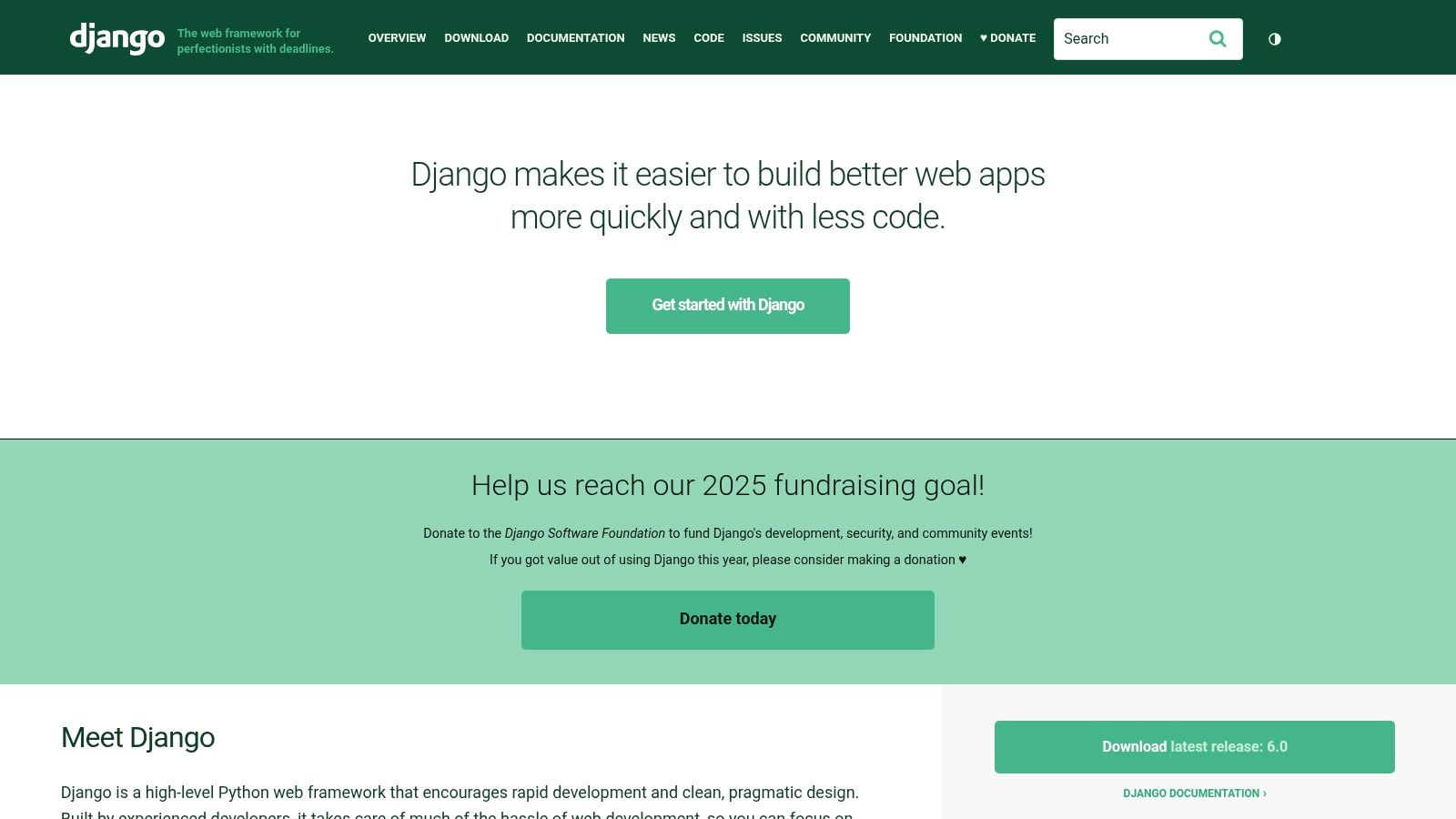
This robust foundation is particularly well-suited for applications that require strong security and data integrity, such as those in fintech or healthcare. When modernizing such systems with AI, Django's structured nature provides a reliable backend for managing complex operations. For instance, you could build a Django API endpoint that securely processes user data, passes it to an AI model for analysis, and uses a tool like Wonderment Apps' prompt management system to ensure that all AI interactions are logged, versioned, and financially tracked, providing crucial oversight for regulated industries.
Key Strengths and Features
Django's greatest advantage is its ability to accelerate development without compromising on quality or security. By providing sensible defaults and built-in solutions for common web development tasks, it allows developers to focus on the unique business logic of their application, a key consideration when choosing the best framework for your web application.
- ‘Batteries-Included’ Philosophy: Comes with a built-in ORM, authentication system, admin panel, and more, significantly reducing the need for third-party packages for core functionalities.
- Emphasis on Security: Django has built-in protections against common security threats like SQL injection, cross-site scripting (XSS), and cross-site request forgery (CSRF), making it a trusted choice for security-conscious projects.
- Scalability and Maturity: It has a proven track record of powering some of the world's highest-traffic websites. Its architecture is designed to scale from small projects to massive enterprise applications.
| Feature | Description |
|---|---|
| Rapid Development | The built-in admin and ORM allow for the rapid creation of CRUD interfaces and back-office tools. |
| Mature Ecosystem | A vast collection of reusable apps and packages available to extend functionality. |
| Clear Policies | Well-defined release and Long-Term Support (LTS) policies provide stability and predictable upgrades. |
| AI Backend Ready | Excellent for building secure APIs that serve as the backbone for AI-powered features on the frontend. |
While its monolithic structure is great for rapid, conventional development, it can feel overly prescriptive for teams building highly decoupled microservices or micro-frontend architectures. Exploring software architecture best practices can help you decide if Django's approach fits your project's needs. Additionally, while its asynchronous capabilities have improved significantly, frameworks built on natively async platforms like Node.js might offer a slight edge for certain real-time use cases.
Website: https://www.djangoproject.com
6. Laravel (+ Forge / Vapor): The All-in-One PHP Powerhouse
For developers seeking a "batteries-included" experience, Laravel stands out as a premier PHP framework renowned for its elegant syntax and comprehensive ecosystem. Created by Taylor Otwell, Laravel provides an end-to-end solution for building everything from simple content sites to robust ecommerce and transactional applications. Its philosophy centers on developer happiness and productivity, abstracting away complex tasks like authentication, routing, sessions, and caching into simple, expressive APIs.
What makes Laravel a unique contender for the best framework for a web application is its tightly integrated first-party ecosystem. Tools like Laravel Forge and Vapor solve the deployment and server management puzzle, a common pain point in the development lifecycle. Forge simplifies provisioning and managing servers on providers like AWS or DigitalOcean, while Vapor offers a fully serverless deployment platform built on AWS Lambda, providing incredible auto-scaling capabilities. This cohesive toolchain allows teams to move from code to production with remarkable speed and reduced operational friction.
Key Strengths and Features
Laravel's greatest asset is its opinionated, full-featured nature, which provides a clear and efficient path for building modern web applications. The framework comes with curated starter kits for popular frontend libraries like Vue and React, as well as its own full-stack, live-update solution called Livewire, giving teams flexible choices for their UI.
- Integrated Ecosystem: First-party packages like Cashier for subscription billing, Horizon for queue management, and Octane for high-performance servers reduce the need to integrate disparate third-party tools.
- Developer Experience: The framework is celebrated for its clean architecture, expressive ORM (Eloquent), and comprehensive documentation, which significantly speeds up development and onboarding.
- Operational Tooling: Forge and Vapor are not just add-ons; they are deeply integrated deployment and management solutions. They handle server provisioning, deployments, SSL certificates, and scaling, letting developers focus on building features.
| Feature | Description |
|---|---|
| Talent Pool | PHP is one of the most widely used web languages, though Laravel-specific talent can vary by region. |
| Speed to Market | The combination of starter kits and integrated tooling allows for rapid prototyping and deployment. |
| Deployment Simplicity | Forge and Vapor abstract away server management and serverless complexities, simplifying operations. |
| AI Integration | Laravel's backend structure is excellent for building robust APIs that can power AI-driven features. |
While Laravel offers a streamlined path, its opinionated nature means less architectural freedom compared to a library like React. Additionally, the operational tools come with their own costs; Forge has a monthly subscription, and Vapor's pricing is layered on top of the underlying AWS usage, which requires careful budget management and governance. For teams choosing PHP, Laravel provides an unmatched combination of development elegance and operational power.
Website: https://laravel.com
7. ASP.NET Core (.NET): The Enterprise-Grade Performer
ASP.NET Core, a key part of Microsoft's .NET platform, is a high-performance, cross-platform framework for building modern, cloud-based web applications. Developed for C# and .NET developers, it is engineered for speed, robustness, and scalability, making it a frequent choice for enterprise-level systems. Its architecture emphasizes performance and flexible deployment options, from self-contained executables to Docker containers, on both Windows and Linux environments.
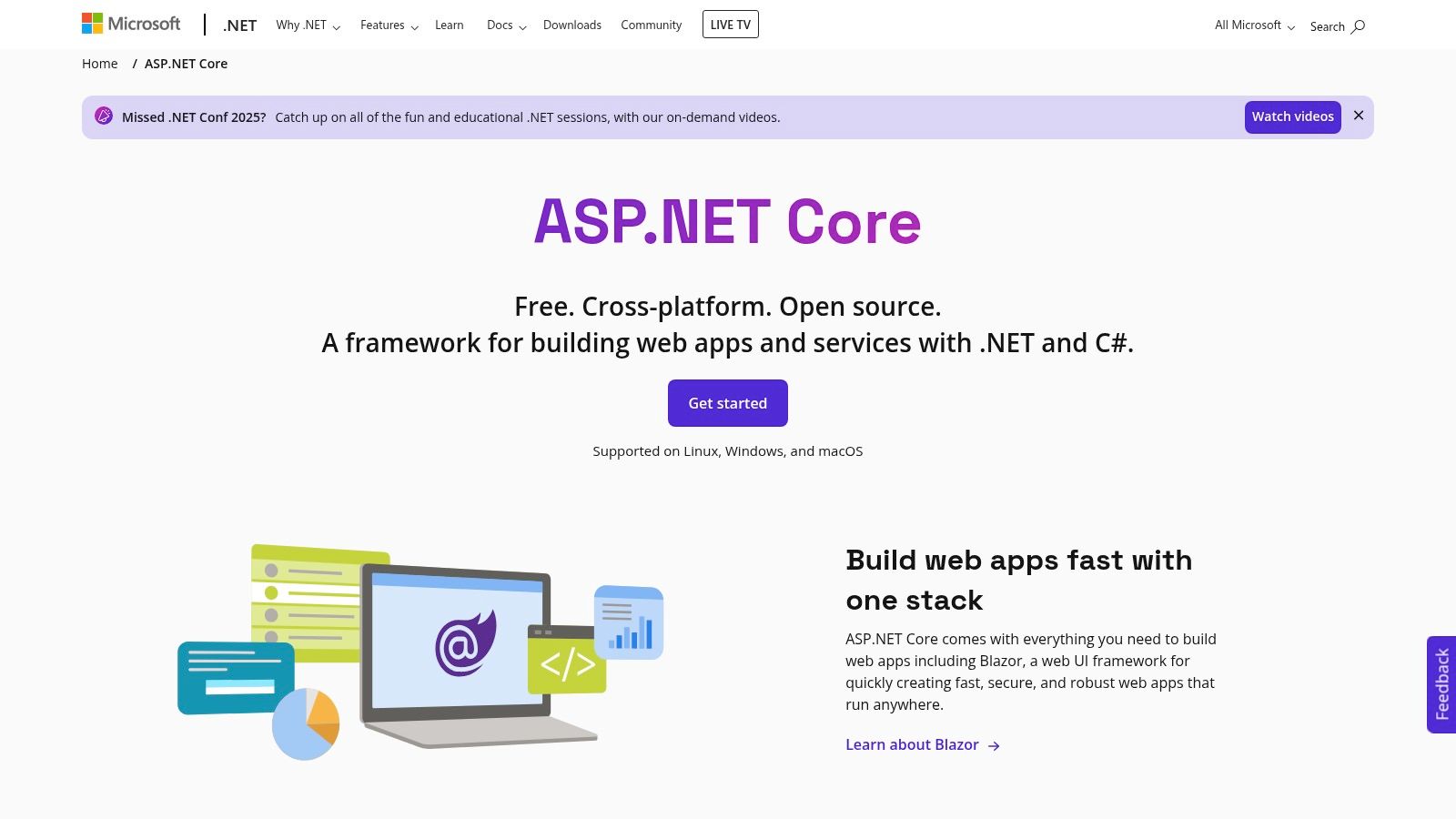
The framework's structured nature is highly advantageous when incorporating sophisticated features like AI. For example, a developer can create a dedicated service layer within an ASP.NET Core application to handle all interactions with AI models. This centralized approach simplifies managing API keys, processing requests, and handling responses, ensuring that AI logic remains organized and decoupled from the user interface. This is especially useful in regulated industries like fintech and healthcare where auditability and clear separation of concerns are paramount.
Key Strengths and Features
ASP.NET Core is backed by Microsoft's long-term support and a mature, enterprise-focused ecosystem. This backing provides stability and a clear roadmap, which is a critical factor when selecting the best framework for a web application intended for long-term use and maintenance.
- Exceptional Performance: Consistently ranks near the top of the TechEmpower benchmarks for web framework performance, ensuring fast response times and efficient resource utilization.
- Cross-Platform and Container-Ready: Develop and deploy applications on Windows, macOS, and Linux. First-class support for Docker and Kubernetes simplifies modern cloud-native deployment strategies.
- Unified Development Model: Features like Blazor allow developers to build interactive web UIs using C# instead of JavaScript, creating a more unified and productive development experience for .NET teams.
- Deep Azure Integration: Seamless integration with Azure services like App Service, Functions, and Azure Active Directory makes it an ideal choice for businesses heavily invested in the Microsoft cloud ecosystem.
| Feature | Description |
|---|---|
| Enterprise Support | Backed by Microsoft with long-term support (LTS) releases, providing stability and security. |
| Developer Tooling | World-class tooling with Visual Studio and Visual Studio Code, including powerful debugging and diagnostics. |
| Security | Built-in features for authentication, authorization, and protection against common web vulnerabilities. |
| AI Integration | The service-oriented architecture is perfect for creating dedicated AI service layers for clean integration. |
The primary consideration with ASP.NET Core is its reliance on the .NET/C# ecosystem. While this is a massive advantage for teams with existing expertise, it presents a learning curve for those unfamiliar with the platform. As with any powerful server-side framework, development teams must remain diligent about applying security advisories and updates to protect against potential vulnerabilities, ensuring the application remains secure and compliant.
Website: https://dotnet.microsoft.com/apps/aspnet
Top 7 Web App Frameworks — Quick Comparison
| Technology | Implementation complexity | Resource requirements | Expected outcomes | Ideal use cases | Key advantages |
|---|---|---|---|---|---|
| React | Moderate — library requires choosing routing/data layers | Large JS ecosystem; experienced React developers | Componentized UIs, high performance with SSR/streaming when configured | Ecommerce, content-heavy apps, modern SPAs | Flexible integrations, huge talent pool, documented performance patterns |
| Angular | High — opinionated framework and steeper learning curve | TypeScript expertise; first‑party tooling and larger codebases | Cohesive, maintainable enterprise apps with predictable upgrades | Large enterprise portals, fintech, government, design‑system apps | Batteries‑included CLI/DI/router; Google support and clear upgrade path |
| Vue.js | Low–Moderate — incrementally adoptable and simple templating | Modest; approachable for small teams and fast onboarding | Rapid development, compiler‑optimized rendering, efficient UIs | Dashboards, storefronts, content sites, incremental migrations | Gentle learning curve, flexible (library→full framework with add‑ons) |
| Next.js + Vercel | Moderate — full‑stack React with platform opinions | React expertise; benefits from Vercel platform and edge tooling | Fast deploys, SSR/SSG, edge performance and CI/CD out of the box | High‑traffic SaaS, ecommerce, content platforms needing fast delivery | Turnkey hosting, global CDN, edge functions, strong developer experience |
| Django | Moderate — "batteries‑included" conventions and scaffolding | Python developers; server resources; ORM/admin reduce build time | Secure, scalable backends with rapid CRUD and admin tooling | Regulated sectors, data‑heavy backends, back‑office applications | Security‑focused defaults, built-in admin, mature ecosystem and LTS |
| Laravel (+ Forge / Vapor) | Moderate — full‑featured framework plus operational tools | PHP developers; optional Forge/Vapor infra and AWS costs | High developer velocity, integrated deployment and serverless options | Ecommerce, transactional apps, content sites needing fast iteration | Excellent developer experience, first‑party deployment/ops tooling |
| ASP.NET Core (.NET) | Moderate–High — requires .NET/C# expertise and enterprise patterns | C#/.NET teams; containerization; strong Azure integrations | High‑performance, enterprise‑grade apps with compliance support | Fintech, government, large‑scale SaaS with strict compliance | Microsoft backing, strong performance, deep Azure and identity ecosystem |
From Framework to Future-Proof: Your Next Steps in AI Modernization
The journey to building a superior digital product doesn't end with selecting the best framework for a web application. As we've explored through the strengths of React, Angular, Vue.js, Next.js, Django, Laravel, and ASP.NET Core, the framework is the foundational blueprint. The true artistry lies in how you build upon that foundation to create a responsive, intelligent, and future-ready application that captivates your audience. The decision between a frontend powerhouse like React and a backend workhorse like Django ultimately hinges on your specific project goals, team expertise, and long-term vision.
However, a recurring theme has emerged: the modern web application is intelligent. Integrating AI is no longer a futuristic concept but a present-day necessity for creating personalized experiences, automating complex processes, and gaining a competitive edge. This is the new frontier where your choice of framework intersects with your AI strategy.
Synthesizing Your Decision: From Theory to Action
Making the final call requires a multi-faceted evaluation. Let's distill the key takeaways into actionable steps to guide your decision-making process.
- Re-evaluate Your Core Requirements: Your use case is your North Star. A high-traffic e-commerce platform has different needs than a secure, compliance-driven healthcare portal. Revisit the "Recommended Picks by Use Case" section and map the strengths of each framework directly to your primary business objectives.
- Assess Your Team's Skillset: The most powerful framework is useless without a team that can master it. Consider the learning curve and existing expertise. A team proficient in C# will find a natural fit with ASP.NET Core, while a JavaScript-centric team might lean towards the React or Vue.js ecosystems.
- Plan for AI Modernization: Don't just build for today; architect for tomorrow. Every framework we discussed can support AI integration, but the implementation complexity varies. Your next critical step is to plan how you will manage the operational side of AI, which is often more challenging than the initial integration. For a deeper dive into strategic advantages, explore how embracing AI can lead to unlocking faster results with AI in app development and future-proof your digital initiatives.
The Missing Piece: Centralizing Your AI Operations
As you venture into AI-powered features, you'll quickly encounter a set of universal challenges that no single framework solves out of the box. How do you manage, test, and deploy different versions of your prompts? How do you securely feed proprietary data into your AI models without compromising security? Most importantly, how do you track and control the often-unpredictable costs associated with API calls to various AI services?
This is precisely where a dedicated prompt management system becomes essential. It acts as a command center for your application's intelligence. At Wonderment Apps, we built our platform to address these exact pain points, providing a robust administrative layer that plugs directly into your application, regardless of the underlying framework. Our tool includes:
- A Prompt Vault with built-in versioning to track changes and roll back if needed.
- A Parameter Manager for securely connecting to your internal databases.
- A comprehensive Logging System to monitor all AI interactions across any integrated AI model.
- A Cost Manager Dashboard for real-time visibility into your cumulative AI spend.
By abstracting this complexity, you empower your developers to innovate faster, experiment safely, and build smarter features without getting bogged down in operational overhead. Choosing the best framework for your web application is the first step; equipping it with the right tools for AI modernization is how you build an application that lasts.
Ready to bridge the gap between your chosen framework and a truly intelligent application? Let Wonderment Apps provide the tools you need to manage, scale, and optimize your AI integrations seamlessly. Visit Wonderment Apps to request a demo of our prompt management system and see how we can help you build the future-proof application your business deserves.