

The core difference between staff augmentation and managed services really boils down to one question: are you looking for extra hands or a specific outcome?
Staff augmentation is like hiring a freelance specialist to sit alongside your team. You get direct control over a temporary expert who can fill an immediate skill gap, perfect for when you just need more development power under your own management. On the other hand, managed services involves handing off an entire project to a partner. They take full responsibility for the results, which is ideal for complex initiatives like building out a new AI platform from scratch.
Choosing Your Tech Partnership Model
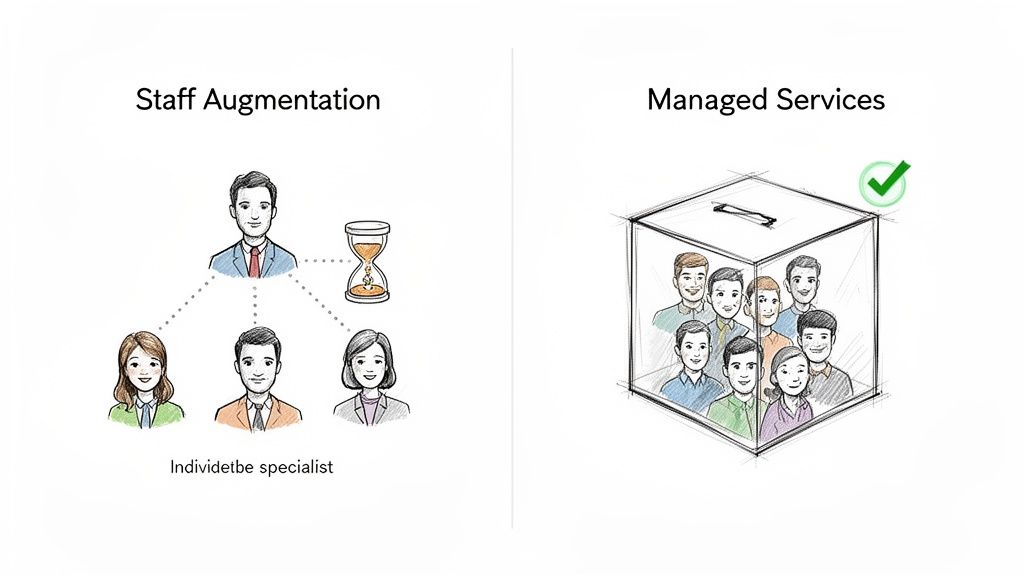
When your software project needs more firepower, you’re at a crossroads. The path you choose will shape your budget, timeline, and how much of your own team’s time is involved. Will you embed temporary experts into your daily operations, or will you delegate the entire outcome to a dedicated partner? Getting this decision right is the first step toward a scalable, successful project.
At Wonderment Apps, we see this as the foundational choice, especially for businesses modernizing their applications with AI. That's why we've even built our own administrative toolkit to make AI integration easier, complete with a prompt vault, cost controls, and logging systems. It's a tool that empowers entrepreneurs and developers to build incredible app experiences that can scale, no matter which partnership model they land on. We’ll show you a demo of this tool in action and how it plugs right into your app.
At-a-Glance Comparison: Staff Augmentation vs. Managed Services
To cut through the noise, here’s a quick summary of how these two models stack up. This table sets the stage for a deeper look at the real-world trade-offs in control, cost, and accountability.
| Factor | Staff Augmentation | Managed Services |
|---|---|---|
| Control | You maintain direct, daily control over tasks and personnel. | You delegate control to the provider, focusing on outcomes. |
| Accountability | You are accountable for the final project outcome. | The provider is accountable for delivering agreed-upon results. |
| Cost Structure | Typically hourly or daily rates (variable). | Fixed, predictable fees tied to service levels (fixed). |
| Best For | Short-term projects, filling skill gaps, and quick scaling. | Long-term initiatives, complex projects, and outcome-based needs. |
Ultimately, you’re choosing between managing resources and managing results. Both can lead to success, but they demand different things from your internal team.
For a deeper dive into how managed services can be structured, this guide on programmatic DevOps as a Service offers great technical insight. This decision also echoes other critical hiring choices; you can learn more about in-house hiring vs. bringing in partners in our related article.
The Real Trade-Offs: Control, Cost, and Accountability
When you’re looking at staff augmentation versus managed services, the decision really boils down to three things: who holds the steering wheel (control), how you pay for the trip (cost), and who’s on the hook if you don’t get there (accountability). These aren't just details for a contract; they fundamentally shape your project's risk, flexibility, and odds of success. Getting this right is the key to picking the right path for your next software initiative.
Staff augmentation puts you firmly in the driver's seat. You get direct managerial control over the experts you bring on board, treating them like extensions of your in-house team. This is great for dynamic projects where requirements might shift week to week. But that control comes with a hidden price—your own team's time.
Your project managers and tech leads suddenly have to handle onboarding, daily stand-ups, task assignments, and performance reviews for these new people. That extra administrative load can pull them away from their core strategic work, a cost that never shows up on an invoice but you’ll definitely feel.
The Cost of Control
With staff augmentation, the cost structure is simple: you pay for time. It's an hourly or daily rate for each person you add to your team. The model is straightforward and can seem cost-effective for short-term needs, like bringing in a QA specialist for a three-month testing sprint before a big launch.
The problem is, this variable cost model makes long-term budgeting a nightmare. We all know software development projects have a tendency to stretch beyond their original scope. When that happens, your costs scale directly with the extra hours. Unexpected delays or complexities can blow up your budget in a hurry, creating a lot of financial uncertainty.
In every successful IT transformation, the critical shift is from headcount control to outcome ownership. This means moving from paying for hours to paying for results, which fundamentally changes how you measure value and manage risk.
This shift in thinking is exactly why so many companies are reconsidering their reliance on temporary staff for core business functions.
The Predictability of Managed Services
Managed services flip the script entirely. Instead of buying hours, you’re paying a predictable, fixed fee for a guaranteed outcome. You give up day-to-day managerial headaches and trust your partner to deliver on the results spelled out in a Service Level Agreement (SLA).
There's a reason this model is booming. The global managed services market was recently valued between $335–$365 billion and is on track to smash $500 billion. That explosive growth, especially in North American and European markets, shows a clear trend. Fintech and ecommerce leaders, in particular, are choosing the stability of managed services over the hands-on management that staff augmentation demands. A good managed services provider handles everything from monitoring to reporting, ensuring you hit your goals without draining your internal resources. You can explore more about this trend with these insights on managed services growth.
Shifting Accountability from Individuals to Outcomes
This is probably the biggest difference of all. With staff augmentation, your company retains 100% of the accountability for whether the project sinks or swims. The contractor you hired is responsible for doing their assigned tasks, but the final outcome? That rests squarely on your team's shoulders. If the project fails, the cost is all yours.
Managed services transfer that accountability directly to the provider. The entire partnership is defined by results, not hours on a timesheet.
- Managed Services: The provider is contractually bound to deliver a specific result, like "99.9% application uptime" or "a fully functional AI-powered recommendation engine." If they don't deliver, the risk is theirs.
- Staff Augmentation: You are paying for a person's time and skills. Whether their work contributes to a successful project is ultimately up to your internal project management to figure out.
This shift is a game-changer. For an ecommerce business building a new checkout system, a managed services partner is accountable for making sure that system actually processes transactions securely and efficiently. With staff augmentation, you are accountable for piecing together the work of several developers into a functional whole. That one distinction changes the entire dynamic, turning a simple vendor relationship into a real strategic partnership focused on shared success.
Making the Right Choice: A Decision Framework
Deciding between staff augmentation and managed services is more than just a resourcing call—it’s a strategic move. The right answer isn't universal; it hinges entirely on your project's scope, timeline, internal know-how, and just how much risk your company is willing to own.
To find the right fit, you have to ask the right questions. Being honest about your needs will point you down the best path, whether you just need a short burst of specialized talent or a long-term partner to take the reins of a complex software project.
This decision tree breaks down the core logic, starting with the single most important question: how much control do you need?
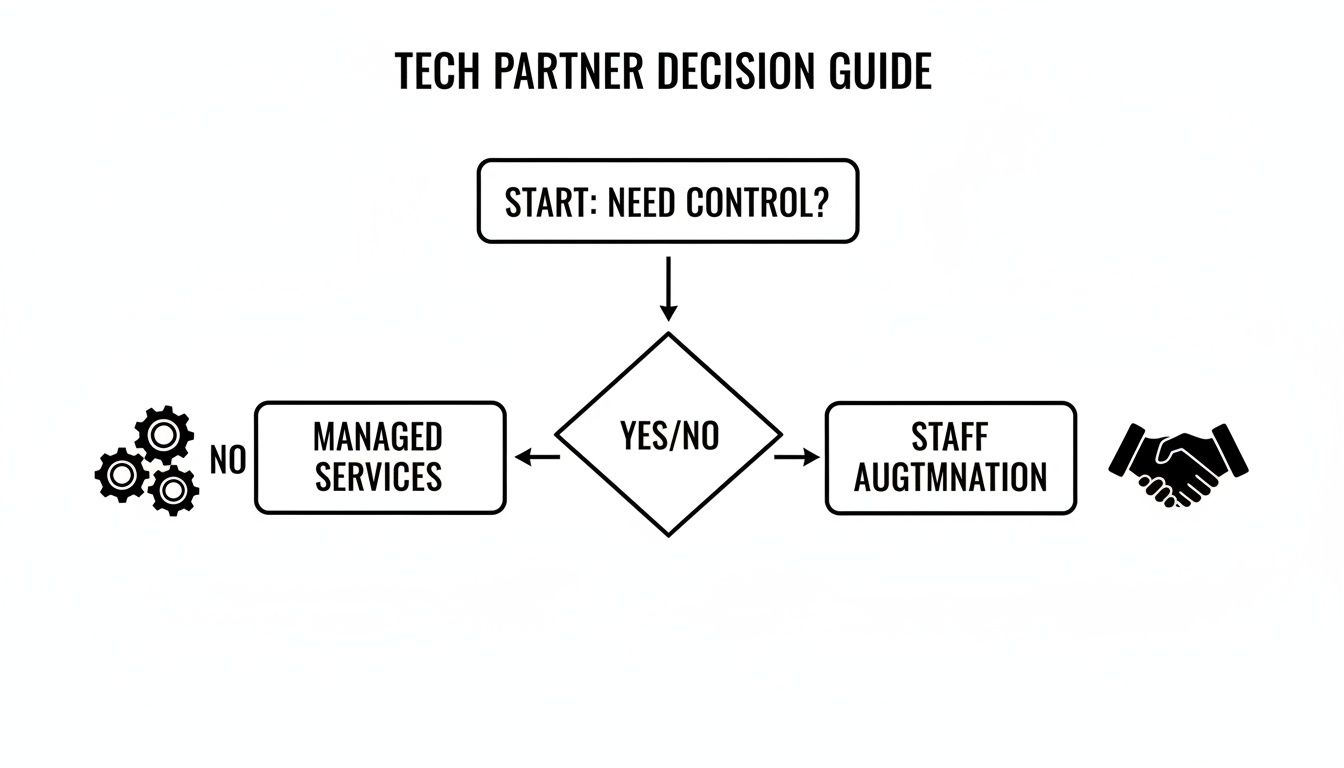
As you can see, if maintaining direct, daily control over the team is non-negotiable, staff augmentation is your answer. But if you’re focused on outcomes and ready to delegate the "how," managed services is the far more effective option.
When Staff Augmentation Excels
Think of staff augmentation as your go-to tactical solution. It’s perfect for filling a specific, well-defined gap where you keep full ownership of the project. This model shines when you need to plug a temporary hole or bring in a niche skill your current team lacks.
Here are a few classic scenarios where augmentation makes perfect sense:
- A Specialized Feature Build: Your team is crafting a new mobile app but you don't have a senior iOS developer who's a wizard with Swift. Augmenting your team for three months gets that feature built without the long-term cost of a full-time hire.
- A Quick Burst of QA Testing: You’re staring down a major product launch and need to triple your testing power for a six-week sprint. Bringing in temporary QA engineers gives you the confidence to hit your deadline.
- Covering for Leave: One of your key backend developers is heading out on parental leave for four months. A temporary contractor keeps your velocity up and prevents the project from stalling out.
The goal here is to add capacity, not offload responsibility. You need more hands on deck, but your project manager is still the one steering the ship.
This approach works wonders for short-term projects that are already well-defined and managed internally. The key is having the in-house leadership to direct the augmented talent effectively. For a deeper dive into these tactical models, our guide on outstaffing vs. outsourcing can offer more clarity.
When Managed Services is the Clear Winner
Managed services is the strategic play. It’s for complex, outcome-driven initiatives where you need a partner to take complete ownership from start to finish. This model is built for projects that carry significant risk, demand a diverse skill set, or are critical to your long-term business goals. As you frame your decision, it's crucial to define enterprise-level criteria that will shape your partnership.
Managed services is the superior choice in situations like these:
- Complete AI Modernization: You need to overhaul a legacy e-commerce platform by integrating an AI-powered recommendation engine. That takes a solution architect, data scientists, and backend engineers all working in sync—a perfect job for a managed team that guarantees the final outcome.
- Building a Scalable App from Scratch: You have a vision for a new fintech app that has to handle thousands of secure transactions per second. A managed services partner brings the entire end-to-end team—PMs, designers, developers, and QA—to design, build, and launch it for you.
- 24/7 Support for a Mission-Critical Platform: Your healthcare application has to maintain 99.99% uptime to serve patients. A managed services provider can deliver round-the-clock monitoring and support under a strict SLA, something that’s nearly impossible to cobble together with augmented staff.
Comparing Team Structures and Project Outcomes
The theoretical lines between staff augmentation and managed services get a lot clearer when you see how the teams are actually put together and what everyone agrees "success" looks like. One model is about adding individual hands to your project; the other is about hiring a self-sufficient unit to deliver a specific result.
Getting this distinction right is the key to picking a partner that truly fits what you need.
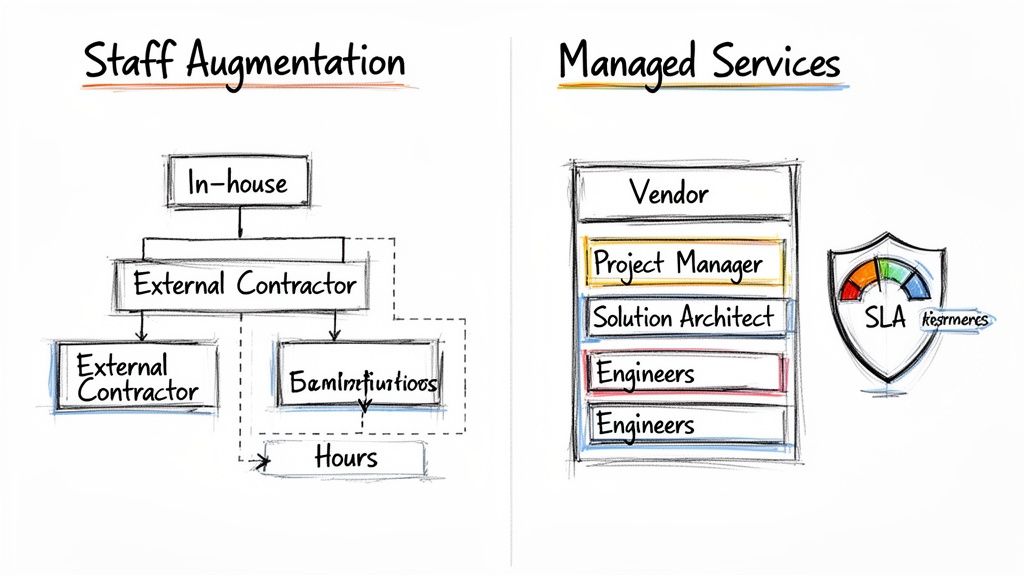
At its core, the difference comes down to how a project is staffed. With staff augmentation, you’re essentially "renting" specialists to plug into your current team. You're still the one building and managing the overall group.
Staff Augmentation Team Composition
Let’s say your in-house crew includes a project manager, a product owner, and a couple of mid-level developers. You've hit a wall and realize you need a senior backend engineer with deep AI experience to hit a tight deadline. This is a classic staff augmentation scenario.
Your team structure would look something like this:
- Your Project Manager: Directs all the work and assigns tasks to the entire team.
- Your In-House Developers: Keep humming along on their assigned features.
- Augmented Senior Developer: Reports directly to your PM, works side-by-side with your team, and zeroes in on the specialized backend work you give them.
In this setup, you have total control, but you're also completely on the hook for orchestrating every person's effort to get to a finished product. There are serious trade-offs here, which we cover in our full breakdown of IT staff augmentation.
Managed Services Team Composition
Managed services is a whole different ballgame. Instead of adding a person, you get a fully-formed, independent team from a partner like Wonderment Apps. This team isn't there to just fill a role—they’re built to deliver a concrete business outcome.
A typical managed services team for an AI modernization project might look like this:
- Dedicated Project Manager: Your single point of contact who manages the project from start to finish.
- Solution Architect: Lays out the high-level technical blueprint for a scalable and high-performing solution.
- Lead and Junior Engineers: Handle all the development work, from building APIs to integrating AI models.
- QA Specialist: Makes sure the final delivery is bug-free and nails all the requirements.
This group operates as a cohesive unit, managed by the provider, all focused on delivering the promised solution. You're talking to their project manager, not chasing down individual developers.
It's a fundamental shift from managing people to managing a partnership. Your focus moves from daily task assignments to milestone reviews and strategic alignment, freeing your internal leaders to concentrate on core business goals.
How Success Is Measured: SLAs and Outcomes
This structural difference has a massive impact on how success is defined and measured. The contracts for each model tell the story: one is for skilled labor, the other is for tangible results.
A pivotal CompTIA study found that companies using managed services saw a 45% drop in IT operational costs and a 50% jump in productivity. This is because the model shifts full accountability to the provider through Service Level Agreements (SLAs), drastically reducing your management overhead.
Let’s look at a simple table to make this clear.
Comparing Team Structures and SLA Focus
| Aspect | Staff Augmentation | Managed Services |
|---|---|---|
| Team Structure | A hybrid team of your employees and individual external contractors. | A self-contained, fully managed team provided by the vendor. |
| Management | Your internal managers direct day-to-day tasks for everyone. | The vendor's project manager directs their team's tasks. |
| Accountability | You are responsible for the final project outcome. | The vendor is responsible for delivering the agreed-upon outcome. |
| Contract Focus | Based on time and materials (e.g., hourly rates for specific skill sets). | Based on results and performance, defined by Service Level Agreements (SLAs). |
| Typical Success Metric | The individual successfully completes assigned tasks and works the agreed hours. | The provider meets specific, measurable business goals (e.g., uptime, performance). |
As the table shows, the entire framework for success is different.
With staff augmentation, the contract is straightforward. It’s based on time and materials—you pay an hourly rate for a person. Success is measured by them showing up and competently doing the tasks you assign. The project's ultimate success or failure still rests on your shoulders.
In managed services, contracts are built around those Service Level Agreements (SLAs). These aren't just goals; they're legally binding promises tied to measurable business results.
- Application Uptime: The provider might guarantee 99.95% uptime for your platform.
- Performance Metrics: An SLA could require API response times to stay under 200 milliseconds.
- Security Compliance: The partner could be contractually responsible for ensuring the app passes all required security audits.
This is the bottom line: managed services are contractually obligated to deliver business value. Staff augmentation is obligated to provide skilled people. One sells you a finished, working product; the other sells you the parts and leaves the assembly to you.
Industry-Specific Scenarios and Recommendations
Choosing between staff augmentation and managed services isn’t just a technical decision; it's a strategic one that has to make sense for the unique pressures and opportunities in your industry. A model that works for a fast-moving ecommerce brand just won't fly for a compliance-heavy healthcare provider. The right choice hinges on your sector’s specific demands for speed, security, and scalability.
Making the right call means understanding the context. A fintech company building a mission-critical payment gateway has a completely different risk profile than a media company launching a new streaming feature. This is where the theoretical debate of staff augmentation vs. managed services gets real.
Ecommerce and Retail
The ecommerce world is all about the customer experience. Personalization engines, frictionless checkouts, and high-performance mobile apps are no longer nice-to-haves—they're table stakes. These complex, interconnected systems demand a cohesive vision and execution, which is a strong argument for a managed services approach.
Take, for example, building an AI-driven personalization engine. This isn’t a small, isolated feature; it's a core business function that requires a coordinated team of data scientists, backend developers, and UX specialists.
- Managed Services is Ideal: A partner takes full ownership of designing, building, and maintaining the engine. Their responsibility is tied directly to a business outcome, like boosting average order value by 15%.
- Staff Augmentation is Risky: Trying to assemble that kind of talent piece by piece dumps a huge integration risk on your internal team. If the components don't work together flawlessly, the project fails, and the buck stops with you.
For any ecommerce company, where a single hour of downtime during a holiday sale can cost millions, the guaranteed uptime and performance metrics of a managed services SLA are incredibly valuable.
Fintech and SaaS
In the fintech and SaaS worlds, security, compliance, and reliability are the bedrock of customer trust. Whether you're handling financial transactions or storing sensitive business data, there is absolutely no room for error. These non-negotiable requirements build a powerful case for managed services.
A managed services provider specializing in fintech brings much more than developers to the table; they bring a battle-tested understanding of regulatory frameworks and security protocols. They are contractually obligated to deliver a product that is not just functional but also secure and compliant from day one.
When you're dealing with mission-critical applications where a security breach could be an existential threat, delegating the outcome to a partner with proven security expertise is the smarter bet. They own the risk of delivering a hardened, compliant system.
Staff augmentation, on the other hand, can introduce vulnerabilities. Bringing in temporary developers who may not be deeply familiar with your specific security stack or compliance needs just expands your risk profile. A managed services partner makes security a core part of their deliverable, not an afterthought.
Healthcare and Wellness
The healthcare sector operates under the tight grip of HIPAA and other data privacy laws. Building any digital health product—from a patient portal to a telehealth platform—demands an unwavering focus on protecting sensitive patient information. This is another area where managed services provides a clear, decisive advantage.
A managed services partner with deep healthcare experience gets that HIPAA compliance isn't just a checkbox; it's a fundamental design principle. They build security and privacy into every single stage of the development lifecycle, from architecture all the way to deployment.
- Managed Services ensures compliance: They can be held accountable via SLAs for delivering a HIPAA-compliant product, complete with the necessary audit trails and robust data encryption.
- Staff augmentation creates compliance gaps: Relying on individual contractors who might not have specific healthcare compliance training puts the burden of oversight—and all the risk—squarely on your shoulders. One mistake could lead to crippling penalties.
When patient data is on the line, choosing a partner who contractually guarantees a compliant outcome isn't just a preference—it’s a critical part of risk management.
How to Accelerate Your Next Software Project
Choosing the right engagement model is a great first step, but picking the right partner is what actually gets your vision built. After weighing staff augmentation against managed services, the next move is finding a team that doesn't just execute but truly accelerates your software goals with the right tools and deep expertise.
This is exactly where we come in. At Wonderment Apps, our Managed Projects practice is designed for businesses that need more than just developers—they need guaranteed outcomes. We build and deploy complete, self-managed teams of engineers, designers, and project managers who take full ownership, from the first line of code to the final launch. It's the ideal setup for complex projects where accountability is everything.
Powering Your Project with a Unique AI Toolkit
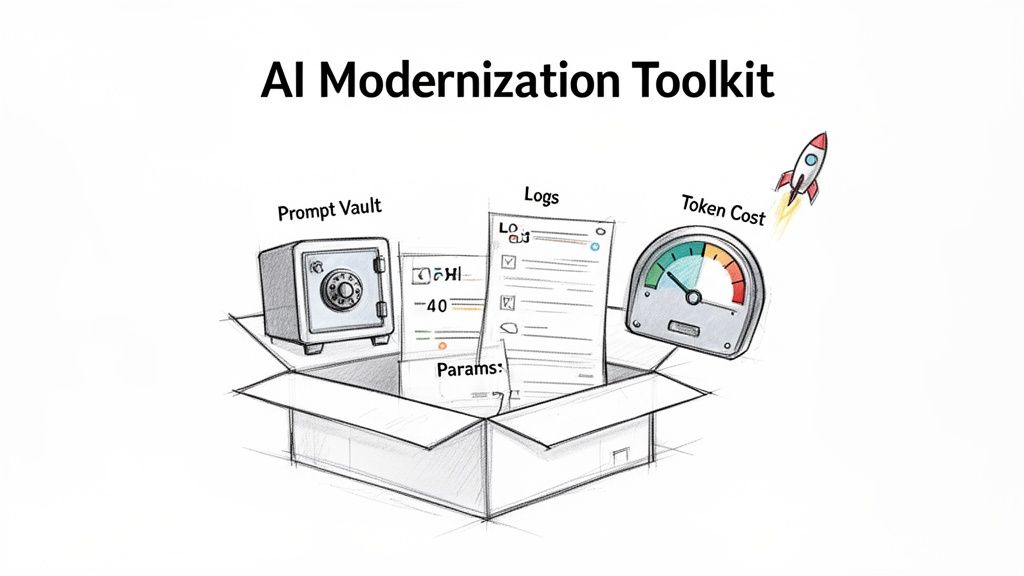
Building modern software almost always involves AI, but that integration can get messy and expensive without a solid foundation. We ran into this challenge ourselves, so we built our own solution: a unique prompt management system designed to give entrepreneurs and developers the control they need.
It's an administrative system that you can plug into your existing app or software to modernize it for AI integration. It streamlines development by providing critical guardrails:
- Prompt Vault with Versioning: Store, manage, and track every version of your AI prompts. This ensures you have consistency and a clear path for improving performance over time.
- Parameter Manager: Securely access and manage internal database parameters, which allows AI models to work with your proprietary data without putting it at risk.
- Comprehensive Logging: Keep a complete log of every interaction across all your integrated AIs. You get total visibility for debugging, fine-tuning, and optimization.
- Cost Manager: Monitor your cumulative spend on AI services in real-time. No more budget surprises—just cost-effective operations.
This toolkit isn't just a nice-to-have; it's central to how we deliver intelligent, data-driven applications that are built to perform, scale, and last for many years to come.
The real acceleration in software development comes from having both a dedicated team and the right foundational tools. When you combine outcome-focused project management with a powerful AI integration framework, you create a direct path to measurable results.
Whether you're building a brand-new application or overhauling a legacy system, this combination of a skilled managed team and a powerful toolkit removes the usual friction and risk. It frees up your internal teams to focus on strategy while we deliver a reliable, smart, and cost-efficient solution.
Ready to see how our approach can speed up your next project? Schedule a demo to get a firsthand look at our prompt management system and learn how our Managed Projects can help you build incredible app experiences, faster.
Common Questions About Staff Aug vs. Managed Services
When you're deciding between staff augmentation and managed services, a few key questions always come up. Getting clear on the practical differences in cost, flexibility, and who owns the project knowledge can really help you choose the right path for your software development.
Can I Switch From Staff Augmentation to Managed Services?
Absolutely. In fact, it's a pretty common evolution. Many of our partners, including us here at Wonderment Apps, help clients make this exact transition. It usually happens when a project starts with a few key hires but grows into something bigger that needs full ownership and guaranteed results.
A good partner will work with you to redefine the scope, set up clear, outcome-driven Service Level Agreements (SLAs), and smoothly shift the team into a fully managed model. This way, you don't lose any momentum, but you gain all the strategic advantages of a managed team.
Which Model is Better for Projects with Evolving Requirements?
This is a classic "it depends" scenario, but maybe not for the reason you think. While staff augmentation gives you direct, day-to-day control, a sharp managed services provider that lives and breathes agile development is also fantastic in fluid situations. It's a bit of a myth that managed services have to be rigid.
A modern managed services team is built to handle uncertainty. They work in iterative sprints, rely on constant feedback loops, and keep communication wide open. They take on the project risk, making sure the final product hits your business goals, even if the road to get there has a few twists and turns.
How Does Knowledge Transfer Work in Each Model?
This is a huge one, and it directly impacts the long-term health of your project. The difference is stark.
- Staff Augmentation: Knowledge transfer is entirely on you. You have to build and maintain the internal processes to capture what your temporary team members know before their contracts end. If you don't, that expertise walks out the door with them.
- Managed Services: The provider owns knowledge retention. It’s part of the service. They keep detailed internal documentation and make sure the team stays up to speed. A quality partner also provides comprehensive docs and training when they hand the finished project over to your in-house team.
With managed services, institutional knowledge becomes a deliverable, not a liability. This protects your investment and ensures your internal team can support and build upon the solution long after the initial project is complete.
Is One Model Always More Expensive Than the Other?
Not at all. Looking only at the hourly rate is a classic mistake. Staff augmentation might seem cheaper on paper, but that number doesn't tell the whole story. You have to account for the hidden costs—your own management overhead, onboarding time, and providing all the necessary tools and equipment.
Managed services usually come with a predictable, fixed fee that can look higher at first glance. But that price includes all the project management, tooling, and—most critically—accountability for the final outcome. For complex projects, this almost always leads to a lower total cost and a much better return on your investment.
At Wonderment Apps, we help you find the perfect balance between control and outcomes. Whether you need a managed team to deliver a mission-critical AI platform or specialized talent to accelerate your roadmap, we provide the expertise and tools to build exceptional software.
Ready to build your next great app experience? Schedule a demo to see our AI toolkit and discuss how we can help.