

Mobile app development for healthcare is fundamentally changing how patients and providers connect. It's about turning the smartphone in your pocket into a secure, powerful tool for virtual care, health monitoring, and managing critical medical information. But let's be honest, modernizing a healthcare app today means more than just a slick interface—it's about integrating smart technologies like AI to build an experience that can scale to meet any user demand.
Your Smartphone Is the New Doctor's Office
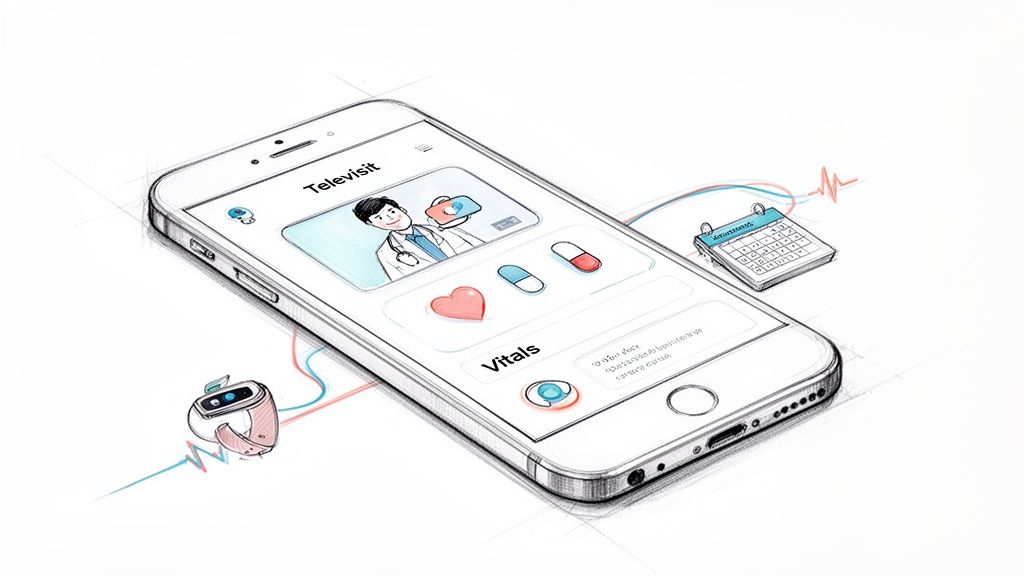
Welcome to the new reality of patient care, where your phone is the digital front door to medical services. What once felt like science fiction—consulting a doctor from your couch or tracking a chronic condition in real-time—is now a daily routine for millions. Mobile health (mHealth) apps have evolved far beyond simple fitness trackers; they are now sophisticated clinical tools.
These apps give patients an active role in their own well-being. From managing complex medication schedules to joining virtual therapy sessions, the power to manage one's health is literally in the palm of their hand. This isn't just about convenience; it's about driving better health outcomes.
The Booming Market for mHealth Solutions
The growth in this space is staggering. The global mHealth apps market was valued at USD 37.5 billion in 2024 and is on track to hit USD 86.37 billion by 2030. That's a compound annual growth rate (CAGR) of 14.8%, fueled by massive smartphone adoption and an ever-increasing demand for accessible care.
Right now, the medical app segment is leading the charge with a dominant 73.0% revenue share, as providers lean on these tools for patient monitoring and creating highly personalized treatment plans. You can read the full research about the mHealth app market to get a deeper look at these trends. This incredible growth signals a fundamental shift in how healthcare is delivered and consumed.
Modernizing Healthcare with AI Integration
At the heart of this evolution is the integration of advanced tech like Artificial Intelligence (AI). AI can supercharge a healthcare app, powering features like intelligent symptom checkers, predictive health alerts, and personalized treatment recommendations. But building these features requires a robust, secure, and manageable backend.
This is where the magic happens. We've seen firsthand how challenging AI integration can be, which is why Wonderment Apps developed a specialized prompt management system. Think of it as an administrative toolkit that lets developers and entrepreneurs plug powerful AI capabilities directly into their healthcare applications—without the usual headaches.
Our system takes the complexity out of managing AI integrations. It gives you a prompt vault with versioning, a parameter manager for secure database access, a complete logging system, and a cost manager to keep your AI spending under control. We want to empower you to build modern, intelligent healthcare solutions that are built to last.
This guide will walk you through the entire journey of mobile app development for healthcare, from your initial idea to launching a scalable, market-ready mHealth solution.
Building a healthcare app is a multi-step process that demands careful planning and execution across several distinct phases. From initial discovery to post-launch support, each stage has its own unique focus and set of challenges to navigate.
Key Stages in Healthcare App Development
| Development Stage | Primary Focus | Key Considerations |
|---|---|---|
| Discovery & Strategy | Defining the app's purpose, target audience, and core features. | Market research, competitive analysis, defining MVP scope, compliance strategy. |
| Design (UX/UI) | Creating intuitive, accessible, and engaging user interfaces. | User journey mapping, wireframing, prototyping, accessibility standards (WCAG). |
| Backend Development | Building the server-side logic, database, and APIs. | Scalability, security (HIPAA/GDPR), data encryption, interoperability (FHIR). |
| Frontend Development | Developing the client-side application for iOS and/or Android. | Platform choice (native vs. cross-platform), performance optimization, device compatibility. |
| Testing & QA | Ensuring the app is secure, functional, and bug-free. | Unit testing, integration testing, security penetration testing, user acceptance testing (UAT). |
| Deployment & Launch | Releasing the app to the Apple App Store and Google Play Store. | App store submission guidelines, marketing plan, server configuration. |
| Maintenance & Support | Providing ongoing updates, security patches, and user support. | Performance monitoring, bug fixes, feature enhancements, OS updates. |
Successfully navigating these stages requires a team with deep expertise not just in technology, but in the unique regulatory and user-centric demands of the healthcare industry.
Building Trust with Security and Compliance
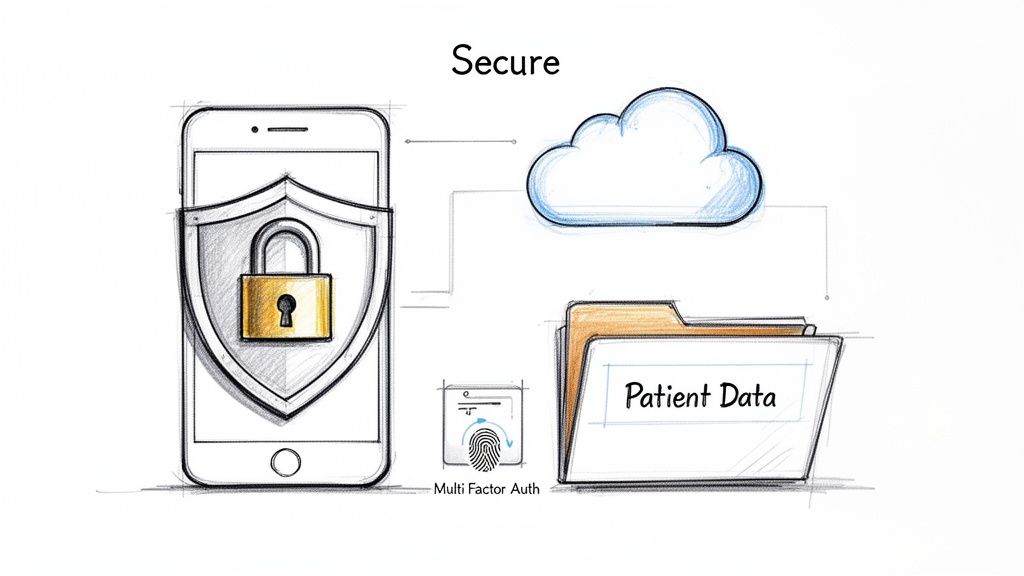
In healthcare, trust isn't just a nice-to-have; it's the foundation of everything. When a patient uses your app, they're handing over their most sensitive information. That’s why security and compliance aren't features you just bolt on later—they are the bedrock of your entire project.
Think of it like building a hospital. You wouldn't design the patient rooms first and then try to squeeze in the structural supports. The steel frame goes up first. In app development, that frame is built from robust security protocols and strict adherence to regulatory standards.
Demystifying Healthcare Regulations
Navigating the alphabet soup of healthcare regulations can feel daunting, but it all comes down to one core principle: protecting patient data. The two big frameworks you’ll bump into most are HIPAA in the United States and GDPR in Europe.
- HIPAA (Health Insurance Portability and Accountability Act) This US law is the gold standard for safeguarding sensitive Protected Health Information (PHI). It dictates everything from how data is stored and encrypted to who is even allowed to look at it.
- GDPR (General Data Protection Regulation) While not just for healthcare, this EU regulation creates a comprehensive framework for data privacy for its citizens. If your app handles the health data of any EU resident, you must follow GDPR's strict rules on consent and data management.
Getting this wrong isn't just a technical slip-up. It can lead to crippling fines, legal battles, and a total collapse of patient trust. A single HIPAA violation can cost up to $50,000 per incident. For a deeper dive, our guide on how to navigate the complexities of HIPAA compliant app development is a great place to start.
At its core, compliance is about creating a secure environment where patients feel safe. It's a non-negotiable promise to your users that their privacy is your top priority, baked into your app’s DNA from the very first line of code.
The Nuts and Bolts of App Security
Compliance sets the rules, but robust security is how you actually play the game. Building a secure healthcare app means creating a multi-layered defense to protect data from ever-present cyber threats. This is where the theory becomes practical.
A critical first step is end-to-end encryption. This essentially scrambles data as it travels between a user's phone and your servers, making it completely unreadable to anyone who might intercept it. But security doesn't stop there.
Here are a few other must-haves:
- Secure Data Storage: All PHI must be encrypted, whether it’s sitting on the device or in the cloud. This ensures that even if a physical server is breached, the data itself remains gibberish.
- Multi-Factor Authentication (MFA): Requiring more than just a password—like a one-time code sent to a phone—adds a crucial layer of security. It makes it dramatically harder for the wrong person to get in.
- Regular Vulnerability Scanning: Proactively hunting for and patching security holes in your app and infrastructure is like sending your system for regular health check-ups. You find problems before they find you.
Business Associate Agreements Explained
Let's say your app uses third-party services, like a cloud provider (AWS or Azure) or an analytics tool that touches PHI. You absolutely must have a Business Associate Agreement (BAA) in place with them. A BAA is a legal contract that obligates that vendor to uphold the same HIPAA security standards that you do.
Without a BAA, you are on the hook legally for any data breach that happens on their end. It’s a vital document that extends your compliance framework to every partner in your tech stack, creating an unbroken chain of trust.
For an in-depth look at safeguarding patient data and ensuring regulatory compliance in your healthcare application, explore these 10 Mobile App Security Best Practices for React Native in 2025. By embedding these principles from day one, you build more than a functional app; you build a digital health partner your users can truly trust.
Designing a Healing User Experience
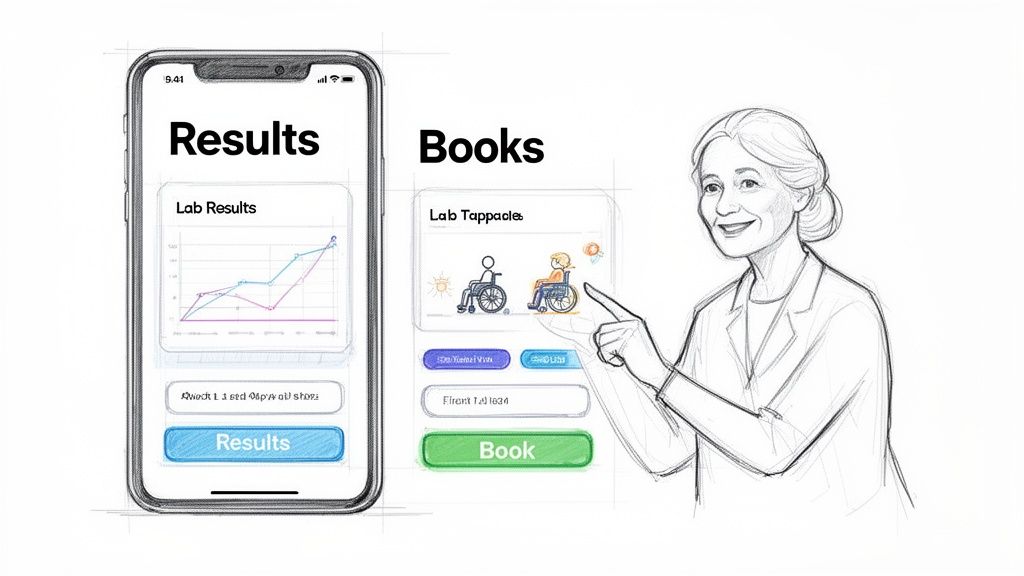
A truly great healthcare app feels less like software and more like a trusted partner. It should anticipate needs, offer comfort, and provide absolute clarity when users need it most. This is where the human touch in mobile app development for healthcare really shines, focusing on an intuitive and accessible User Experience (UX).
The audience for a healthcare app is incredibly broad. You have tech-averse seniors managing chronic illnesses on one end and rushed clinicians needing critical data in seconds on the other. A generic, one-size-fits-all design just won't cut it. The design has to be clean, empathetic, and universally understood.
Creating Calm from Chaos
Let's face it: healthcare is stressful. A patient waiting anxiously for lab results or a doctor juggling multiple urgent cases is already dealing with a heavy cognitive load. The last thing they need is a confusing, frustrating app interface.
Our goal is to design a "healing" experience that actively reduces anxiety, not adds to it. This means taking complex medical information and translating it into plain, reassuring language that anyone can digest.
- Clean Interfaces: Use plenty of white space, clear typography, and a calming color palette. Cluttered, overwhelming dashboards only cause more confusion.
- Simple Navigation: A user should be able to find what they need in three taps or less. Core functions like "Book Appointment" or "View Results" have to be obvious and immediate.
- Data Visualization: Instead of dumping raw numbers on the screen, use simple charts and graphs to show trends in blood pressure or glucose levels. Smart color-coding can instantly tell a patient if a result is in a normal range.
Great design in healthcare isn't about flashy animations or trendy layouts. It’s about building a digital space that feels safe, supportive, and incredibly easy to use. The design should empower users, giving them a sense of control over their own health journey.
Accessibility Is Non-Negotiable
Designing for accessibility isn't a "nice-to-have" feature; it's a fundamental requirement. Your user base will inevitably include people with visual impairments, motor limitations, and a wide range of digital literacy. Following standards like the Web Content Accessibility Guidelines (WCAG) isn't optional, it's essential.
This means building in features like high-contrast color options, resizable text, and full compatibility with screen readers. Every button, image, and link must have a descriptive label, and the app should be navigable with just a keyboard or voice commands. By building an inclusive app from the ground up, you ensure every patient can get the care they deserve.
To get a better handle on this, check out our deep dive into the challenges of designing digital products for healthcare.
Designing for Two Distinct Users
Healthcare apps often have to serve two completely different audiences at the same time: patients and providers. Each group has its own unique goals, and the UX has to be specifically tailored to each.
| User Group | Primary Goal | Key Design Considerations |
|---|---|---|
| Patients | To easily manage their health, find information, and talk to providers. | Simple language, clear instructions, an empathetic tone, and obvious access to support. |
| Clinicians | To quickly access patient data, streamline workflows, and make informed decisions. | Data-dense dashboards, efficient navigation, EHR integration, and quick-add features. |
For example, a patient portal might feature large, friendly buttons and a guided, step-by-step process for scheduling a visit. The clinician’s view of that same app, however, needs to show a patient's entire medical history, recent vitals, and pending lab orders on a single, scannable screen.
Ultimately, thoughtful design does more than just make an app easier to use. A frictionless appointment scheduler or a clear display of lab results builds trust, reduces anxiety, and creates an experience that genuinely helps in the healing process.
Integrating AI for Smarter Healthcare Solutions
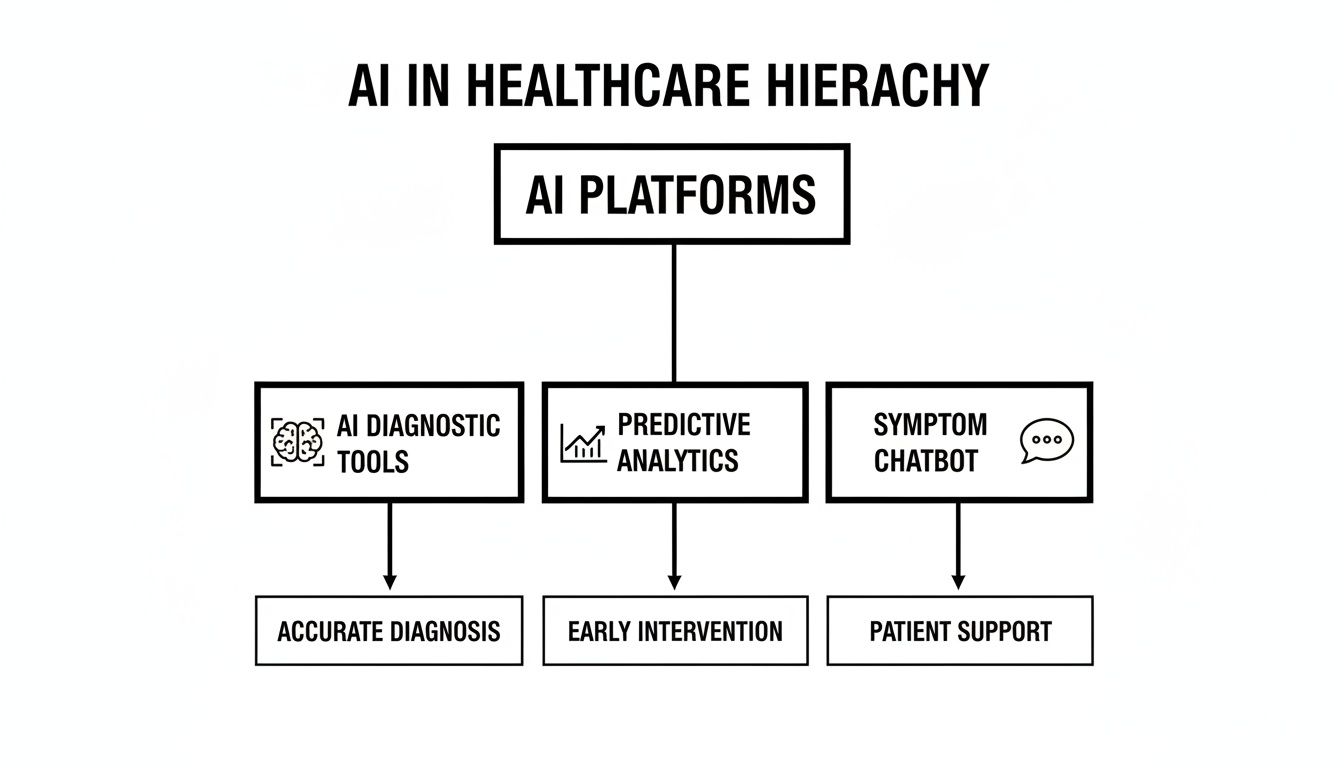
Artificial Intelligence isn't some far-off concept in medicine anymore; it's a real, practical tool that's personalizing healthcare right now. When you strategically add AI and Machine Learning (ML) into your app, you can elevate it from a simple data tracker into an intelligent health partner. This is about moving beyond basic features to deliver care that's predictive, personalized, and proactive.
The applications are as diverse as they are powerful. AI-driven algorithms can pour over medical images like X-rays or MRIs with incredible accuracy, helping clinicians spot problems faster than the human eye. In the same way, predictive analytics can sift through thousands of patient data points to flag individuals at high risk for conditions like sepsis or heart failure, paving the way for early intervention.
Practical Use Cases for AI in mHealth
The true potential of AI in healthcare app development really comes to life when you see it in action. These aren't just flashy features; they're tools that directly improve patient outcomes and make clinical workflows smoother.
Here are a few compelling examples:
- AI-Powered Diagnostic Tools: Picture an app that helps dermatologists identify skin cancer just by analyzing photos a patient uploads from home. This kind of AI serves as a powerful assistant, flagging suspicious areas that need an expert's review.
- Predictive Analytics for At-Risk Patients: By analyzing data from wearables and electronic health records, an app can predict which patients are most likely to be readmitted to the hospital. This gives care teams a heads-up to provide targeted support and prevent costly, stressful returns.
- Intelligent Chatbots for Triage: AI-driven chatbots can guide patients through a series of questions to assess their symptoms, offer up reliable information, and point them to the right level of care—whether that's a quick telehealth visit or a trip to the emergency room.
Apps for cardiovascular disease management are a perfect example of AI's impact. They've captured a massive 41.20% market share by dramatically cutting hospital readmissions. This success is fueled by the global burden of heart disease and how effective these apps are at using AI for risk prediction, especially when paired with continuous ECG monitoring from wearables. In North America, which holds a 37.45% share of this market, favorable reimbursement policies and high smartphone use are only speeding up this trend. You can find more details about the mobile health market on Mordor Intelligence.
The Unique Challenges of AI in Healthcare
Bringing AI into a healthcare setting isn’t as simple as plugging in a new API. The stakes are incredibly high, and the technology comes with some serious responsibilities. One of the biggest hurdles is data bias. If an AI model is trained mostly on data from one demographic, it might perform poorly or make flat-out wrong predictions for others. This can actually make health disparities worse, not better.
Clinical validation is another non-negotiable step. An AI algorithm that suggests a diagnosis or treatment plan has to be rigorously tested and proven to be both safe and effective. It often requires a level of scrutiny similar to a new medical device. This process is absolutely essential for earning the trust of both clinicians and patients.
Without the right oversight, these advanced features can become a black box—complex, unpredictable, and surprisingly expensive to run. This is exactly the problem we wanted to solve.
Simplifying AI Integration with a Powerful Toolkit
At Wonderment Apps, we developed an administrative toolkit designed to take the mystery out of AI integration for healthcare app developers. Instead of wrestling with multiple AI models, confusing prompts, and runaway costs, our system gives you a central command center to manage everything from one place. For a closer look at how this works, you might be interested in our article on crafting effective AI solutions for healthcare.
Our toolkit provides the controls you need to plug powerful AI capabilities into your app while keeping you in the driver's seat.
- Prompt Vault with Versioning: Store, test, and manage all your AI prompts in one spot. You can track different versions to see what works best and roll back changes instantly, ensuring your AI's responses are always consistent and reliable.
- Parameter Manager: Securely connect your AI models to internal databases. This allows the AI to pull relevant, real-time information—like a patient’s history or recent lab results—to provide incredibly contextual and accurate outputs.
- Cost and Logging Controls: Get a full, transparent view of your AI usage. A unified logging system tracks every single interaction across all your integrated AIs, while a cost manager lets you monitor your cumulative spend so there are never any budget surprises.
Choosing the Right Technology for Your App
Picking the tech stack for your healthcare app is like laying the foundation for a new hospital. It determines how robust it will be, how many people it can serve, and whether you can add a new wing in a few years. This isn’t just a developer's decision; it’s a strategic choice that will shape your budget, your timeline, and the app's entire future.
The first major fork in the road is choosing between a native or cross-platform approach. This one decision will ripple through every part of your app's development, user experience, and long-term maintenance.
Native vs Cross-Platform Development
Think of it this way: building a native app is like hiring a Savile Row tailor. The suit is custom-made for a single purpose, using the finest materials for that specific environment. It's crafted just for one operating system—iOS or Android—using their own programming languages, Swift or Kotlin. The result is a perfect fit. You get peak performance, instant access to hardware like the camera or GPS, and a user interface that feels completely intuitive.
Cross-platform development, on the other hand, is like creating a brilliant, adaptable pattern that can produce great suits for different people. Frameworks like React Native or Flutter let your team write the code once and deploy it across both iOS and Android. It's often a faster and more budget-friendly route, but you might have to accept small compromises in raw performance or wait a bit to access the very newest device features.
Choosing the right path for your mobile app development for healthcare project depends entirely on your specific needs. The table below breaks down the key trade-offs.
Platform Comparison Native vs Cross-Platform
A breakdown of the key differences between native and cross-platform development to help you choose the right approach for your healthcare app.
| Factor | Native (iOS/Android) | Cross-Platform (React Native, Flutter) |
|---|---|---|
| Performance | Highest possible performance, smooth animations, and fast response times. Ideal for processor-intensive tasks. | Very good performance, but may have slight overhead. Not always ideal for complex graphics or heavy computation. |
| User Experience (UX) | Delivers the most authentic UX by following strict OS-specific design guidelines (e.g., Apple's Human Interface Guidelines). | Provides a consistent UX across platforms, but may not feel 100% "native" to power users. |
| Access to Device Features | Immediate and full access to the latest device hardware and software features (e.g., ARKit, advanced camera APIs). | Access to most features is available through plugins, but there can be a delay after new OS updates. |
| Development Cost & Time | Higher initial cost and longer timeline, as you need separate teams/codebases for iOS and Android. | Lower cost and faster time-to-market since one codebase serves both platforms. |
| Maintenance | More complex maintenance. A bug fix or update needs to be implemented and tested on two separate codebases. | Simpler maintenance. Fix a bug once, and it's fixed everywhere (in most cases). |
For a healthcare app that needs to process medical images or handle real-time data from wearables, the performance gains from native development are often non-negotiable. Don't make the mistake of picking a platform on initial cost alone.
The Interoperability Imperative
Beyond the platform, there's an even bigger challenge in healthcare: interoperability. In simple terms, this is your app's ability to "speak the same language" as every other system in the healthcare world. An app that can't connect to other systems is like a specialist who refuses to read a patient's chart from another hospital—its value is severely limited.
For an app to become a truly essential clinical tool, it needs to integrate seamlessly with Electronic Health Records (EHRs), laboratory systems, and medical devices. That means you have to build your app from the ground up to follow established data exchange standards.
Two of the most important standards you'll encounter are:
- HL7 (Health Level Seven): This is the classic, long-standing standard for moving clinical and administrative data between different healthcare software systems.
- FHIR (Fast Healthcare Interoperability Resources): A newer, web-based standard that uses modern APIs to make sharing health information much faster and simpler. FHIR has quickly become the preferred choice for mobile and cloud-based apps.
Designing your app's architecture around these standards from day one is the only way to ensure it can plug into a hospital's workflow, securely pull patient data, and send updates back. That’s how you create a truly connected healthcare experience.
You simply can't overstate the importance of this connected ecosystem. Telemedicine apps, once a niche product, are now central hubs for care, blending video calls, digital prescriptions, secure payments, and wearable data into one platform. This trend is driving massive growth, with the global mHealth market projected to climb from USD 91.4 billion in 2025 to USD 201.1 billion by 2030, a 17.1% CAGR. And when these apps plug into hospital EHRs and insurance APIs, they can cut operational costs for providers by up to 30%. Discover more insights about mobile health technologies from BCC Research.
Frequently Asked Questions
Thinking about building a healthcare app brings a lot of important questions to the surface. How much should you budget? What mistakes can sink your project before it even starts? Who can you trust to build it? Getting clear, honest answers is the first step toward success.
We've been in the trenches, launching over 100 successful healthcare applications. Here's what our experience has taught us.
How Much Does It Cost to Develop a Healthcare App?
There's no single price tag. The cost of a healthcare app varies wildly depending on its complexity, the features you need, and the strict compliance standards it has to meet. But we can talk in tiers.
A simple Minimum Viable Product (MVP)—say, an app for basic appointment scheduling and patient education—could start around $50,000. This is a smart way to get your core idea into the hands of real users without a massive initial investment.
From there, the budget grows. A full-featured, HIPAA-compliant app with EHR integration, telemedicine, and e-prescribing can easily top $300,000. The major factors driving up the cost are things like:
- Telemedicine Functionality: Building secure, real-time video and messaging isn't simple.
- Third-Party Integrations: Hooking into EHRs, lab systems, and medical devices requires specialized expertise.
- AI and Machine Learning Features: Adding predictive analytics or smart diagnostic tools adds another layer of complexity.
- Rigorous Testing: Making sure the app is secure, reliable, and compliant in every possible scenario is a non-negotiable expense.
Keep in mind, the budget doesn't stop at launch. You should set aside 15-20% of the initial development cost annually for ongoing maintenance, security patches, and compliance updates.
What Are the Biggest Mistakes to Avoid in mHealth App Development?
Plenty of promising mHealth projects hit the same predictable roadblocks. Knowing what they are from day one can save you a world of headaches, time, and money. The biggest blunders usually come from underestimating just how different the healthcare world is.
Here are the four most common mistakes we see:
- Neglecting Compliance: Treating HIPAA or GDPR like a last-minute checkbox is a recipe for disaster. This isn't just about avoiding huge fines; it's about earning and keeping user trust. Security and privacy have to be baked into every decision, from the first sketch to the final line of code.
- Poor User Experience (UX): A clunky, confusing interface will send clinicians and patients running. If a doctor can't pull up patient info in seconds or a patient gives up trying to book an appointment, your app has failed. Deep user research and relentless testing are essential.
- Ignoring Interoperability: An app that can't talk to other systems is just a fancy data silo. If it doesn't connect with the EHRs and other tools that providers rely on, it becomes more of a burden than a help. You have to plan for standards like FHIR from the very beginning.
- Feature Overload: Trying to cram every possible feature into version one is a classic trap. It blows up your budget, pushes back your launch, and often creates a product that does a lot of things poorly instead of a few things perfectly. Start with a focused MVP that solves one critical problem, then listen to your users and build from there.
How Do I Choose the Right Development Partner for My Project?
This is probably the single most important decision you'll make. You're not just hiring coders; you're bringing on a strategic partner who needs to guide you through the minefield of healthcare regulations and technology.
Look for a team with proven, hands-on experience in healthcare. Don't be shy about asking for specific case studies of HIPAA-compliant apps they've actually built and launched. A slick portfolio means nothing if they don't have a track record of navigating the industry's unique security and regulatory hurdles.
An ideal partner, like Wonderment Apps, becomes an extension of your team. They should be with you every step of the way—from discovery and design to development, testing, and post-launch support. They need to speak the language of healthcare fluently, understanding data privacy, interoperability standards, and clinical workflows as well as they understand code. That deep industry expertise is what ensures your app will be secure, compliant, and valuable long after it hits the app stores.
Modernizing your app with AI doesn't have to be a complex, costly endeavor. At Wonderment Apps, we've built a powerful prompt management system specifically to help entrepreneurs and developers like you seamlessly integrate AI into new or existing software. This administrative tool includes a prompt vault with versioning, a parameter manager for secure database access, and cost and logging controls to give you full visibility. Schedule a demo with us today to see how our tool can help you build a smarter, more effective healthcare solution that’s built to last. https://wondermentapps.com