

At its core, the difference is pretty straightforward: hybrid cloud is all about blending your private, on-premise infrastructure with a single public cloud to create one interconnected environment. Multi-cloud, on the other hand, means you're using services from two or more public clouds—think AWS and Azure—often without them being directly integrated.
This isn't just a technical footnote; it's a foundational business decision that impacts everything from cost and scalability to your ability to innovate and integrate AI into your custom software.
Choosing Your Cloud Strategy
Picking between a hybrid or multi-cloud model will shape how your teams develop software, manage data, and respond to the market for years. As companies weigh their options, they often question whether major cloud migrations are a worthwhile investment. The answer usually depends on the long-term vision. This is especially true as AI becomes more integrated into operations, where reining in costs and complexity is a constant battle.
Modern tools, like a prompt management system, are becoming essential for managing this new layer of operational intricacy. Imagine a system that gives you a version-controlled prompt vault for AI models, a parameter manager for secure database access, and a cost tracker to keep an eye on spending—all critical for staying in control, no matter which cloud setup you choose. At Wonderment Apps, we've developed exactly this kind of administrative tool to help developers and entrepreneurs modernize their apps for AI. If this sounds like a fit, you should definitely request a demo.
The Rise of Diversified Cloud Environments
The days of relying on a single cloud provider are fading fast. We've seen a dramatic shift in the infrastructure world as organizations move toward more diverse, flexible strategies. The numbers don't lie: an incredible 92% of organizations are expected to have a multi-cloud strategy by 2026, mixing and matching various public and private cloud services.
Right now, the average company already uses 2.2 public clouds. This signals a clear preference for picking specialized, "best-of-breed" services from different vendors instead of going all-in with one. This isn't just a trend; it’s a strategic move to gain flexibility, build resilience, and access the best tech out there for designing excellent app experiences.
The question is no longer if you should adopt a complex cloud strategy, but how you can manage it effectively to unlock its full potential without being overwhelmed by the operational overhead.
Here’s a quick breakdown of how the two dominant approaches stack up.
| Feature | Hybrid Cloud | Multi-Cloud |
|---|---|---|
| Core Concept | Combines private infrastructure (on-premise) with one public cloud. | Uses services from two or more public cloud providers. |
| Primary Goal | Extend on-premise capabilities with public cloud scalability. | Leverage "best-of-breed" services from different vendors. |
| Integration | Tightly integrated and managed as a single, cohesive unit. | Services are often managed independently, with less integration. |
| Best For | Organizations with significant on-premise investments or strict data regulations. | Businesses seeking to avoid vendor lock-in and optimize performance. |
Comparing The Core Architectural Differences
To really get to the heart of the hybrid cloud vs. multi-cloud debate, we need to move past the simple definitions and look at their core architectural philosophies. These aren't just slightly different setups; they represent fundamentally distinct ways of building and running your digital infrastructure. Each choice carries serious implications for your operations, security, and growth down the line.
A hybrid cloud is all about integration. It creates a single, unified system by tightly coupling a private environment (like your own data center) with a public cloud. The whole point is to create seamless interplay where workloads can shift between the two environments as if they were one logical unit. Think of it like building a custom extension onto your house—it’s different, but it’s designed to connect and work perfectly with the main structure.
Multi-cloud, on the other hand, operates on the principle of federation. This involves using services from several public cloud providers that usually stay separate and distinct. The goal isn’t to build one big, interconnected system. Instead, it’s about picking the best tool for the job from a wide-open market, like shopping at different specialty stores instead of one giant retailer. This approach gives you maximum flexibility and helps you avoid getting locked into a single vendor.
This table provides a side-by-side comparison of the core attributes of hybrid and multi-cloud strategies, helping you quickly grasp the fundamental distinctions in their architecture and operational model.
Hybrid Cloud vs Multi Cloud At A Glance
| Attribute | Hybrid Cloud | Multi-Cloud |
|---|---|---|
| Core Principle | Integration between private and public clouds. | Federation of multiple public cloud services. |
| Connectivity | Deep, dedicated links (VPN, direct connect). | Primarily user-to-cloud connections; inter-cloud is complex. |
| Data Control | High control; sensitive data stays on-premise. | Data is distributed across various provider environments. |
| Security | A single, extended security perimeter to manage. | Multiple, distinct security perimeters to manage and unify. |
| Vendor Lock-in | Reduced, but still tied to one public cloud partner. | Minimized by design; choice of best-in-class services. |
| Ideal Use Case | Regulated industries, legacy systems modernization. | Best-of-breed app development, high availability, cost optimization. |
Ultimately, the choice hinges on whether your strategy demands a deeply integrated extension of your private infrastructure or a flexible portfolio of independent services.
Integration and Connectivity
The defining feature of a hybrid cloud's architecture is its deep, dedicated connection. This is typically achieved with secure VPNs, dedicated network lines, and specialized software platforms that create a single management pane. The entire model is built on a stable, high-performance bridge between your on-premise data center and your public cloud partner. This is what enables powerful workflows like cloud bursting, where an application running on-premise can automatically tap into public cloud resources during traffic spikes.
A multi-cloud architecture doesn’t make that same assumption of built-in integration. While you can connect services, the main connections are usually from the user or application to each individual cloud, not between the clouds themselves. This means the heavy lifting of integration falls on your development team, which has to juggle different APIs, authentication methods, and data transfer protocols for each provider.
The core architectural question is this: Do you need a deeply integrated extension of your existing private infrastructure (hybrid), or do you need a flexible portfolio of independent, best-in-class services (multi-cloud)?
To fully appreciate the architectural nuances here, it helps to first understand the foundational differences laid out in this definitive guide on cloud vs on-premises.
Data Governance and Security Posture
From a security standpoint, these two models couldn't be more different, each with its own set of challenges and perks.
-
Hybrid Cloud Security: This model gives you extremely fine-grained control over your most sensitive data by letting you keep it inside your own private infrastructure. This is a huge win for industries with strict data sovereignty or compliance rules, like finance and healthcare. The security perimeter, while complex, is clearly defined—it extends from your on-premise environment into a single, known public cloud partner.
-
Multi-Cloud Security: Here, your attack surface is much wider and more fragmented. Each cloud provider has its own security tools, identity management systems, and compliance frameworks. Your security team has to become masters of multiple platforms and ensure consistent policies are enforced across all of them. The trade-off for this complexity is resilience; if one provider has an outage, your services on another can keep right on running.
The concept map below helps visualize how these two distinct strategies branch out from a central business goal.
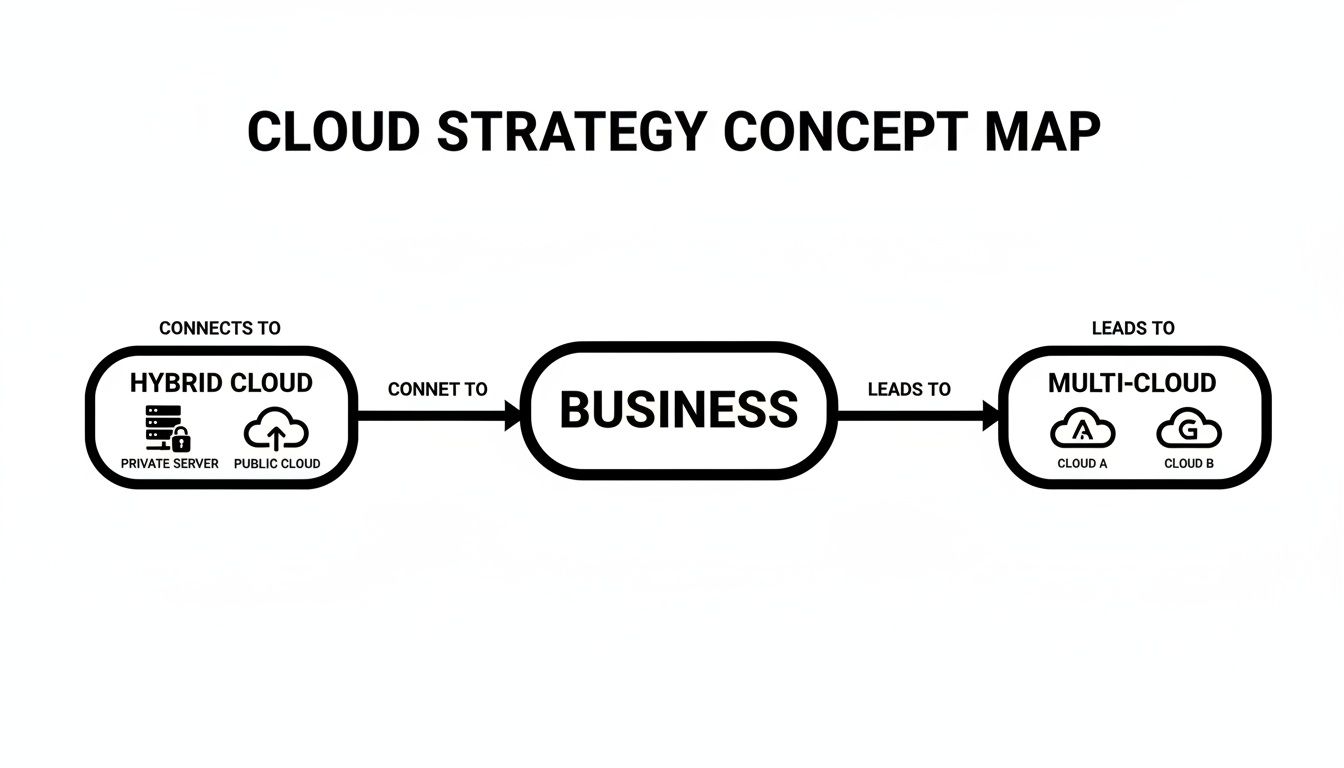
This image makes it clear that while both are valid cloud strategies, hybrid is all about connecting the private and public worlds. Multi-cloud, in contrast, is about making the most of multiple public platforms.
Analyzing The Financial Impact And Cost Management
Every major infrastructure decision comes down to the bottom line. The debate between hybrid cloud vs. multi-cloud is certainly no exception. To make a sound investment and avoid those dreaded budget overruns, you have to get a handle on the financial models and hidden costs baked into each strategy. The two approaches have fundamentally different economic profiles that go way beyond surface-level subscription fees.
A hybrid cloud strategy is a mix of Capital Expenditure (CapEx) and Operational Expenditure (OpEx). You have the upfront CapEx hit for buying and maintaining your private, on-prem hardware—the servers, storage, and networking gear. This gets balanced by the pay-as-you-go OpEx model of the public cloud piece, which gives you flexibility for workloads that go up and down.
In contrast, a multi-cloud model is almost entirely an OpEx game. There are no data centers to build or hardware to babysit. This approach can be more cost-efficient by letting you shop around for the best prices on specific services. It creates a competitive environment among providers that can help drive down your expenses.
Uncovering The Real Costs
Beyond the initial setup, each model has its own unique ways to optimize costs—and its own potential pitfalls. These hidden expenses often dictate the true total cost of ownership (TCO) and can really catch unprepared teams off guard. The financial implications are massive; the hybrid cloud market is projected to rocket from $85.3 billion in 2021 to an expected $262 billion by 2027. You can dig into this rapid market growth and other compelling cloud computing statistics to see just how big this is.
-
Hybrid Cloud Optimization: A huge financial win here is cloud bursting. This lets applications running on your private infrastructure "burst" into the public cloud to handle sudden demand spikes. You only pay for the extra horsepower when you need it, avoiding the cost of overprovisioning your own data center for peak traffic that hardly ever happens. The catch? Watch out for data egress fees—the cost of moving data out of the public cloud and back on-prem. They can become a major hidden expense if you're not careful.
-
Multi-Cloud Optimization: The advantage with multi-cloud is playing the field by using spot instances and reserved instances across different providers. You can run non-critical workloads on whatever the cheapest compute resources are at any given moment. The biggest financial risk is complexity. Without a unified view, trying to track spending across multiple dashboards and billing cycles is a nightmare that often leads to wasted resources and surprise bills.
The core financial trade-off boils down to this: the predictable, upfront investment of a hybrid model versus the complex, variable operational costs of a multi-cloud environment. Success in either model really hinges on vigilant management and having the right tools for the job.
The Critical Role Of Management Tools
No matter which path you take, effective cost management is impossible without the right tools, especially when you bring AI into the mix. The variable, token-based pricing of AI models can make costs spiral out of control in a distributed environment. This makes a centralized management platform an absolute necessity for keeping a lid on your finances. For a deeper dive into this kind of financial strategy, check out our insights on how cost reduction is making a comeback in tech trends.
A solid administrative tool gives you that single pane of glass to monitor spending across all your environments. It helps you track cumulative spend on AI services, manage API costs, and stop budget overruns before they happen. Without this visibility, you're essentially flying blind, putting the financial viability of your cloud and AI initiatives at risk.
Real-World Scenarios Where Each Model Excels
Theory is great, but seeing how these cloud models perform in the wild is where things get interesting. The true difference between hybrid and multi-cloud becomes crystal clear when you map them to specific business challenges. These practical examples help visualize how each architecture solves distinct problems, making it easier to see which strategy clicks with your own goals.
Choosing the right path isn’t just a technical exercise; it’s about enabling your business to do what it does best. That could mean protecting sensitive data or rapidly building new features with the best tools for the job.
Hybrid Cloud in Action: The Fintech Advantage
Imagine a fintech company that handles millions of sensitive customer transactions daily. This company operates under strict regulatory frameworks like PCI DSS and GDPR, where data sovereignty and security are non-negotiable. For them, a full migration to a public cloud just isn’t an option—it could expose critical customer data and lead to severe compliance penalties.
This is the perfect scenario for a hybrid cloud architecture.
- On-Premise Core: The company keeps its core transaction processing systems and customer databases securely on its private, on-premise servers. This gives them maximum control over data access, security protocols, and compliance auditing.
- Public Cloud Analytics: At the same time, the firm wants to run powerful data analytics and machine learning models to detect fraud and understand customer behavior. Building this kind of infrastructure on-premise would be incredibly expensive. Instead, they use a public cloud partner to spin up massive compute resources on demand, analyze anonymized data, and then shut the resources down, paying only for what they use.
In this model, the hybrid cloud acts as a secure bridge. It allows the fintech firm to maintain ironclad security for its most valuable assets while tapping into the public cloud’s immense power and scalability for less sensitive, compute-heavy tasks. This balanced approach provides the best of both worlds without compromising on regulatory duties.
A hybrid model excels when you have significant existing investments or unbreakable compliance requirements that anchor part of your operations on-premise, while still needing the agility and scale of the public cloud.
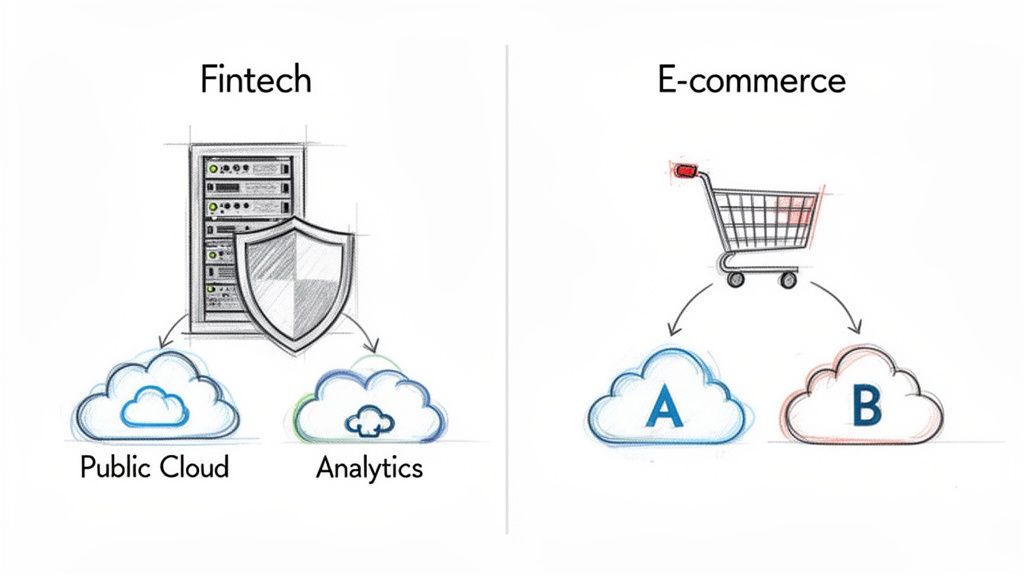
The image illustrates a key insight: organizations from finance to entertainment pick cloud solutions that directly address their specific operational needs, whether for security, scale, or innovation.
Multi-Cloud in Action: The E-commerce Edge
Now, let's picture a rapidly growing e-commerce platform. Their primary goals are delivering a flawless user experience, personalizing product recommendations with AI, and ensuring their site is always online—even during massive traffic spikes like Black Friday. For this company, vendor lock-in is a major fear, and they want the freedom to use the absolute best technology for every single part of their application.
This business is an ideal candidate for a multi-cloud strategy.
Here’s how they might assemble their "best-of-breed" stack:
- Provider A for Core Infrastructure: They could run their main e-commerce application and high-performance databases on a provider known for its reliability and powerful database services, like Amazon RDS or Azure SQL.
- Provider B for AI and Machine Learning: For their product recommendation engine, they might turn to another provider recognized for its superior AI and ML toolsets, such as Google Cloud's Vertex AI. This lets them build more accurate and engaging personalization features.
- Provider C for Content Delivery: To ensure fast page loads for customers worldwide, they could use a third provider specializing in Content Delivery Networks (CDNs), picking the one with the best performance in their target regions.
By adopting a multi-cloud approach, the e-commerce platform avoids being limited by a single vendor's ecosystem. They gain a competitive edge by strategically selecting top-tier services from across the market, building a more resilient, performant, and innovative application as a result.
How To Choose The Right Cloud Strategy For Your Business
Deciding between a hybrid cloud and a multi-cloud setup is a serious business decision, not just a technical one. The best choice is the one that lines up with your long-term vision, what your team can realistically handle, and where you stand in the market. To get there, you need to cut through the noise and focus on your specific business goals.
Let's move past the theory. Answering a few direct, critical questions will show you the path that best fits your company's unique situation. This isn't just about adopting a cloud model; it's about choosing one that gives you a real competitive edge. It's time to map your reality to the right architecture.
Start With Your Data And Compliance Needs
The first and most important question is always about your data. Where does it live, who can touch it, and what rules govern it? For a lot of businesses, especially in fintech or healthcare, this is the main deciding factor.
- Data Sovereignty: Do you operate in places with strict laws that say customer data must stay within national borders? If the answer is yes, keeping that data on-prem while using a public cloud for everything else makes a hybrid model almost a necessity.
- Compliance Requirements: Are you dealing with regulations like PCI DSS, HIPAA, or GDPR? These demand tight control over sensitive information. A hybrid approach gives you an isolated, highly secure space for this data, which makes audits much simpler and cuts down your risk.
If your data can move freely and isn't tied down by these heavy restrictions, a multi-cloud strategy is definitely still on the table. But if compliance is your absolute top priority, hybrid usually offers the clearest and most defensible way forward.
Evaluate Your Existing Infrastructure
Your current tech stack and the money you've already spent play a huge part in this choice. Almost no one starts with a clean slate, so what you already own matters—a lot.
Think about how significant your on-premise footprint is. If you've poured a lot of money into a private data center that's still working well, a hybrid approach lets you extend its life and get the most out of that investment. It just doesn't make sense to ditch perfectly good infrastructure when you can connect it to a public cloud and gain new capabilities.
The decision often comes down to a simple reality check: Are you looking to get more value out of the systems you already own, or are you building something completely new with a 'best-of-breed' mindset from day one?
On the other hand, if you're a cloud-native company or your on-premise hardware is on its last legs, a multi-cloud strategy gives you a chance to break free from big capital expenses. This model lets you shift money from hardware maintenance over to innovation and making your services better.
Assess Your Team's Operational Capacity
Finally, be honest about your team's skills and their ability to manage complexity. A cloud strategy is only as good as the team executing it.
A hybrid cloud requires a very specific mix of skills. Your team needs to be experts in both private infrastructure management (like VMware or OpenStack) and the specific public cloud you partner with. This takes deep knowledge of networking, security, and integration to make the two worlds talk to each other effectively.
A multi-cloud environment demands a different kind of expertise. Your team has to get good at using multiple cloud platforms, and each one has its own APIs, security models, and ways of charging you. This adds a ton of operational overhead. Without the right management tools and a highly skilled team, that complexity can quickly lead to security holes and runaway spending.
Choosing Your Path:
- Go Hybrid If: You have strict compliance needs, major on-premise investments you need to protect, or you want to modernize legacy systems one step at a time.
- Go Multi-Cloud If: Your top priority is avoiding vendor lock-in, picking the best-in-class services for different tasks, and maximizing your resilience and cost savings across public clouds.
Modernizing Your Apps With The Right Tools And Partners
Choosing between hybrid and multi-cloud is more than an architectural decision; it’s about setting your entire application strategy up for success. But even the most brilliant strategy can crumble without the right tools to manage it and the right engineering partner to execute it. This is where the real work begins.
Operational complexity and runaway costs are the silent killers of cloud initiatives. Managing a distributed environment—whether it’s a mix of on-prem and public cloud or several public clouds—is nearly impossible without a centralized control plane. You're just flying blind.
Unifying Your AI Operations With A Central Toolkit
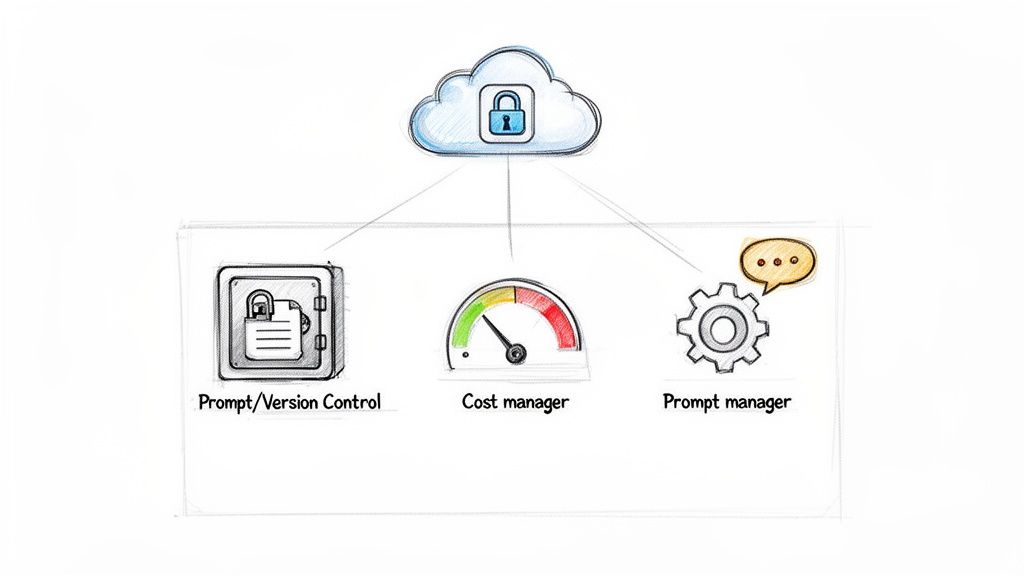
When you add AI into the mix, the management challenges multiply. You’re suddenly dealing with inconsistent model outputs and token costs that can spiral out of control. It’s exactly this kind of chaos that led us to develop a powerful prompt management system at Wonderment Apps, giving your team the governance layer needed to modernize your software and move forward confidently.
Picture having one place to manage all your AI integrations:
- A Prompt Vault With Versioning: Stop the guesswork. You can manage, test, and deploy prompts with full version control to guarantee your AI behaves consistently and predictably.
- A Secure Parameter Manager: Confidently connect AI models to your internal databases. Our manager makes sure only the right data is accessed, keeping everything secure and compliant.
- An Integrated Logging System: Gain full visibility with a comprehensive logging system that tracks activity across all your integrated AI services.
- A Unified Cost Manager: Get a single, unified view of AI spending across every provider. You can track your cumulative spend, token usage, and API calls in real-time, catching budget overruns before they ever become a problem.
This isn't just about adding controls; it's about empowering your team to build faster and smarter. To dig deeper, check out our guide on how to modernize legacy systems the right way.
Partnering For Scalable And Resilient Systems
Great tooling is only half the battle. Successful modernization hinges on deep engineering expertise. You need a partner who gets the subtleties of designing, building, and managing truly scalable systems in these complex cloud environments. At Wonderment Apps, we step in as that expert engineering partner, helping de-risk your cloud and AI projects from day one.
The right partner doesn’t just build what you ask for; they build what your business needs to thrive for years to come, anticipating challenges and architecting for future growth.
Our teams live and breathe this stuff. We specialize in creating high-performance applications built for the long haul. We'll help you pick the best-fit AI models, engineer solid integrations, and set up the governance you need to operate efficiently as you grow. Whether you’re sorting out a hybrid setup or conducting a multi-cloud symphony, we bring the clarity and craftsmanship to make your project a win.
Ready to see how the right tools and team can transform your cloud strategy? Book a demo of our prompt management system today and let's build your future-proof application together.
Common Questions, Answered
As you start digging into hybrid and multi-cloud, a few practical questions always seem to pop up. Let's tackle some of the most common ones to clear up the confusion and address the real-world concerns you might have while weighing your options.
Can A Hybrid Cloud Also Be A Multi Cloud?
Yes, and this setup is becoming more and more common. A company’s strategy can easily be both. You have a hybrid model when you connect your private, on-premise infrastructure to a public cloud. You become multi-cloud the moment you use services from a second public cloud provider.
For example, a large enterprise might run its core applications on AWS, directly connected to its private data center. At the same time, it could tap into Google Cloud for its specialized machine learning services. This layered approach blends the security of private infrastructure with the "best-of-breed" advantage of using multiple public clouds, giving you maximum flexibility.
What Is The Biggest Challenge Of A Multi Cloud Environment?
Without a doubt, the biggest challenge is operational complexity. When you adopt multiple cloud providers, you’re suddenly juggling different management consoles, security policies, billing systems, and APIs. That fragmentation can overwhelm even the most skilled teams.
If you don't have the right management tools and a strong governance framework, this complexity quickly spins out of control, leading to a few predictable problems:
- Cost Overruns: Trying to track spending across separate dashboards is a recipe for losing control of your budget.
- Security Gaps: When security policies aren't consistent across providers, you create vulnerabilities and widen your attack surface.
- Integration Headaches: Getting services from different vendors to play nicely together takes a significant amount of engineering effort.
Which Model Is Better For AI And Machine Learning?
There’s no single right answer here—the best model for AI and machine learning workloads depends entirely on your specific use case and data requirements. Both strategies bring something different to the table for AI-driven projects.
A multi-cloud approach often makes the most sense when your goal is to cherry-pick the best AI/ML services from different providers. A team might use Google's advanced natural language processing tools while relying on AWS for its powerful data warehousing capabilities.
On the other hand, a hybrid cloud strategy is the clear winner when your sensitive training data has to stay on-premise for security or compliance reasons. This lets you tap into the massive, scalable computing power of the public cloud for model training and inference without ever moving your core datasets off-site.
Your cloud strategy is the foundation of your digital future. But a strategy alone isn't enough—you need the right tools and engineering partner to bring it to life without getting overwhelmed by complexity. Wonderment Apps provides an administrative toolkit with prompt versioning, a secure parameter manager, and a cost manager to keep your AI initiatives under control. Ready to modernize your application and build it to last? Learn more about how we can help at Wondermentapps.com.