

When we talk about digital transformation in the public sector, we're not just talking about buying new software. We're talking about a fundamental shift in thinking. It’s about ditching slow, paper-based government processes and creating modern, digital services that are actually built for citizens. This isn't just about bolting on new tech; it's a complete overhaul of how agencies operate, make decisions, and connect with the people they serve. The goal? To deliver the same kind of speed, convenience, and personalization we've all come to expect from our favorite apps and online stores.
Modernizing legacy applications with AI is a game-changer, but it also opens up a Pandora's box of management challenges. How do you control what the AI says? How do you keep it from accessing sensitive data? And how do you stop the costs from spiraling out of control? This is where having a smart administrative tool becomes your secret weapon. For instance, Wonderment Apps has developed a prompt management system that acts as a control panel for AI integration, giving developers and business leaders the tools to manage prompts, secure data access, and monitor spending. It’s the kind of practical tool that turns a daunting modernization project into a manageable success.
The Inevitable Shift to a Digital-First Government

The days of standing in long lines for a permit, mailing in stacks of paper forms, or getting lost in a maze of confusing government websites are numbered. A massive change is happening right now, as public sector organizations realize that modernization isn't just a tech project—it's essential for their survival and relevance. The core idea is simple but incredibly powerful: government services should be designed to fit into the lives of citizens, not the other way around.
This shift isn't happening in a vacuum. It's being pushed forward by a perfect storm of pressures. Citizens, who are used to the seamless experiences they get from companies like Amazon and Netflix, are now asking, "Why can't government be this easy?" This rising tide of expectation is forcing agencies to finally ditch clunky old systems for more agile, responsive, and data-driven ways of working.
The Forces Driving Public Sector Change
A few key factors are really putting the pedal to the metal on this digital-first movement. Each one is a challenge, for sure, but it's also a golden opportunity for leaders to build a government that's more efficient and worthy of public trust.
- Heightened Citizen Expectations: People want to apply for a business license or check on a benefit payment with the same ease as ordering a pizza on their phone. That's the new baseline, period.
- Persistent Budget Pressures: Public agencies are in a constant state of being asked to do more with less. Digital tools are the answer, helping to automate repetitive tasks, slash operational costs, and free up staff for more important, high-value work.
- The Need for Resilience: If the last few years have taught us anything, it's that governments have to be able to pivot on a dime. A solid digital infrastructure makes that possible, enabling remote work, services that can scale up or down as needed, and the rapid launch of new programs during a crisis.
Making the leap from analog to digital is a heavy lift, especially when you're dealing with software that's decades old. The path forward often involves integrating advanced AI to find new efficiencies and insights. But you can't just flip an "AI switch"—it requires a ton of careful management and control.
At its heart, digital transformation in the public sector is an exercise in trust-building. Every streamlined process, easy-to-use app, and proactive notification reinforces the idea that government can be efficient, responsive, and genuinely helpful.
Paving a Clear Path Forward
To get through this change successfully, you need more than just a big vision; you need the right set of tools. As agencies start trying to weave AI into their existing applications, they run headfirst into big hurdles with security, governance, and keeping costs from spiraling out of control. This is exactly where a specialized administrative tool becomes a non-negotiable.
Take a platform like the one developed by Wonderment Apps; it provides that critical control layer. It gives leaders the power to manage AI prompts, connect securely to internal databases, log every AI interaction for a clear audit trail, and monitor spending in real-time. This hands public sector leaders the confidence to innovate without giving up the security and oversight the public rightly demands, turning the scary idea of modernization into a clear, manageable, step-by-step process.
Why the Tipping Point for Government AI Is Now
For years, artificial intelligence in government felt more like a concept on the horizon than a practical tool for today. That's changing—and fast. We’ve hit a moment where AI is no longer a futuristic idea but an immediate, urgent priority for public sector organizations ready for real digital transformation.
This shift isn’t happening in a vacuum. It’s being driven by a perfect storm of powerful market forces and intense internal pressures. The private sector has raised the bar for digital experiences, and citizens now bring those same expectations for speed and efficiency to their government interactions. At the same time, agencies are trying to do more with less, making AI-powered automation and insights incredibly appealing.
The Soaring Govtech AI Market
You can see just how big this movement has become by looking at the market’s explosive growth. The global AI in government and public services market is on a steep climb, projected to jump from USD 22.4 billion in 2024 to over USD 98 billion by 2033.
That staggering leap, representing a compound annual growth rate of 17.8%, shows a fundamental change in how government agencies are thinking about modernization. While North America is leading the charge, there's a troubling gap between knowing and doing. More than 60% of government leaders see how important AI is, yet only about a quarter have managed to truly integrate it into their organizations. You can dig into more findings on the impact of AI in the public sector from Appmaisters.
This data points to a major disconnect. Leadership gets the potential, but broad, strategic rollouts are stuck in first gear. Too many agencies are caught in a loop of small pilot projects that never scale up enough to deliver meaningful public value.
Grassroots Adoption Creates New Urgency
While leadership debates strategy, their employees aren't waiting around. A fascinating trend is bubbling up from the ground floor: public sector workers are adopting AI tools on their own. Surveys reveal that nearly half of government employees are already using AI tools every week to get their jobs done.
This bottom-up movement is both a huge opportunity and a serious risk. On one hand, it shows a workforce that's eager to innovate and find smarter ways to work. But on the other, this unsanctioned use of AI can open the door to major security vulnerabilities and data privacy headaches if it isn't managed correctly.
This grassroots AI adoption is a clear signal to leadership: the demand for modern tools is already here. The challenge is not to stop it, but to channel this energy into a secure, productive, and scalable enterprise-level strategy.
This reality puts agencies in a position where they have to act. It's time to move beyond fragmented experiments and build a unified, secure framework for AI. Sticking with the status quo means missing out on efficiency gains while leaving the organization exposed. For leaders wondering where to start, the first step is to understand how to properly leverage artificial intelligence in your business with a clear, manageable plan.
We are at an inflection point. The combination of market momentum, leadership buy-in, and employee-driven adoption makes one thing crystal clear: the time for scaled, mission-critical AI deployment has arrived. The agencies that move decisively now will shape the future of digital government and set a new standard for public service.
Navigating the Legacy Systems Maze
For many public sector agencies, the biggest thing stopping real innovation isn't a lack of ideas—it's the sprawling, decades-old maze of legacy systems they're built on. This is more than just an inconvenience. It's a fundamental roadblock that kills agility, drains budgets, and makes it impossible to deliver the modern services citizens expect.
Think of these old systems as the digital equivalent of a crumbling foundation. You simply can't build a modern, AI-powered skyscraper on top of it without dealing with what's underneath. These systems, often written in programming languages older than the employees who maintain them, create massive operational bottlenecks and leave gaping security holes that put public data at serious risk.
The Scale of the Infrastructure Crisis
This isn't an isolated problem; it's a crisis. Government agencies are running on fumes, with over 60% of essential IT systems powered by outdated technology. Even more shocking, a staggering 65% of these systems still rely on COBOL. When you see numbers like that, it's clear why quick fixes are usually doomed from the start.
Just moving these ancient applications to the cloud—a common "lift and shift" strategy—rarely solves the core issues. It’s like dropping an old, clunky engine into a brand-new car and hoping for top performance. You've just moved the problem to a new address. Real, lasting change demands a much smarter approach to modernization.
Beyond Maintenance to True Modernization
The goal can't just be about keeping old systems on life support. It has to be about transforming them into a solid platform for future growth. Legacy modernization is the critical investment needed to unlock the real power of AI, advanced analytics, and the kind of seamless services people now demand. But getting there isn't easy.
It's a tough reality, but transformation success rates are still alarmingly low. Only about 35% of digital transformation initiatives actually hit their goals. For the public sector, where the challenges are often steepest, the stakes are even higher.
Despite the hurdles, the payoff for getting it right is enormous. Agencies that pull off a successful modernization see incredible results. Organizations that build out connected, modern operations have reported 30% productivity gains and a 50% improvement in quality. These aren't just abstract stats; they translate to faster service, fewer errors, and a better experience for citizens. You can read our detailed guide on how to successfully modernize legacy systems to get started.
Setting the Stage for AI and Analytics
Ultimately, finding your way through the legacy systems maze is the first, non-negotiable step toward a smarter, more responsive government. A modern infrastructure is the launchpad for everything else. Without it, powerful AI models and data analytics tools are just ideas on a whiteboard, unable to access the siloed, locked-away data trapped in those old systems.
Beyond the tech, a successful modernization also demands a sharp focus on Governance, Risk Management, and Compliance (GRC). Rebuilding the technological foundation is a golden opportunity to embed modern security, establish clear data governance, and ensure compliance from the ground up. By reframing modernization not as a painful cost but as a strategic investment, public sector leaders can finally start building the resilient, efficient, and trusted government of the future.
An Actionable Roadmap to Modernization
Kicking off a full-scale modernization effort can feel like trying to rebuild a highway during rush hour traffic. It's complex, and the stakes are high. The secret isn't a risky, all-at-once "big bang" overhaul. Instead, the most successful agencies use a structured, phased approach that builds momentum over time.
A clear roadmap makes all the difference. It demystifies the process, transforming what feels like an overwhelming goal into a series of concrete, manageable steps.
This journey doesn't start with buying new tech. It begins with a deep, honest look at the current state of affairs—mapping out workflows, pinpointing the biggest headaches for citizens and staff, and defining what success actually looks like. Without this groundwork, even the most impressive technology will fall flat.
Phase 1: Assess and Align
The first phase is all about discovery. Before you can map a route to your destination, you have to know exactly where you're starting from. This means a thorough audit of your current tech, processes, and people.
Getting stakeholder buy-in from day one is non-negotiable. This isn't just about a sign-off from the top; it's about bringing department heads, IT staff, and frontline employees into the fold to build a shared vision. When everyone gets the "why" behind the change, they become champions for the project instead of roadblocks.
Phase 2: Strategize and Plan
With a clear picture of your starting point and a team of advocates on board, you can start building your strategic plan. This is where you turn that high-level vision into a real action plan with clear priorities, timelines, and budgets. A solid digital transformation strategy is the blueprint for everything that follows.
This phase must also tackle two critical, often-overlooked components: data governance and cybersecurity. You need to set clear rules for how data is collected, stored, and used to ensure privacy and compliance right from the start. Cybersecurity can't be an add-on later; it has to be baked into the plan from the beginning.
The path from outdated, blocked processes to modern, cloud-based operations is a common one, as the diagram below shows.
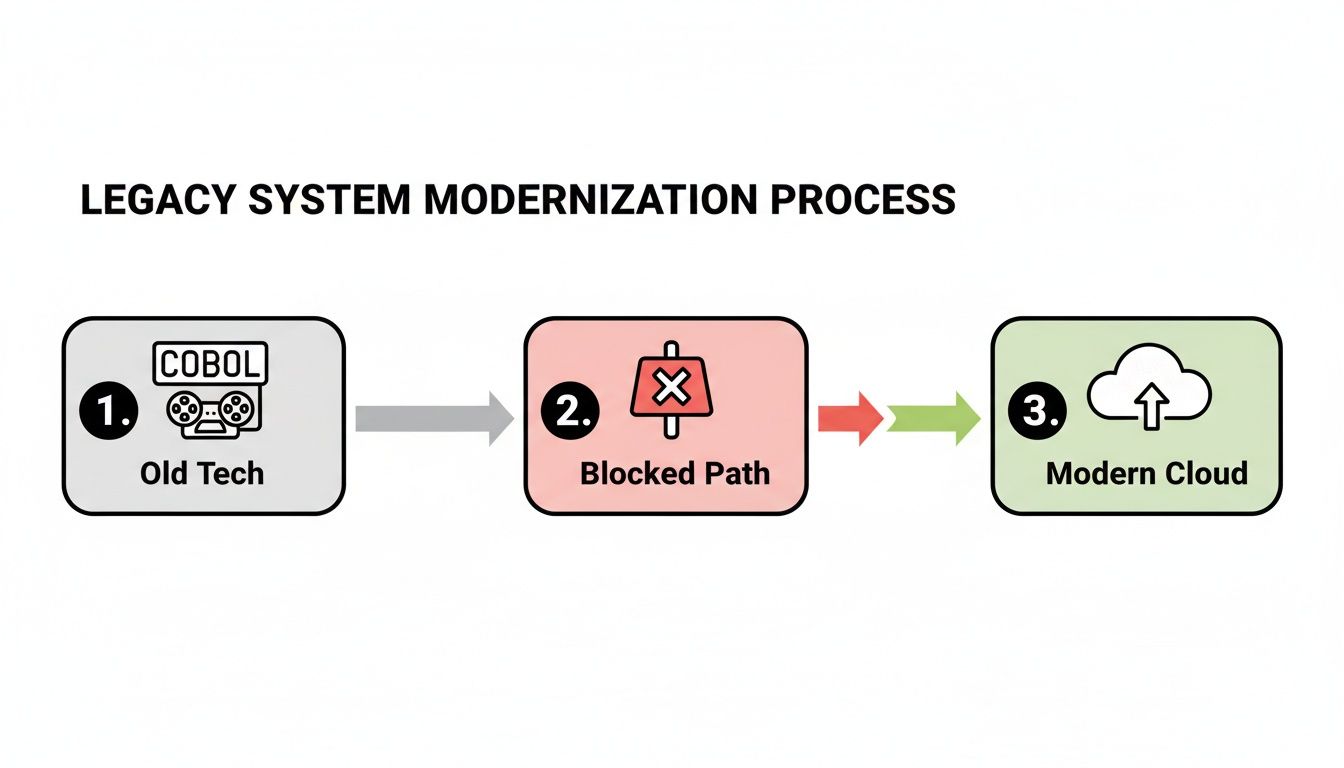
This visual drives home the point that modernization is about clearing roadblocks to become more efficient and agile, not just swapping out old tech for new.
Phase 3: Implement and Iterate
Now, it's time to start building. Rather than trying to do everything at once, this phase is all about an agile, iterative approach. You start small. Pick a high-impact pilot project that can deliver a quick, visible win. Digitizing a single permit application, for example, can prove the concept's value and build excitement for what's next.
This method lets your team learn and adapt as they go. It lowers risk, shows progress to stakeholders, and helps you fine-tune your strategy before tackling more complex systems. Every successful iteration builds the momentum—and the evidence—you need to justify the next investment.
Change management is the lifeblood of this phase. Technology is only as good as the people using it. Constant communication, targeted training, and celebrating small wins are crucial for guiding employees through the transition and getting them to embrace the new tools.
Phase 4: Optimize and Scale
Digital transformation isn’t a project with a finish line; it’s a continuous process of improvement. Once new systems are up and running, the final phase is about monitoring performance, gathering feedback, and always looking for ways to get better. Use analytics to track key performance indicators (KPIs) and spot areas for enhancement.
As you prove the value of your initial projects, you can start scaling those successful solutions to other departments and services. This creates a powerful cycle of improvement, ensuring your agency stays agile, responsive, and ready to meet the changing needs of your community for years to come.
Thinking through each stage of the journey is crucial for turning a vision into a reality. The table below breaks down what each phase entails, from objectives to potential stumbling blocks.
| Phase | Key Objective | Critical Activities | Potential Pitfall |
|---|---|---|---|
| 1. Assess & Align | Gain a clear understanding of the current state. | Conduct tech/process audits, identify pain points, secure stakeholder buy-in, and establish a shared vision. | Lack of executive support or unclear project goals. |
| 2. Strategize & Plan | Develop a concrete, actionable roadmap. | Prioritize initiatives, define scope and budget, create data governance and cybersecurity plans, select partners. | Planning in a silo without cross-departmental input. |
| 3. Implement & Iterate | Deliver value quickly and learn from experience. | Launch pilot projects, use agile methodologies, manage change through training and communication, gather feedback. | Trying to do too much at once ("big bang" failure). |
| 4. Optimize & Scale | Drive continuous improvement and expand success. | Monitor KPIs, gather user feedback for optimization, scale successful solutions to other departments, plan next steps. | Treating it as a one-time project, not a new mindset. |
This phased approach helps demystify the process, turning a massive undertaking into a series of achievable milestones that build upon each other for lasting success.
Your AI Modernization Toolkit with Wonderment Apps
Moving from a strategic roadmap to actually getting things done takes more than a plan; it demands the right tools. For public sector agencies, this is where the theory of modernization runs smack into the real-world hurdles of governance, security, and budget control. Let's be honest, weaving powerful AI into existing applications isn't as simple as plugging in a new device. It requires a solid administrative layer to manage the potential chaos.
This is precisely the challenge Wonderment Apps was built to solve. Our prompt management system acts as that critical control center, giving you the oversight and auditability that public trust absolutely demands. Think of it as the administrative toolkit that lets you finally modernize your software with AI—without ever losing control.
The Governance Layer for Public Sector AI
Picture our system as the central nervous system for your agency's AI integrations. It sits between your legacy applications and the various AI models you want to use, giving you a single point of command. This kind of setup is non-negotiable for government agencies that have to maintain strict oversight over data, costs, and performance while pursuing digital transformation in the public sector.
Instead of a scattered approach where different teams might use AI in unmanaged, risky ways, our platform centralizes everything. It empowers your developers and IT leaders to innovate safely, ensuring every single AI-powered enhancement aligns with your agency's tough standards for security and accountability.
Core Features of the Wonderment Toolkit
To deliver this level of control, our platform is built on four key pillars. Each feature is designed to solve a specific pain point that public sector organizations hit when trying to bring AI into their existing applications.
-
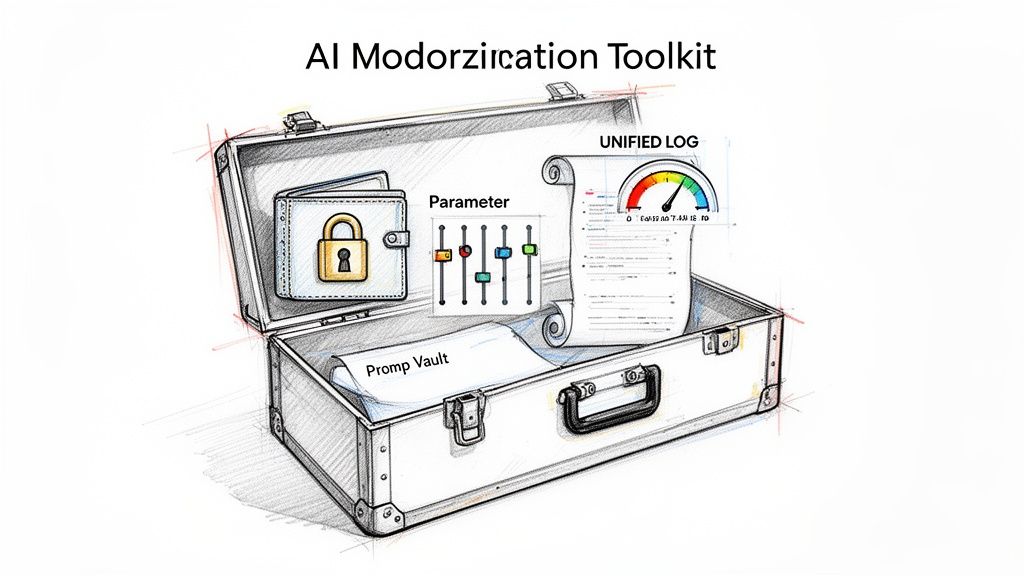
The Prompt Vault with Versioning: Every instruction your team gives an AI model is a "prompt." Our vault securely stores every version of every prompt ever created. This creates a fully auditable history, letting you track changes, roll back to previous versions, and know exactly how the AI is being told to behave over time—a must-have for transparency and debugging.
-
The Parameter Manager: To be truly useful, AI needs access to your internal data. Our parameter manager provides a secure gateway, letting you define exactly what information from your databases the AI can see and use. This is how you prevent sensitive data from being exposed while still unlocking powerful, context-aware AI functionality.
This granular control is the difference between a secure, effective AI tool and a potential data breach.
By managing parameters centrally, you ensure that AI interactions are not only powerful but also compliant with strict data privacy and governance protocols. It turns your internal data into a secure asset for AI, not a liability.
Unified Logging and Cost Management
Beyond managing the inputs, real control means having total visibility over the outputs and the expenses. Our toolkit gives you a clear, consolidated view of all AI activity and its associated costs, which gets rid of any nasty surprises and allows for much smarter financial planning.
Unified Logging System
Our system logs every single interaction across all integrated AI models in one place. Whether you're using models from OpenAI, Google, or Anthropic, you get a single, unified audit trail. This complete oversight is essential for security reviews, performance monitoring, and ensuring you're compliant with public sector regulations. It answers the critical questions: who used the AI, what did they ask, and what response did they get?
Transparent Cost Manager
AI usage can get expensive, and it can happen fast. Our cost manager provides a real-time dashboard showing your cumulative spend across all your AI services. This transparency lets agency leaders track their budget in the moment, forecast future costs, and make data-driven decisions about where to put their resources. No more shocking invoices at the end of the month—just clear, predictable financial oversight.
Together, these features empower public agencies to embrace AI with confidence. You get the benefits of modernization without sacrificing the control, security, and auditability that are non-negotiable in government. It’s the practical toolkit you need to turn your roadmap into a successful reality.
Answering Your Key Modernization Questions
Stepping into a digital transformation in the public sector journey always kicks up a lot of good questions and real concerns. Agency leaders need to know where to start, how to handle the risks, and most importantly, how to get their teams to come along for the ride. Getting clear, straight answers is the only way to build enough confidence to move from just talking about change to actually making it happen.
This final section is all about tackling the most common questions we hear from leaders in the public sector. The idea is to cut through the noise and give you some straightforward advice to build your modernization effort on solid ground.
Where Should a Public Sector Agency Start with Digital Transformation?
The sheer size of a full-on transformation can feel paralyzing. The best way to break through that is to start small and stay focused. Forget about trying to overhaul an entire department right out of the gate. Instead, zero in on a single, high-impact process that you know is a major source of frustration for citizens or your own staff.
Think about things like permit applications, public information requests, or those clunky internal reporting systems. Those are perfect candidates for a pilot project. The first step is to really map out the existing workflow and tech to see exactly where the bottlenecks are. Even more critical: go talk to the people who use the system every day. Their insights are gold.
A successful pilot project does two things beautifully:
- It delivers real value, fast. It solves an actual problem and makes someone's life tangibly easier.
- It becomes your proof-of-concept. You get hard data and a success story you can use to build momentum and get stakeholders excited about what’s next.
This approach of taking small, deliberate steps massively lowers your risk while proving what modern technology can actually do in the real world.
How Can We Manage Security and Privacy Risks of Using AI?
For any government agency, security and privacy aren't just best practices—they're your core duty to the public. This demands a serious, multi-layered strategy that looks at risk from every possible angle.
First things first, you need a rock-solid data governance framework. This means classifying your data by how sensitive it is, setting up crystal-clear rules for who can access what, and making sure everyone knows their role in protecting it. For any organization using AI in the public sector, knowing and following the rules is non-negotiable, as laid out in a practical guide to AI GDPR compliance.
Next, as you bring in AI, you absolutely have to choose solutions that give you deep oversight and a clear audit trail. This is exactly where tools like Wonderment Apps' prompt management system come in. With features like version-controlled prompt vaults and detailed logging, you create an unchangeable record of how AI is being used and what data it touches.
A "privacy by design" mindset is non-negotiable. It means building security and privacy into the very fabric of a project from day one, not trying to bolt it on later. This is the only way to build and keep the public's trust.
How Do We Justify the Cost with a Limited Budget?
When budgets are tight, every dollar has to prove its worth. The key is to stop talking about modernization as just a cost and start framing it in terms of return on investment (ROI) and, just as importantly, cost avoidance.
The ROI is about so much more than just saving a few dollars. It’s about huge efficiency gains, like cutting down manual data entry by 80%. It’s about massive improvements in how you serve the public, like slicing citizen wait times in half. You also have to tally up the "cost of inaction"—what are you spending right now on maintaining old systems, patching security holes, and working around operational logjams?
Put together a clear business case that spells out these long-term savings and risk reductions. Use the real numbers from your successful pilot project to make your case. When you can point to concrete, measurable results, you're not asking for an expense anymore. You're demonstrating a smart, strategic investment.
How Do We Get Long-Term Employees to Adopt New Technologies?
Getting people on board is a change management challenge, not a tech problem. You could have the most amazing tools in the world, but they're useless if your team won't touch them. The secret is to involve your people from the very beginning.
Don't just spring new software on your staff. Instead, build small, cross-functional teams that mix veteran employees with your tech folks to design the new processes together. This gives them a real sense of ownership and makes sure the solution actually fixes the problems they face every day.
You have to answer their one big question: "What's in it for me?"
- Talk to Them Clearly: Show them exactly how the new tools will get rid of tedious tasks and free them up to do more interesting, high-impact work.
- Provide Real Training: Offer hands-on training that’s built for different roles and comfort levels with technology.
- Find Your Champions: Identify those respected employees who are excited about the change and empower them to help guide their colleagues.
Finally, celebrate the small wins out in the open. When you highlight how a new process made a team’s job easier or led to a better outcome for a citizen, you create positive buzz. It shows everyone that this transformation is about making their work better, not replacing them.
Ready to turn your modernization roadmap into reality with the right tools and expert support? At Wonderment Apps, we provide the administrative toolkit and engineering partnership to help you integrate AI securely and effectively. Schedule a demo today to see how our platform can give you the control, oversight, and confidence you need to lead a successful digital transformation.