


Let's be honest, a great user experience doesn't just materialize out of thin air. It's born from understanding the world your users live in, and a huge piece of that world is shaped by your competitors. A solid UX competitive analysis is your secret weapon, revealing the unspoken rules of your market and highlighting where you can truly make your mark.
This isn't about blindly copying features. It's a strategic process for sidestepping costly mistakes, validating bold design choices, and spotting those golden opportunities that everyone else has missed. When you systematically evaluate what works—and more importantly, what doesn't—for your rivals, you gain a clear map of user expectations and pain points. That map is even more powerful when you realize it can guide not just your design, but how you can strategically integrate AI to build an app experience that leaves the competition in the dust. At Wonderment, we've even built a prompt management system to help developers and entrepreneurs plug AI into their existing apps and modernize them with total control.
Uncover Market Standards and User Expectations
Every industry has its own set of unwritten rules. For an e-commerce app, a seamless checkout experience is completely non-negotiable. For a project management tool, intuitive task creation is table stakes. A competitive analysis shows you exactly what these baseline expectations are.
If you fail to meet them, you're already playing from behind. By understanding these standards from day one, you ensure your product feels familiar and intuitive, drastically reducing the learning curve for new users.
Drive Strategic Innovation, Not Imitation
The goal here isn’t to build a carbon copy of another app. Far from it. The real value is in finding the gaps. Where do competitors create friction for their users? What crucial user need are they all collectively ignoring? These gaps are your openings for true innovation.
"A UX competitive analysis can also help designers understand their users better. By looking at the competition through customers’ eyes, UX researchers can empathize better to discover what excites and frustrates them."
This is your chance to build a feature or a user flow that is 10x better than anything else available. That’s how you create a powerful, compelling reason for users to choose you over everyone else. This strategic approach is what turns simple research into a genuine competitive advantage.
Justify Design Decisions with Data
How many times have you struggled to convince stakeholders to invest in a redesign or a new feature? Competitive analysis gives you the hard data you need to build your case.
Showing that 80% of your top competitors offer a specific feature, or that users consistently complain about a certain workflow in app store reviews, provides concrete evidence for your design choices. This data-backed approach strips away subjectivity, builds alignment across your team, and gets everyone moving in the same direction.
The impact of getting this right is massive. The global UX services market is projected to soar from $2.59 billion in 2022 to $32.95 billion by 2030. This explosive growth is fueled by companies using UX benchmarking to get ahead.
It's no surprise when you see the numbers. Well-designed interfaces can boost conversion rates by up to 400%. In today's climate, a staggering 77% of brands see customer experience—honed through rigorous competitor analysis—as their primary competitive advantage. You can dig into more of these compelling UX statistics and what they mean for your business.
Just think about using these insights to power AI-driven features that adapt to user needs in real-time. With a modern prompt management system, you can turn competitive intelligence into smart, personalized experiences that feel magical. At Wonderment, our own administrative tool includes a prompt vault with versioning and a cost manager, allowing us to test and deploy these AI enhancements efficiently. This is how you build a product that doesn't just compete, but leads the pack.
A thorough UX competitive analysis delivers more than just a list of features to build. It provides a strategic foundation that touches every part of your product development process, from initial design concepts to long-term business goals.
Core Benefits of UX Competitive Analysis
| Benefit Area | Strategic Impact | Example Outcome |
|---|---|---|
| Product Strategy | Pinpoints market gaps and unmet user needs, guiding roadmap prioritization. | A fintech app discovers competitors lack robust budgeting tools for freelancers, leading to a new feature set that captures a niche market. |
| Design & UX | Establishes baseline usability standards and identifies opportunities for superior user flows. | An e-commerce site redesigns its checkout process to be two steps shorter than its main rival's, measurably reducing cart abandonment. |
| Risk Mitigation | Validates design decisions with market data, reducing the risk of building unwanted features. | Data shows users on competitor platforms rarely use a complex reporting feature, saving the team months of development on a similar, low-impact idea. |
| Stakeholder Alignment | Provides objective evidence to justify design choices and secure buy-in for new initiatives. | A presentation showcasing competitor weaknesses in mobile onboarding convinces leadership to invest in a native app redesign. |
| Innovation | Uncovers competitor weaknesses and emerging trends, sparking ideas for breakthrough features. | A travel app notes that no competitors integrate local event APIs, leading to a unique feature that suggests activities near a user's hotel. |
Ultimately, integrating these findings into your workflow ensures you're not just building a product, but building the right product for the right audience in a competitive market.
Building Your Analysis Framework
You can't win a game without a plan, and the same goes for UX competitive analysis. Just jumping into competitor websites without clear goals is a recipe for disaster. You'll end up with overwhelming spreadsheets and vague insights that don't help you build a better product. A structured approach, on the other hand, is your map to uncovering insights you can actually use.
First things first: define what you want to achieve. A fuzzy goal like "see what competitors are doing" is a waste of everyone's time. Your objectives need to be specific, measurable, and tied directly to your product's strategic goals. Are you trying to slash churn in your onboarding? Then your objective should be to analyze how top competitors guide new users to that critical "aha!" moment.
Set Clear and Actionable Objectives
Think about your current business challenges and frame them as research questions. This simple shift turns a passive review into an active investigation, ensuring every piece of data you collect has a purpose.
Here’s how that looks in practice:
- Goal: Increase user engagement in our mobile app.
- Objective: Analyze the gamification, personalization, and community features of our top 3 competitors.
- Goal: Improve our conversion rate during checkout.
- Objective: Map the checkout flows of leading e-commerce sites, noting the number of steps, form field design, and payment options offered.
- Goal: Validate a new AI-powered feature concept.
- Objective: Find out if any indirect competitors are solving a similar user problem with AI and evaluate their user experience.
This targeted approach keeps you from getting lost in the weeds and focuses the entire process on driving real improvements to your own UX.
Choosing Your Competitors Wisely
With your objectives locked in, it's time to pick who you're going to analyze. It’s tempting to only look at the biggest names in your space, but that’s a shortsighted view. A truly effective analysis needs a broader perspective, looking at both direct and indirect competitors.
Direct competitors are the obvious ones—they offer a similar solution to the same audience. Think Uber and Lyft. Sizing them up helps you understand baseline user expectations and identify the industry standards you simply can’t ignore.
Indirect competitors solve the same core user problem, just in a completely different way. For a project management tool like Asana, an indirect competitor could be a simple note-taking app like Notion or even a physical whiteboard. Honestly, this is often where the most exciting innovations are found, since they aren't stuck playing by the same rules.
A healthy mix is key. I recommend aiming for 3-5 direct competitors to get a solid read on the current landscape and 1-2 indirect competitors to spark fresh ideas and challenge your own assumptions.
For a great primer on the fundamentals, check out this guide on how to perform a quick and easy competitive analysis. It's perfect for structuring your initial research and making sure you cover all the essential bases.
Pinpoint Crucial UX Elements to Dissect
Finally, you need to decide what you're going to analyze for each competitor. Creating a consistent checklist is non-negotiable; it ensures you're comparing apples to apples and can easily spot patterns across the board. This is where you get into the real nitty-gritty of the user experience.
Your list should include everything from high-level strategy down to the granular design details. Here’s a solid starting point:
- Core User Flows: How do users sign up, create their first project, or make a purchase? Mapping these journeys is the best way to uncover points of friction and moments of delight. To really nail this, explore our guide on the best practices for creating powerful user flows.
- Information Architecture (IA): How is everything organized and labeled? Is the navigation intuitive or a total maze? A confusing IA is a top reason users bounce.
- Visual Design and Branding: What's the overall look and feel? Analyze their use of color, typography, and imagery to decode the brand personality they're projecting.
- Micro-interactions: This is about the small stuff that makes a big difference—the subtle animation on a button click, the design of a loading spinner, the helpfulness of an error message. These tiny moments have a huge impact on how polished an app feels.
- Content and Tone of Voice: How do they talk to their users? Is the language formal and corporate, or casual and friendly? This shapes the entire user relationship.
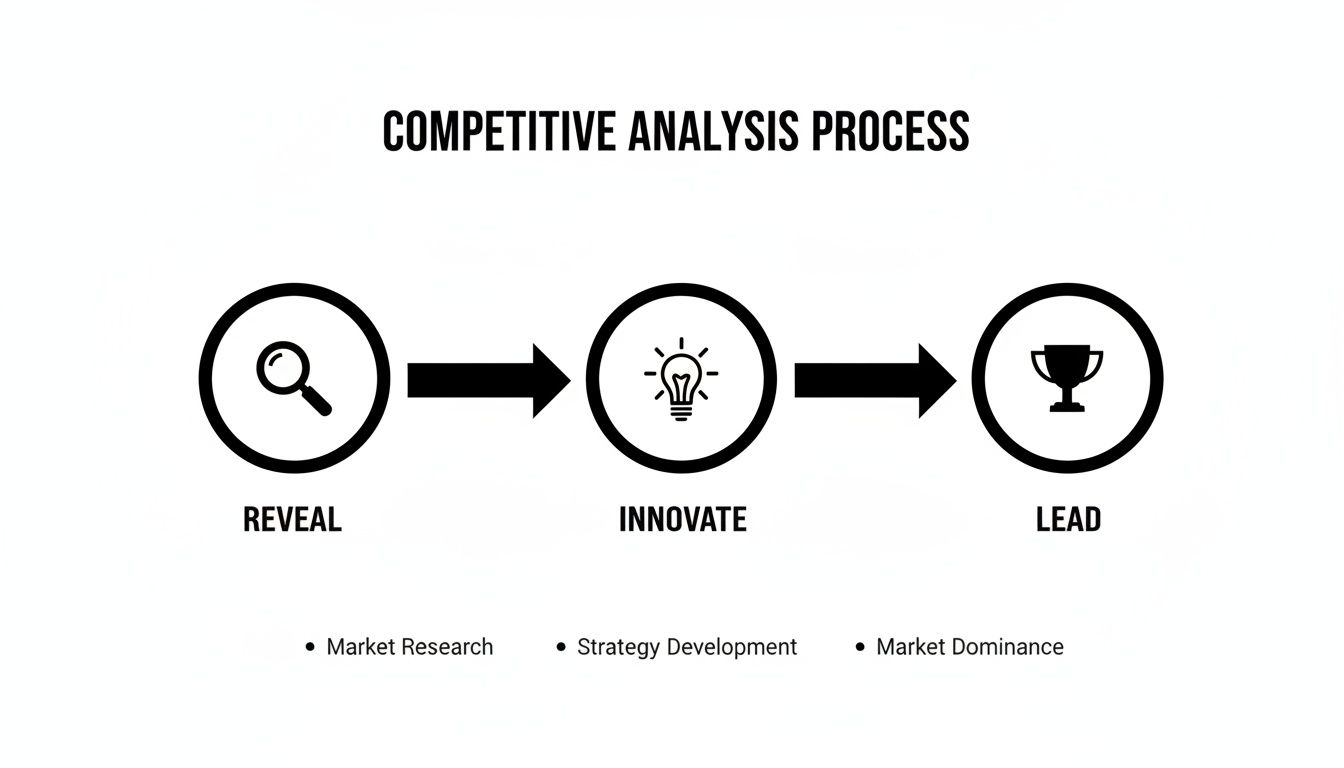
This kind of framework transforms competitive analysis from a vague research task into a strategic weapon, making sure your efforts are focused and your findings are ready for action.
Gathering Intelligence with Proven Research Methods
With your framework set, it's time to roll up your sleeves and become a UX detective. This is the part where you collect the raw evidence that will shape your entire strategy. Remember, effective data gathering isn't about finding every single detail; it's about efficiently collecting the right details that speak directly to your goals.
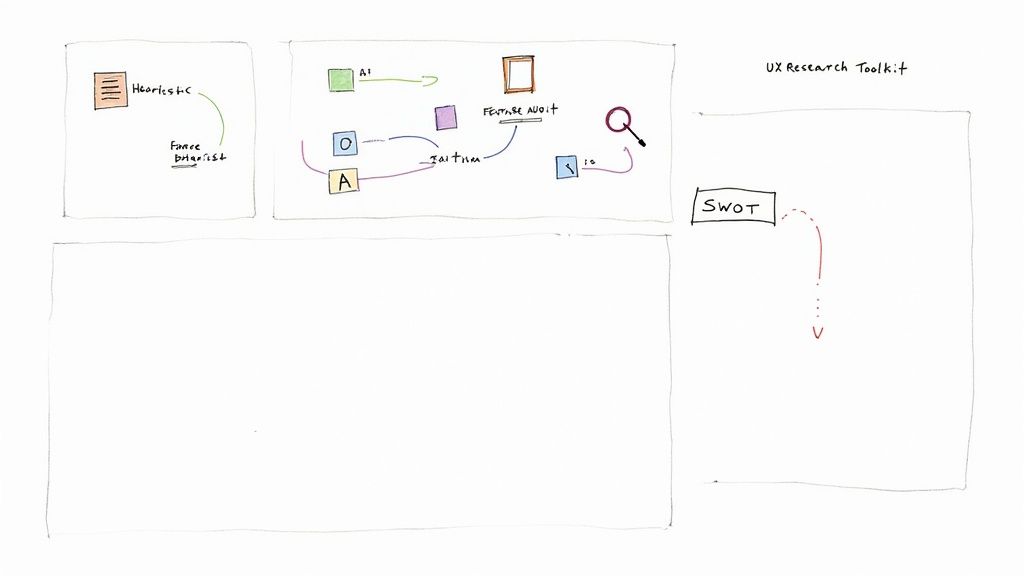
This process isn't a one-size-fits-all activity. The methods you choose should directly map back to the objectives you established earlier. Let's walk through some of the most practical research methods I've found deliver the most value for the time invested.
Conduct a Heuristic Evaluation
A heuristic evaluation is a structured way to assess a competitor's user interface against a set of established usability principles. Think of it as a professional inspection, giving you an objective benchmark for how intuitive their product truly is. You're not just saying "I don't like this button"; you're evaluating it against proven design standards.
To get started, I always recommend using an established framework like Nielsen's 10 Usability Heuristics. This gives you a consistent scorecard to grade everything from error prevention to the clarity of system status.
This methodical approach helps you move beyond personal opinion. Instead of subjective feedback, you generate a qualitative score that clearly shows where a competitor’s design is solid and where it fails to meet fundamental user expectations.
Systematically Map Critical Task Flows
One of the most revealing exercises you can do is to walk a mile in your competitor's user's shoes. This means mapping out their critical task flows step-by-step. Go through the entire process of signing up, creating a first project, or completing a purchase on their platform.
As you navigate these flows, document every single action and screen. Note where the experience feels seamless and where you encounter friction or confusion.
- Onboarding: How quickly do they get a new user to that "aha!" moment?
- Core Tasks: Is completing a primary action, like adding an item to a cart, intuitive or cumbersome?
- Settings & Customization: Can users easily personalize their experience, or is the process buried and complex?
This kind of analysis reveals the subtle design choices that shape the entire user journey. You'll quickly spot where competitors excel at reducing user effort and where they've created frustrating dead ends—valuable lessons for what to avoid in your own design.
By comparing your user journeys to successful competitors, you can uncover the keys to their success. You might discover that they use fewer steps or strategic call-to-action placement to convert more customers. This is about understanding the "why" behind their design, not just the "what."
This process is a close cousin to hands-on user testing. To dive deeper into evaluating user interactions, exploring methods for the usability testing of a website can provide a powerful complementary perspective.
Perform a Comprehensive Feature Audit
A feature audit is exactly what it sounds like: a systematic inventory of the features your competitors offer. But the goal isn't to create a laundry list to copy. The real value comes from categorizing and analyzing these features to understand their strategic purpose.
I find it easiest to create a simple spreadsheet. List out all major and minor features for each competitor, then organize them by the user goal or the part of the user journey they support.
This visual map makes it incredibly easy to see where the market is saturated and, more importantly, where it's wide open. You might find that all your competitors have focused heavily on one area of the user experience while completely neglecting another. Those neglected areas are your prime opportunities for differentiation.
Run a Strategic SWOT Analysis
The classic SWOT (Strengths, Weaknesses, Opportunities, Threats) analysis is an incredibly powerful tool when you apply it specifically to UX design. It pushes you to synthesize all the data you've gathered into a clear strategic overview.
- Strengths: Where is a competitor's UX undeniably strong? (e.g., "Their mobile checkout is incredibly fast and intuitive.")
- Weaknesses: What are their biggest usability flaws or missing features? (e.g., "Their search functionality is slow and returns irrelevant results.")
- Opportunities: Based on their weaknesses, what market gaps can you fill? (e.g., "We can build a superior search experience with better filtering.")
- Threats: What external factors or competitor strengths could pose a risk to your product? (e.g., "They just launched an AI-powered recommendation engine that we can't match yet.")
Conducting this analysis for each key competitor provides a clear, high-level summary that is perfect for sharing with stakeholders. It translates your detailed findings into a concise, actionable format that highlights both risks and strategic openings. To effectively gather all this intelligence, it always helps to continually improve your research skills and stay sharp.
Turning Raw Data Into Design Opportunities
So, you've done the legwork. You’ve got a mountain of notes, screenshots, and observations from digging into your competitors. But let's be honest, raw data is just noise. The real magic in competitive analysis ux design happens when you start connecting the dots—that's synthesis. This is the moment you uncover genuine, actionable opportunities that give your product an edge.
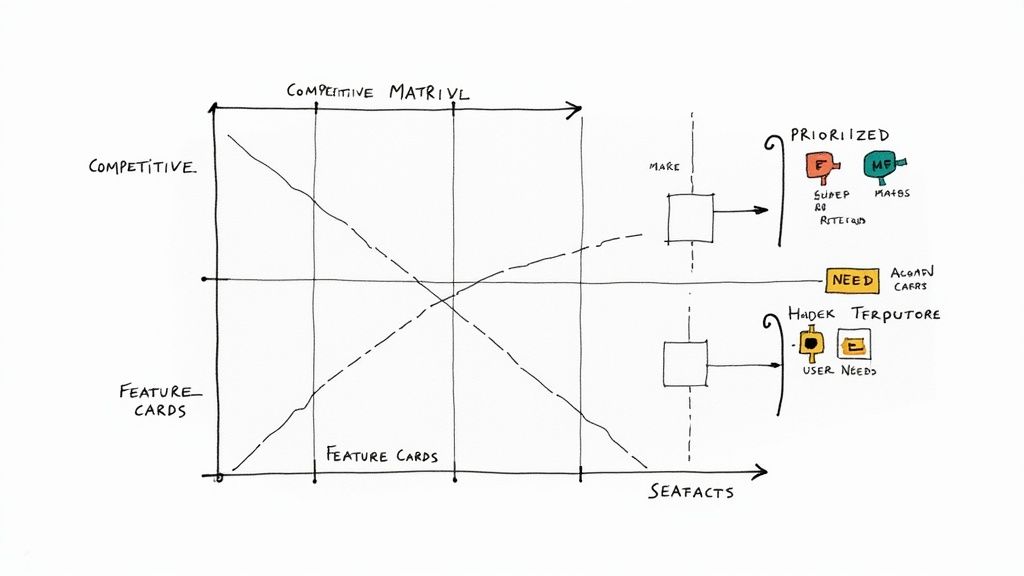
This is where your meticulous research evolves from a simple collection of facts into a strategic roadmap. It’s all about shifting the focus from "what they have" to "what our users truly need." Let's walk through how to make that happen.
Chart the Landscape with a Competitive Matrix
The first move in making sense of everything is to get it all organized visually. For this, a competitive feature matrix is your best friend. It’s a deceptively simple tool that gives you a powerful, at-a-glance view of the entire competitive landscape.
Just create a spreadsheet or a table. Down the first column, list the key features, UX attributes, and user flows you've been tracking. Then, across the top row, list your product and each competitor you analyzed. Now, just go through and mark what each product offers.
You could use simple checkmarks, but I find a scoring system (like a 1-5 scale) works even better. This lets you rate the quality of each feature's execution, which instantly highlights patterns. You'll quickly see which features are table stakes, which are rare differentiators, and exactly where you stand in the mix.
Your goal isn't just to match competitor checkmarks. Think of the matrix as a diagnostic tool. It's for understanding market saturation and spotting where you can innovate instead of just playing catch-up.
This visual breakdown makes it incredibly easy to share your findings with stakeholders and align everyone on your product's strategic position.
Uncover Unmet Needs with Gap Analysis
With your matrix built, it's time for a gap analysis. This is where you graduate from simply spotting missing features. A proper gap analysis is about uncovering the unmet user needs that your product is uniquely positioned to solve.
Look at your completed matrix and start asking some tough questions:
- Feature Gaps: What essential features do most competitors have that you don't? This tells you a lot about baseline user expectations.
- Quality Gaps: Where do competitors offer a feature, but the experience is clunky, slow, or just plain confusing? A poorly executed feature is a huge opportunity for you to swoop in with a superior solution.
- Strategy Gaps: What user pain points are all the competitors ignoring? This is where true differentiation is born. For example, if no one in the project management space offers robust, native collaboration tools, that's a strategic gap you could own.
This process gives you a clear path for prioritizing what to build next. Instead of chasing every shiny new trend, you can focus on the initiatives that will deliver the biggest impact for your users and, ultimately, your business.
Take a look at this simplified example to see how you might structure the matrix.
Competitive Feature Matrix Example
A quick glance at a matrix like this can tell you a story. It’s not just a collection of checks and crosses; it’s a map of the market’s strengths, weaknesses, and, most importantly, the hidden opportunities.
| Feature/UX Attribute | Your Product | Competitor A | Competitor B | Competitor C |
|---|---|---|---|---|
| User Onboarding | Guided Tour | Video Tutorial | Interactive Walkthrough | Minimal |
| Mobile App | iOS Only | iOS & Android | iOS & Android | None |
| AI Assistant | None | Basic Chatbot | Predictive Analytics | None |
| Team Collaboration | Basic Sharing | Real-time Editing | Task Assignments | Basic Sharing |
| Reporting | Limited | Advanced | Advanced & Customizable | Basic |
This table immediately shows that while you have an iOS app, falling behind on Android support is a risk. Even more critically, it screams opportunity in AI-powered features—an area where the competition is either weak or completely absent.
By systematically synthesizing your research, you transform that messy pile of data into a clear set of strategic priorities. These insights become the bedrock for updating user personas, refining journey maps, and building a product roadmap that’s grounded in solid evidence, not just guesswork.
Putting Your Insights Into Action with AI
An analysis is only as good as the action it inspires. All the data, matrices, and charts in the world are meaningless unless you translate them into tangible improvements that your users can actually feel.
This final step is about making your findings stick. It’s where you take all that hard-won intelligence from your competitive analysis ux design process and turn it into a lasting advantage. This is how you operationalize insights and get the entire team—from product to engineering to marketing—aligned and excited.
Weave Insights into Compelling Deliverables
The most effective way to share your findings is by embedding them directly into the artifacts your team already uses every day. Don't just present a slide deck that gets filed away and forgotten. Actively update your core design and strategy documents.
This approach makes the insights impossible to ignore and guarantees they influence future decisions.
Consider how your findings can sharpen these key documents:
- Updated User Journey Maps: Show exactly where a competitor’s flow is superior or creates friction. Visualize the new, improved journey your product will offer, highlighting the specific pain points you are now solving.
- Revised Design Principles: If your analysis revealed that speed and simplicity are the winning factors in your market, codify that. Create a new design principle like, "Core tasks must be completable in three clicks or less."
- Prioritized Feature Roadmaps: Use your gap analysis to directly inform what gets built next. When you can show that a feature addresses an unmet need and a competitor's weakness, its priority on the roadmap becomes crystal clear.
This transforms your analysis from a static report into a living, breathing part of your product strategy.
Modernize Your App with AI-Driven Features
Here’s where you can make a massive leap past the competition. Your analysis has handed you a playbook of their weaknesses and your opportunities. Now, you can use AI to build intelligent, dynamic experiences that directly address the gaps you uncovered.
Instead of just matching features, think about how AI can solve the underlying user problem in a fundamentally better way. If competitors have clunky reporting tools, could you build an AI that generates plain-language summaries of user data on command?
This is precisely how you modernize an application and build for the future. By strategically applying AI, you can create features that feel personalized, predictive, and incredibly helpful. You can learn more about how to leverage artificial intelligence to transform your user experience in our detailed guide.
Innovate with Confidence and Control
Bringing these AI-powered ideas to life requires the right infrastructure. Rapidly prototyping and testing AI features can get complex and expensive without a system to manage it all. This is where a dedicated prompt management platform becomes essential for any team serious about innovating.
Imagine having a central prompt vault with built-in versioning. This allows your team to rigorously test different personalized onboarding flows or AI-generated content, tracking what works best without chaos.
Pair that with a parameter manager that can securely pull from your internal database, and you can create truly dynamic user experiences that adapt in real time.
At Wonderment, our administrative tool was built to solve these exact challenges. It includes robust logging across all integrated AI models and a cost manager that gives you a clear, cumulative view of your spending. This combination of creative freedom and tight financial control means you can experiment and build a lasting competitive edge with complete confidence.
Common Questions About UX Competitive Analysis
Even with a great framework in hand, questions always come up once you're deep in the weeds of a competitor's product. Let's walk through some of the most common ones I hear from teams doing a competitive analysis for UX design.
How Often Should I Run a UX Competitive Analysis?
It's better to think of this as an ongoing practice, not a one-and-done project. A really deep analysis is absolutely crucial when you're launching something new, entering a different market, or planning a major overhaul. That's what sets your foundation.
But the real magic happens with lighter, quarterly "health checks." These regular check-ins keep you sharp and aware of new features your competitors are shipping, what's trending in the market, and how user expectations are changing. This continuous pulse-check is what prevents you from getting blindsided by a rival's big move.
What’s the Difference Between Direct and Indirect Competitors?
Getting this right is fundamental to a well-rounded analysis. It's pretty simple, actually.
- Direct competitors are the obvious ones. They offer a very similar solution to the same crowd you're targeting. Think Uber and Lyft—they're fighting for the same riders.
- Indirect competitors solve the same core problem, just in a totally different way. For Uber, an indirect competitor could be a public transit app like Citymapper, a bike-sharing service, or even a classic car rental platform.
Looking at both is vital. Direct competitors show you what users have come to expect as table stakes. But your biggest "aha!" moments often come from indirect competitors—they're the ones that can spark true innovation.
Can a Small Team Actually Do This Effectively?
Absolutely. You don't need a huge budget or a dedicated research department to pull this off and get fantastic insights. For smaller teams, the game is all about being ruthlessly focused.
Instead of getting overwhelmed by analyzing ten different companies, just pick 2-3 of your most important rivals. Zero in on their most critical user journeys, like their onboarding flow or checkout process. You can get a ton of value from simple, accessible methods like combing through app store reviews, mapping out their main task flows, or running a quick heuristic evaluation. A lean, targeted analysis that actually gets finished is infinitely more valuable than a massive one that sits half-done.
The goal is inspiration, not imitation. When you see something a competitor does well, the first question isn't "How can we build that?" It's "Why does this work so well for their users?" Get to the bottom of the user need it solves before you even start thinking about features.
Once you understand the why, you can start brainstorming how to solve that same need in a way that's better, more unique, and actually fits your own product's vision. Focusing on the strategy behind the feature—not just the feature itself—is how you make sure your design decisions are innovative, not just derivative.
Ready to turn these competitive insights into a modern, AI-powered user experience? Wonderment Apps gives you the tools and expertise to build intelligent applications that truly stand out. Our administrative toolkit, with its prompt vault and cost manager, lets you innovate with both confidence and control.
Schedule a demo today and see how we can help you build a lasting competitive edge.