

Can you imagine a modern hospital trying to function with paper charts and manila folders? It seems impossible, doesn't it? Today, healthcare software solutions are the central nervous system of patient care. They've moved far beyond simple billing to power everything from the first diagnosis to long-term recovery. This guide will show you how to design excellent, scalable app experiences, pick the right developers, and use AI to modernize your software to last for years to come.
The Digital Heartbeat of Modern Healthcare
In every corner of the medical world, software has become the invisible yet essential tool that keeps things running. It’s the silent partner helping a surgeon map out a complex procedure, the secure line allowing a patient to message their doctor at midnight, and the analytical engine that helps public health officials spot disease outbreaks before they spiral out of control.
This isn't just about swapping paper for pixels. It’s about creating a connected, intelligent system where information flows seamlessly and securely between patients, providers, and payers. The real goal here is to make healthcare more proactive, personalized, and efficient for everyone involved.
Why Modernization Is No Longer Optional
Sticking with outdated, clunky systems just isn't a viable option anymore. Patients' expectations have changed; they want the same digital convenience from their doctor that they get from their bank or favorite online store. At the same time, regulatory demands for data security and interoperability are stricter than ever.
This rapid evolution is mirrored in the market's explosive growth. The global healthcare enterprise software market was valued at USD 43.62 billion in 2024 and is projected to skyrocket to USD 158.63 billion by 2034. This surge underscores the urgent need for providers to adopt better tools and technologies to manage their data.
Bringing your systems up to speed isn't just a technical upgrade—it's a strategic move for survival and growth. As we'll dig into, the digital transformation in the healthcare industry is picking up speed, and falling behind means risking both patient satisfaction and operational stability.
From Wearables to AI: The New Frontier
The reach of healthcare software now extends far beyond the hospital's four walls. It lives in our pockets and on our wrists. For a real-world example, just look at the wide array of Apple Watch Health Features, which can track everything from heart rate variability to fall detection.
This constant stream of patient-generated data opens up incredible opportunities for innovation. But plugging these new capabilities—especially advanced AI—into older applications can be complicated and expensive. This is where a new generation of administrative tools comes into play, designed to help developers and entrepreneurs modernize their existing apps for AI integration.
For developers and entrepreneurs, the challenge is no longer just building an app, but building an intelligent one. An AI prompt management system acts as a central control panel, allowing you to plug sophisticated AI features into your software without starting from scratch. We've developed a tool like this at Wonderment and we're excited to show you how it works—you can schedule a demo to see it in action.
This approach offers a clear path to modernization. It allows you to manage AI prompts, control data access for security, and keep an eye on costs, all in one place. It's the key to building scalable, future-proof applications that can genuinely improve patient outcomes.
Understanding the Core Types of Healthcare Software
Diving into the world of healthcare software solutions can feel a lot like learning a new language. You're hit with a barrage of acronyms and categories, and it’s easy to get turned around. But when you get down to it, all these tools are designed to solve very specific problems within the complex world of patient care and hospital operations.
Think of it like a mechanic's toolbox. You wouldn't use a socket wrench to change a tire; you'd use a lug wrench. Each tool has a specific job. Getting a handle on these core software categories is the first step for any leader looking to make a smart technology investment.
The diagram below shows how different software tools branch out to support either clinical operations or patient outcomes, all anchored by a central system.
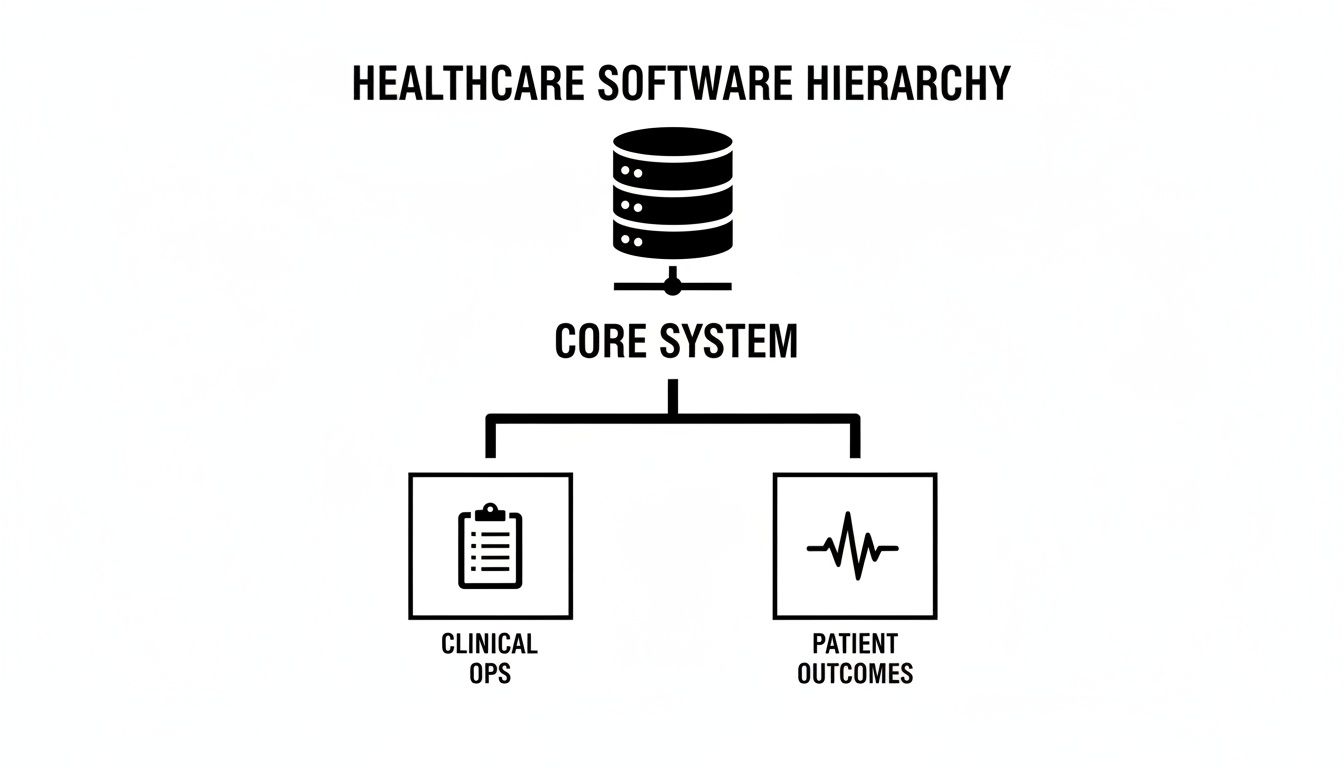
This really brings home the idea that every piece of software, whether it’s for billing or diagnostics, ultimately ties back to the core mission: improving how healthcare is delivered and experienced.
To make sense of the landscape, let's break down the main players. Here’s a quick look at the most common types of healthcare software, what they do, and who uses them.
Key Healthcare Software Solutions at a Glance
| Software Type | Primary Function | Main User Group |
|---|---|---|
| EHR/EMR | Manages patient charts, medical history, and treatment plans. | Clinicians (doctors, nurses) |
| Telehealth | Enables remote consultations via video and secure messaging. | Patients & Clinicians |
| Patient Portal | Provides patients secure access to their health info and services. | Patients |
| Practice Management | Handles administrative tasks like scheduling and billing. | Administrative Staff |
| Medical Imaging | Processes and analyzes diagnostic images (X-rays, MRIs). | Radiologists & Specialists |
This table gives you the lay of the land, but the real power comes from understanding how these systems work together to create a cohesive healthcare experience.
The Digital Patient Chart
At the very heart of most clinical settings, you'll find Electronic Health Records (EHR) and Electronic Medical Records (EMR). People often use these terms interchangeably, but there's a crucial difference. An EMR is basically the digital version of a patient's paper chart from a single practice. It stays within the four walls of that clinic.
An EHR, on the other hand, is built for a bigger picture. It's a complete, holistic view of a patient’s health journey, designed to be shared securely with other providers, like specialists, labs, or hospitals.
Think of an EMR as a single chapter in your health story, written by one doctor. An EHR is the entire book, with contributions from every provider you've ever seen. Both are absolutely vital for reducing medical errors and getting clinicians the data they need, right when they need it.
The Virtual House Call and Front Door
The pandemic didn't invent telehealth, but it certainly put it on the map, turning the "virtual house call" into a daily reality. Modern telehealth platforms offer secure video conferencing, messaging, and sometimes even remote monitoring, making care far more accessible and convenient. The U.S. telemedicine market alone is projected to hit $64 billion by 2025.
Working hand-in-hand with telehealth are patient portals. These act as a secure digital front door to a patient's health information. Through a portal, patients can:
- Schedule appointments online
- Check lab results and view their medical records
- Send secure messages to their care team
- Pay bills and manage their account information
These tools aren't just a convenience; they empower patients to become active participants in their own care, which dramatically boosts engagement and overall satisfaction.
Software That Keeps the Lights On
Beyond the examination room, a whole other category of software makes sure a healthcare facility actually runs like a business. These are the unsung heroes of the healthtech world—the operational tools that keep things moving.
- Practice Management Software (PMS): This is the administrative command center. It tackles everything from patient scheduling and registration to managing tasks for the front office staff.
- Medical Billing Software: This is a specialized tool that wrangles the incredibly complex process of creating insurance claims, submitting them, and tracking payments. It's designed to cut down on costly billing errors and speed up the revenue cycle.
- Hospital Management Software: For larger facilities, this software is a must. It helps administrators get a bird's-eye view of everything from bed availability and staff assignments to pharmacy inventory and financial reporting.
The Rise of Specialized and Monitoring Tools
Finally, we're seeing an explosion of innovative software pushing the boundaries of what’s possible in care delivery. Remote Patient Monitoring (RPM) solutions, for example, use IoT devices—like smart blood pressure cuffs or glucose meters—to collect patient data from their own homes. This allows doctors to manage chronic conditions proactively and step in before a small issue becomes a full-blown health crisis.
Along the same lines, medical imaging software gives specialists incredibly powerful tools to view, process, and analyze MRI or CT scans, often creating 3D models for better diagnosis or surgical planning. Each of these specialized healthcare software solutions fills a unique need, and together, they are building a more connected, data-driven, and patient-focused healthcare system.
What Goes Into High-Performing Medical Software?
Once you’ve figured out the type of healthcare software you need—whether it’s an EHR or a telehealth platform—the real work begins. You have to understand what separates a great system from a mediocre one. It's not about the category; it’s about the specific features that make or break daily operations, keep patients safe, and allow your practice to grow. The fanciest tools are useless if your staff can't figure them out or if they don't connect with your other critical systems.
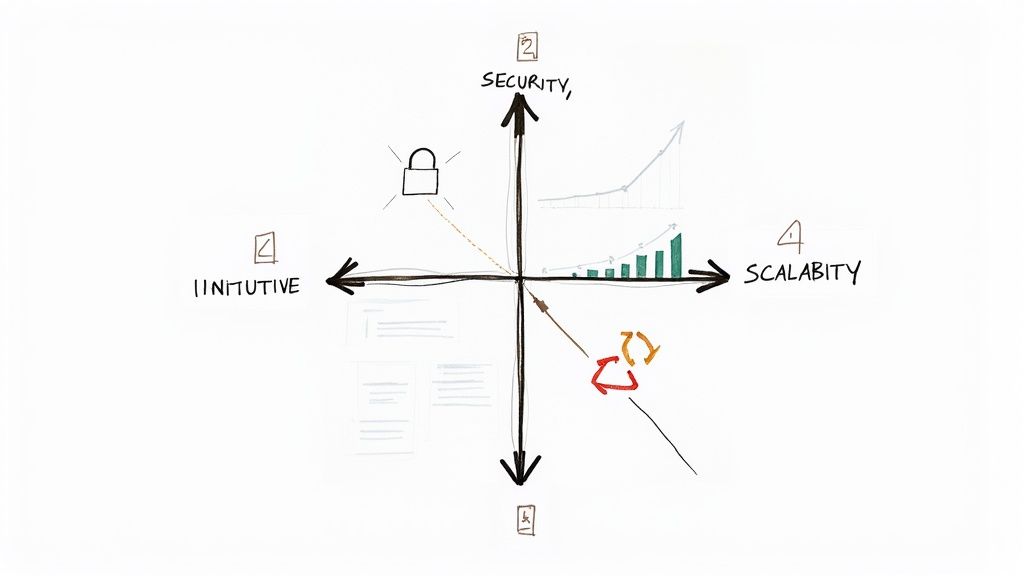
Truly effective medical software stands on three core pillars: intuitive design, ironclad security, and seamless interoperability. If you neglect even one of these, you're setting yourself up for frustrated staff, devastating data breaches, or dangerous gaps in patient care.
An Intuitive Experience for Clinicians
Doctors and nurses are constantly under pressure. The last thing they need is software that slows them down. A clunky, confusing user interface (UI) isn't just an annoyance; it's a direct path to burnout and can even contribute to medical errors.
An intuitive UI means less time fighting with menus and more time focusing on the patient. This comes from clean layouts, logical navigation, and workflows that actually mirror how clinicians work in the real world. A well-designed EHR, for instance, should let a doctor review a patient’s history, order labs, and write a prescription in just a few clicks—no instruction manual required.
Ironclad Security and Compliance
In healthcare, data security isn’t just a nice-to-have feature. It’s a legal and ethical requirement. Protected Health Information (PHI) is some of the most sensitive data out there, making healthcare organizations a prime target for cyberattacks. Any software handling PHI must be built with security baked into its core.
This goes way beyond a simple password. Here are the non-negotiables:
- End-to-End Encryption: Makes sure all data is unreadable to unauthorized parties, whether it’s sitting on a server or moving across a network.
- Role-Based Access Control (RBAC): Restricts user access to only the specific information they need for their job. A billing specialist has no reason to see a patient’s detailed clinical notes, and RBAC ensures they can't.
- Comprehensive Audit Trails: The system must log every single action taken on a patient's record—who accessed it, when they did it, and what they changed.
A single security breach can lead to millions in fines, wreck your reputation, and, worst of all, completely destroy patient trust. Partnering with a software vendor who doesn't have proven security expertise is a gamble no provider can afford to take.
For a deeper look, our guide on HIPAA compliant app development breaks down the critical technical safeguards needed to truly protect patient data.
Seamless Interoperability and Scalability
Interoperability is just a fancy word for how well different software systems can talk to each other and share data. Think about it: in a hospital, a patient's info might need to go from the EHR to the lab's system, then to the pharmacy, and finally to billing. If these systems can't communicate, your staff is stuck manually re-entering data—a process that’s both slow and a huge source of errors.
When systems don't talk, the consequences can be serious. Imagine a patient’s primary care doctor updates their allergy information in the EHR, but that update never syncs with the hospital’s system. A life-threatening allergic reaction could be just one prescription away.
Scalability is just as important. Software that’s perfect for a small clinic can completely fall apart when a practice expands to multiple locations. A scalable system is built to handle more users, more patients, and more data without slowing down or crashing. It ensures your technology supports your growth instead of holding it back.
How AI Is Modernizing Healthcare Apps
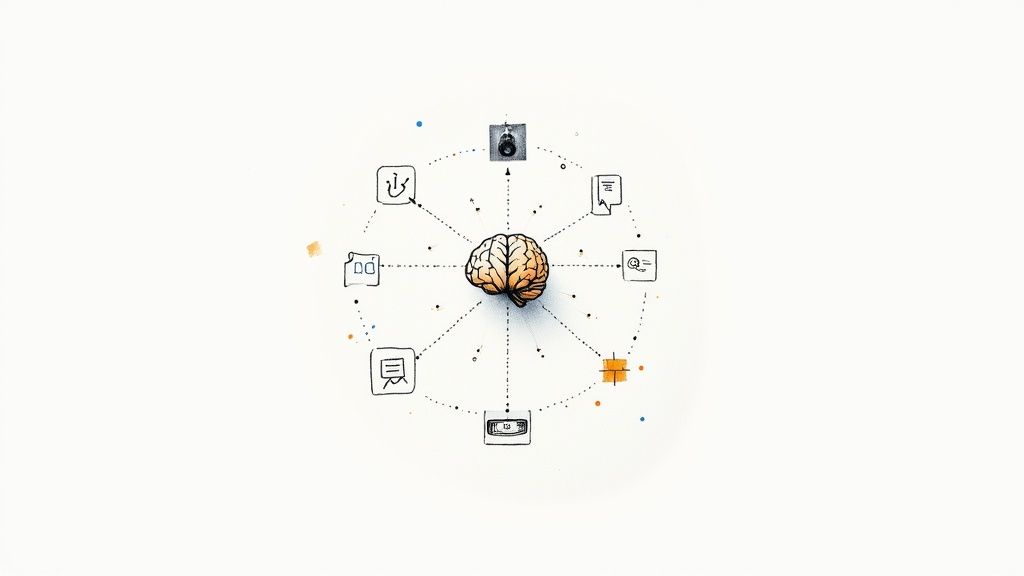
The healthcare systems we've touched on—EHRs, patient portals, and telehealth platforms—are absolutely the foundation of modern care. But the real leap forward is happening right now. Artificial intelligence (AI) is being woven into these systems, turning them from simple digital file cabinets into intelligent partners for clinicians.
This isn't some far-off sci-fi concept; it's a practical evolution that’s making healthcare software solutions more predictive, personal, and profoundly more effective. Think of AI as a powerful analytical engine that can sift through colossal datasets—medical images, patient histories, clinical research—to spot patterns completely invisible to the human eye.
This ability is opening up new frontiers in diagnostics, treatment planning, and even hospital operations. The result? We're moving toward a healthcare ecosystem that doesn't just react to sickness but can actually anticipate health issues before they become critical.
From Predictive Analytics to Smarter Diagnostics
The applications for AI in healthcare are as broad as they are impactful. It’s not just a single piece of technology but a whole toolkit designed to solve different, specific problems. Once you see the real-world use cases, it becomes clear how AI is fundamentally changing how care is delivered.
Here are a few concrete examples of AI in action today:
- Predictive Analytics: AI algorithms can analyze public health data to forecast disease outbreaks, giving hospitals a fighting chance to prepare for a surge in patients. On an individual level, these systems can flag patients at high risk for conditions like sepsis, triggering life-saving early interventions.
- AI-Powered Diagnostic Imaging: In radiology, AI acts as a second set of expert eyes, reviewing MRIs, CT scans, and X-rays to spot the faintest signs of diseases like cancer with incredible accuracy.
- Natural Language Processing (NLP): This is a game-changer for reducing physician burnout. NLP tech can listen to a doctor-patient conversation and automatically transcribe it into a structured note right inside the EHR, freeing up hours of administrative drudgery.
These are just a few of the ways AI is making its mark. Leading health systems are already seeing incredible results. Just look at how Kaiser Permanente's AI-powered initiatives are driving tangible improvements in patient outcomes.
The Challenge of Weaving AI into Existing Systems
While the potential of AI is massive, the idea of integrating it into legacy software can feel overwhelming. A complete system overhaul is often too expensive and disruptive to even consider. This is where the old "rip and replace" approach to modernization just doesn't work.
A much smarter path is to plug AI capabilities directly into the applications you already use. But this creates its own headaches. How do you manage different AI models? How do you control their access to sensitive patient data? And how do you keep API costs from spiraling out of control? Without the right tools, the whole process can become chaotic.
Think of it like this: your current software is a solid, reliable car. AI is the powerful new engine you want to install. A prompt management system is the custom toolkit and control panel that lets your mechanics seamlessly drop in that new engine, tune its performance, and monitor its fuel consumption—all without having to rebuild the entire car from the ground up.
A Mission Control for Your AI Integration
This is exactly where a dedicated prompt management system, like the one we've developed at Wonderment, becomes essential. It acts as a centralized "mission control" for all your AI integrations, giving you the governance and oversight needed to modernize responsibly and effectively. This administrative tool can plug right into your existing desktop or mobile app.
Here’s how our tool gives entrepreneurs and developers the power to innovate with confidence:
- A Prompt Vault: It gives you a secure, central place to create, manage, and use versioning for the instructions you give to AI models. This ensures you get consistent, predictable results every time.
- A Parameter Manager: You get fine-grained control over how the AI interacts with your internal databases, which is critical for protecting sensitive patient information.
- A Logging System: It creates a complete audit trail across all integrated AIs, something that’s absolutely essential for compliance and troubleshooting.
- A Cost Manager: A simple dashboard lets you see your cumulative spend and monitor API costs across all integrated AI models, preventing any nasty surprises on your bill.
This approach takes the risk out of AI adoption and gives your development teams the confidence to innovate. If you're looking to upgrade your healthcare app, you might find our deep dive on AI solutions for healthcare particularly useful.
Choosing the Right Development Partner for Your Project
Building or modernizing healthcare software isn't like piecing together a typical business app. The stakes are just infinitely higher. We're talking about patient safety, sensitive data, and a labyrinth of regulations. Picking the right development partner is one of those make-or-break decisions that will echo through the entire life of your project.
This isn't just about finding coders; it's about finding a strategic partner. You need a team that lives and breathes the unique pressures of healthtech—people who are as fluent in clinical workflows as they are in programming languages.
The best partners don't just take orders. They push back, challenge your assumptions, and guide you through the thorny patches of regulations and user expectations. Think of it as an investment in both your technology and your reputation.
Look Beyond the Portfolio
It’s easy to get wowed by a slick portfolio full of flashy apps. But for a healthcare project, you've got to peel back the layers. A beautiful user interface means absolutely nothing if the software can't securely handle Protected Health Information (PHI) or talk to a hospital's existing Electronic Health Record (EHR) system.
Your top priority should be finding a team with deep, verifiable experience in the healthcare space. The industry is on a tear—the healthcare SaaS market was valued at USD 25.13 billion in 2024 and is expected to rocket to USD 74.74 billion by 2030. That kind of growth brings a lot of developers to the yard, but only a handful have the specialized chops to get it right. You can dig into the drivers of this growth by reading the full market analysis from Grand View Research.
Critical Questions to Ask Potential Partners
To really vet a potential partner, you need to go beyond the generic project management questions. You have to ask pointed questions that expose whether they truly understand the world you operate in.
Here are the kinds of questions that will separate the real healthtech pros from the pretenders:
- HIPAA and Security: "Walk me through your process for ensuring an application is HIPAA compliant from day one. What specific technical safeguards do you build in?"
- Interoperability: "What's your hands-on experience with healthcare data standards like HL7 and FHIR? How do you tackle the challenge of integrating with legacy hospital EHRs?"
- User Experience (UX) Design: "How does your UX design approach change when you're building for a busy clinician versus a patient at home? Show me an example where you designed for a chaotic clinical workflow."
- Cloud Architecture: "Describe a secure cloud architecture you’ve built for a healthcare client. How did you manage data encryption, access controls, and disaster recovery?"
The answers you get will tell you everything you need to know.
The Hallmarks of a Great Healthtech Partner
Beyond their technical answers, look for a team that's thinking about the long game. The best partners are already planning for scalability, ongoing compliance, and future upgrades before the first line of code is even written.
A great development partner in healthcare doesn't just deliver code; they deliver confidence. They give you the assurance that your software is secure, compliant, and built to truly improve the lives of both patients and the clinicians who care for them.
They should also be radically transparent and proactive. In a field where a small mistake can have massive consequences, you need a team that isn't afraid to raise a red flag early and work with you to find a solution. That kind of collaborative partnership is what turns good ideas into healthcare software solutions that actually make a difference.
Where Do You Go From Here?
We’ve covered a lot of ground, moving from the basics of healthcare software like EHRs all the way to the forward-thinking potential of AI. You now have a map to the landscape of modern healthcare technology. But a map is only useful when you start the journey. The real work begins now—this isn't about a single project with a finish line, but a lasting commitment to better care.
If you’re a business leader or an entrepreneur looking to make your mark, the path forward is becoming clearer. The future isn’t just about making healthcare more efficient or secure; it’s about making it smarter and more adaptive. It's time to move past static records and start building dynamic tools that truly empower clinicians and connect with patients in a meaningful way.
From Insight to Impact
The single most important step you can take is to modernize your software. Bringing powerful, manageable AI into your current applications isn't some far-off dream anymore. It’s a practical, achievable goal. The secret is finding tools that cut through the complexity and keep you in the driver’s seat.
This is exactly where a smart approach to AI integration changes the game. Forget about a risky, all-or-nothing overhaul. You can plug advanced capabilities directly into the systems your team already relies on. This approach lets you innovate fast without disrupting the stable, core parts of your operation.
The next big leap in healthcare won't come from ripping out and replacing every system we have. It will come from making those systems smarter. The goal is to build future-proof applications that can grow with your vision and flex to meet the constantly shifting demands of patient care.
If you're ready to stop talking about it and see how it’s done, we invite you to see our technology in action. Schedule a demo of Wonderment's prompt management system today.
You’ll see firsthand how our administrative toolkit makes AI integration simple. We’ll show you how to keep complete control over your data, manage your costs, and build a truly resilient application that will serve you for years to come.
Common Questions
Diving into the world of healthcare software can feel overwhelming. It’s natural to have questions, especially when you’re trying to make the right call on implementation, security, and strategy. Here are a few things that are probably on your mind.
What’s the Toughest Part of Implementing New Healthcare Software?
You’d think it would be the technology itself, but it’s almost always user adoption. Clinicians are stretched thin, and any new tool that messes with their daily rhythm is going to be met with skepticism.
For an implementation to actually work, you have to nail a few things:
- Provide great training that walks users through real-world situations they’ll actually face.
- Show them how it saves time. If it doesn't make their job easier, they won't use it.
- Make sure it plays nice with other systems, especially the EHR. Nothing kills adoption faster than forcing staff to jump between disconnected apps.
Even the most brilliant software will just gather digital dust if the doctors, nurses, and admins who need it every day don't buy in.
How Can I Be Sure My Custom Healthcare App Is HIPAA Compliant?
HIPAA compliance isn’t a feature you add at the end; it has to be part of the project’s DNA from day one. Your first and most important step is finding a development partner who has deep, provable experience with healthcare regulations.
Think of compliance as building a digital fortress around patient data. It isn't just one wall; it's a series of defenses, each one backing up the others.
From a technical standpoint, this means putting specific safeguards in place. We're talking about end-to-end data encryption, strict access controls based on roles, and detailed audit trails that log every single time someone views patient information. You’ll also need to sign a Business Associate Agreement (BAA) with all third-party vendors—cloud providers, AI services, you name it—to ensure everyone touching the data is just as committed to protecting it.
Should I Buy an Off-the-Shelf Solution or Build Something Custom?
Ah, the classic "buy versus build" dilemma. There’s no single right answer here—it really comes down to your specific needs, your budget, and where you see your organization going in the future.
Off-the-shelf software can get you up and running faster and often looks cheaper upfront. The catch is that you might have to twist your internal processes to fit the software's rigid framework, which can lead to major headaches and inefficiencies later on.
Building a custom solution is a bigger investment of time and money from the get-go. But the payoff is a piece of software that works exactly the way you do. This doesn't just create a smoother workflow; it gives you a real competitive edge and the freedom to innovate, scale, and weave in new capabilities like AI as you grow.
Ready to modernize your healthcare application with powerful, manageable AI? At Wonderment Apps, we specialize in building secure, scalable, and intelligent software that meets the unique demands of the healthcare industry. Schedule a demo with our team to see how our prompt management system can help you build for the future. Learn more at wondermentapps.com.