

Building a successful internet of things application is all about creating a living, breathing ecosystem. It’s the art of turning a simple physical sensor into a strategic business tool—one that can drive efficiency, see the future, and unlock entirely new value. This isn't just about connecting a gadget to the internet; it’s about architecting an intelligent, scalable solution from the ground up. The secret sauce? Integrating sophisticated AI in a way that’s manageable, scalable, and doesn’t break the bank.
Modernizing your software with AI can feel chaotic, but a powerful administrative tool can bring order to that chaos. Imagine a central control panel for all your AI integrations—a place to manage prompts, secure data access, and track costs. This is the key to building an AI-powered app that’s built to last.
Your Blueprint for Modern IoT Application Development
The Internet of Things (IoT) has moved far beyond a buzzword. It's now a powerful force actively reshaping industries, from the farm to the factory floor. At its heart, building an IoT application is like giving your business a digital nervous system. Physical devices are the sensory inputs, gathering data from the world around them. That data then zips through a network to a central brain—usually in the cloud—where it’s processed, analyzed, and transformed into something genuinely useful.
This entire flow, from a sensor ping to a decision on a screen, is the foundation of any IoT project. Pulling it off requires a unique mix of hardware engineering, software development, cloud architecture, and data science chops. The market’s explosive growth is a testament to the value here. The U.S. IoT market was valued at roughly USD 413.22 billion in 2024 and is on track to hit USD 667.01 billion by 2030. That kind of rapid expansion signals a massive opportunity for businesses ready to master the development lifecycle.
Understanding the Core Components
To build a solid IoT solution, you need to nail five fundamental pillars. Each piece plays a critical role in the data's journey, taking it from a raw signal in the physical world to a digital insight you can act on.
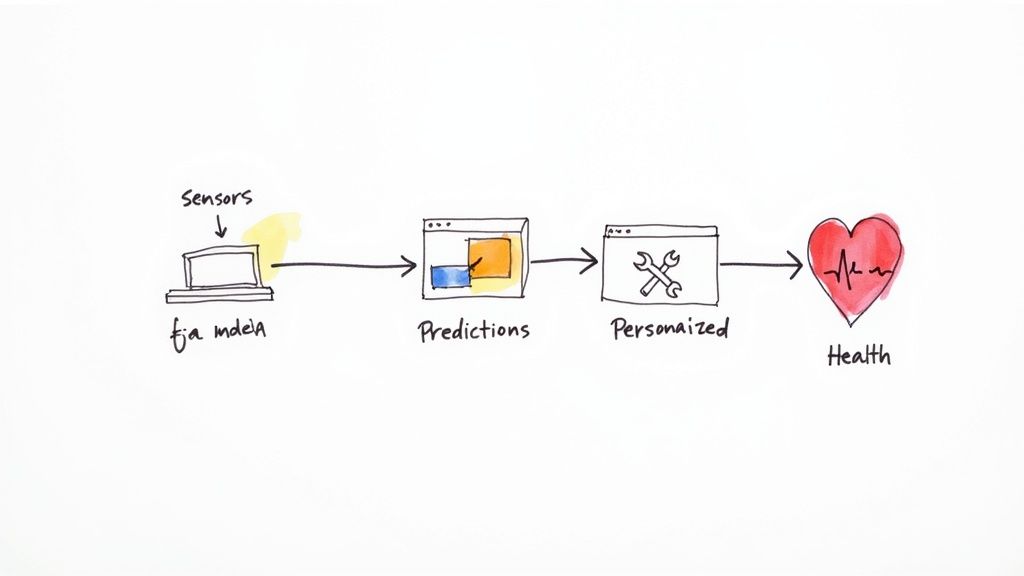
The diagram below maps out this typical data flow, showing how an idea moves from a device to a full-fledged application.
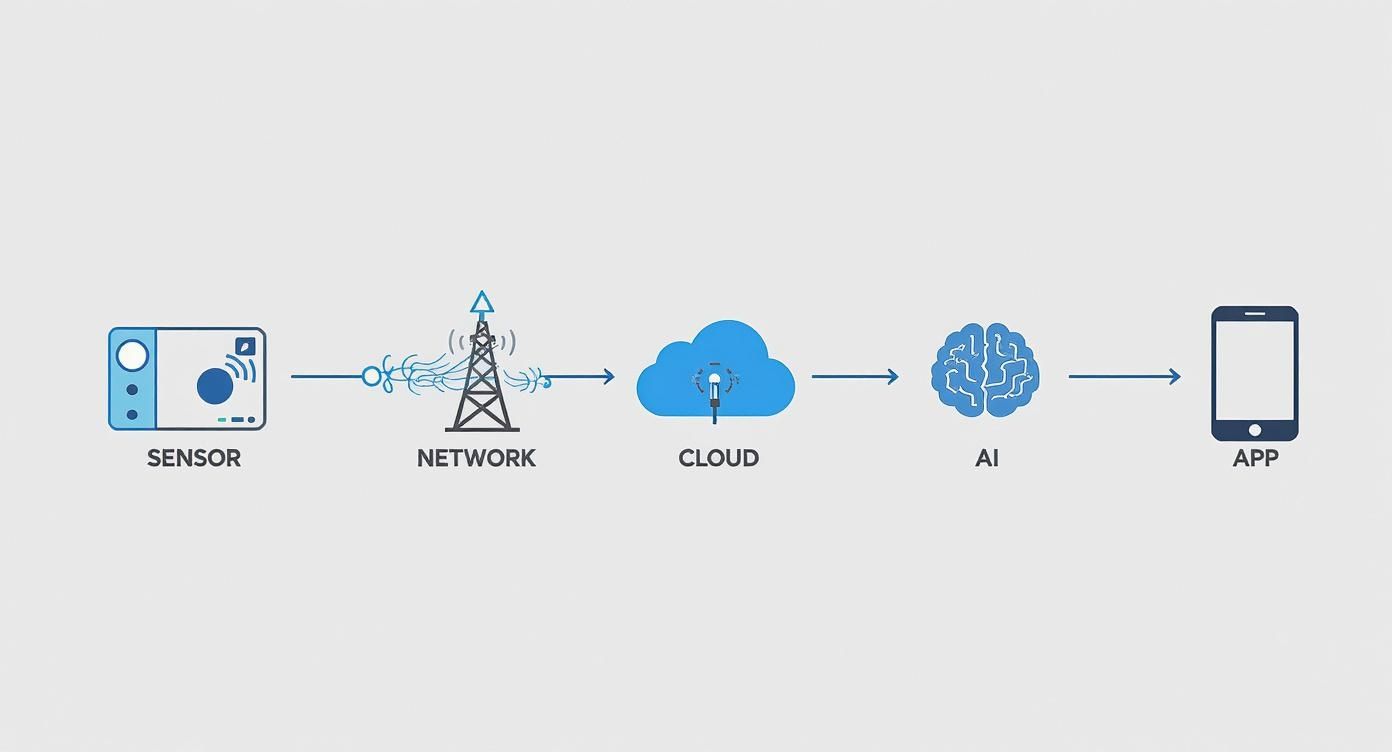
As you can see, it’s a clear progression. Raw data gets collected, transmitted, processed, and then analyzed by AI before finally being served up to a user in an app, creating a complete feedback loop.
Here's a quick look at the core components that make it all work. We've organized them into a table to break down what each one does and what you need to think about.
Key Pillars of IoT Application Development
| Component | Function | Key Considerations |
|---|---|---|
| Devices & Sensors | These are your eyes and ears on the ground, capturing real-world data like temperature, motion, or moisture levels. | Durability, power consumption, cost per unit, and physical security are all major factors. |
| Connectivity & Network | This is the data highway. Options range from Wi-Fi and Bluetooth to cellular (4G/5G) or specialized low-power networks like LoRaWAN. | Your choice impacts battery life, data speed, range, and operational cost. |
| Cloud Platform | The central command center where all the device data is sent for storage, processing, and large-scale analysis. | Scalability is key. You also need to think about data security and integration capabilities. |
| AI & Analytics | This is where the real intelligence comes from. AI models find patterns, predict events, and automate decisions. | The quality of your data directly impacts the accuracy of your AI models. |
| User Application | The final interface—a mobile app or a dashboard—where users can see the insights and control the connected devices. | A great user experience (UX) is non-negotiable. The interface must be intuitive and actionable. |
Each of these pillars is essential for creating a cohesive system where data flows seamlessly and generates real value.
The Power of AI Integration
The real magic of an IoT application happens when you bring in AI. Collecting data is one thing, but using AI to interpret it is a total game-changer. This is where predictive maintenance in manufacturing, a key application driven by IoT devices, turns simple sensor readings into proactive, money-saving actions.
But as you scale up to thousands of devices and AI models, managing it all can become a nightmare.
A dedicated AI management toolkit—with features like a prompt vault for versioning, a cost manager to track spend, and secure data access controls—is no longer a luxury. It is the critical infrastructure needed to build scalable, intelligent, and cost-effective IoT solutions that are designed to last.
This level of control doesn't just simplify development; it gives you a serious competitive edge. Our team specializes in a wide range of custom IoT services designed to bring these complex, intelligent systems to life.
Choosing Your IoT Architecture: Edge vs. Cloud
Right out of the gate, one of the most important decisions you'll make in your internet of things applications development is where your data gets processed. This choice between edge and cloud computing isn't just a technical detail; it fundamentally shapes your application's speed, cost, and what it's capable of. And with the IoT market exploding, getting this right is more critical than ever.
The number of connected IoT devices worldwide is expected to jump from 19.8 billion in 2025 to a staggering 40.6 billion by 2034. This growth is fueling a market projected to swell from USD 1.35 trillion in 2025 to USD 2.72 trillion by 2030. You can dig into more of these numbers by exploring the detailed IoT market statistics on esparkinfo.com.
This flood of data forces a foundational architectural question: where should the "thinking" happen?
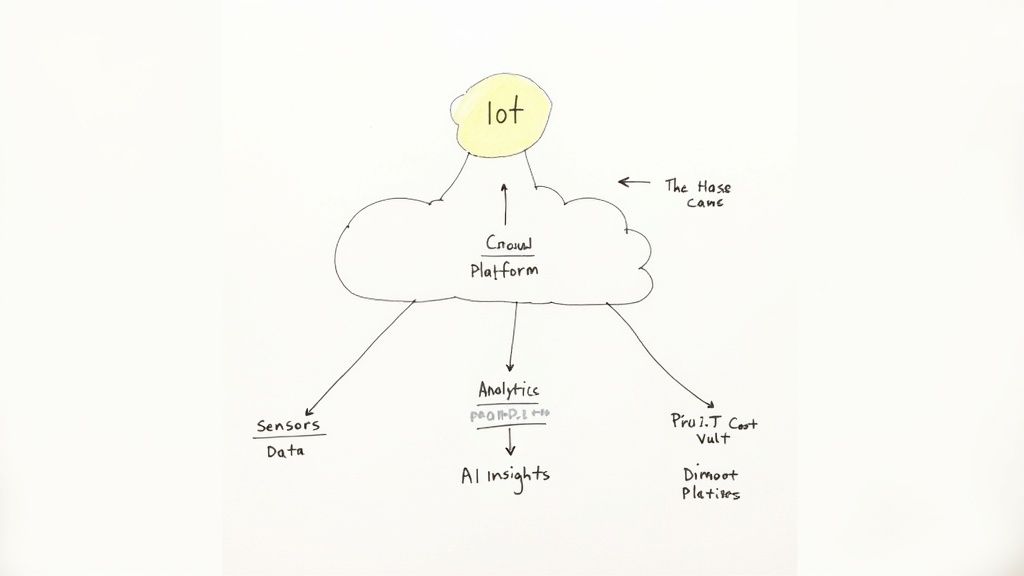
The Central Brain: Cloud Computing
Think of the cloud as a massive, centralized brain. In a pure cloud setup, every bit of data from your sensors—every temperature reading, every motion alert—travels over the internet to powerful servers for storage and heavy-duty analysis.
This model gives you immense processing power and nearly infinite storage. It's perfect for big-data crunching and training sophisticated AI models. If you need to analyze historical trends across thousands of devices, the cloud is your best friend. Our guide on developing applications in the cloud offers a deeper look at making the most of this approach.
The downside? Relying on this central brain can create a noticeable delay, or latency, as data makes the round trip.
The Local Reflex: Edge Computing
Edge computing, on the other hand, is like giving your devices smaller, localized brains. Instead of shipping all raw data to the cloud, the processing happens right on or near the device itself. This "local reflex" allows for instant decision-making. No waiting required.
For applications where every millisecond counts, edge computing is a must. An autonomous car can't afford to wait for a cloud server's permission to hit the brakes; it needs to process camera data and react now. Likewise, a security camera using facial recognition has to identify a threat on the spot, not seconds later after a network delay.
Edge computing isn’t a replacement for the cloud; it’s a powerful partner. The goal is to process time-sensitive data locally for immediate action while sending valuable summary data to the cloud for deeper, long-term analysis.
Finding the Right Balance With a Hybrid Approach
For most modern IoT applications, the real answer isn't "edge or cloud." It's "edge and cloud." A hybrid model simply gives you the best of both, creating a system that's far more efficient and resilient.
In this kind of setup, critical, time-sensitive jobs are handled at the edge. The cloud then takes on the heavy lifting of aggregating data, running advanced analytics, and long-term storage.
Imagine a smart factory. It might use edge computing to detect an equipment failure and trigger an immediate shutdown. It would then send all the diagnostic data to the cloud to help analysts spot failure patterns across the entire facility. This hybrid strategy optimizes for speed, cuts down on data transmission costs, and ensures your application is both responsive and intelligent.
To help you decide on the right mix, this table breaks down the key differences between the two architectures.
Edge vs. Cloud Computing in IoT: A Quick Comparison
| Factor | Edge Computing | Cloud Computing |
|---|---|---|
| Processing Speed | Instantaneous, with very low latency. Ideal for real-time reactions. | Slower due to data travel time (latency). Best for non-urgent tasks. |
| Data Costs | Lower, as only essential or summarized data is sent over the network. | Higher, as all raw data must be transmitted to the cloud. |
| Offline Capability | High. Devices can continue to operate and make decisions without an internet connection. | None. Requires a constant, stable internet connection to function. |
| Scalability | Can be complex to manage as the number of "edge" devices grows. | Highly scalable with massive storage and computational resources on demand. |
Ultimately, choosing the right architecture depends entirely on your project's specific needs—from reaction time and budget to connectivity and scale.
Building a Secure and Scalable IoT Ecosystem
As the world of internet of things applications development explodes, two words have become absolutely non-negotiable: security and scalability. With billions of devices coming online, treating security as an afterthought is a recipe for disaster. A single weak link can expose your entire network, leading to catastrophic data breaches and operational failures.
At the same time, your system must be engineered to grow from ten devices to ten million without needing a complete overhaul.
This growth is happening at an incredible pace, especially in the business world. The enterprise IoT sector is booming, with a global market size hitting approximately USD 671.4 billion in 2024. This market is expected to surge, with enterprise IoT connections projected to reach 24 billion by 2030, far outpacing consumer devices. This massive scale underscores the urgent need for a robust, future-proof foundation.
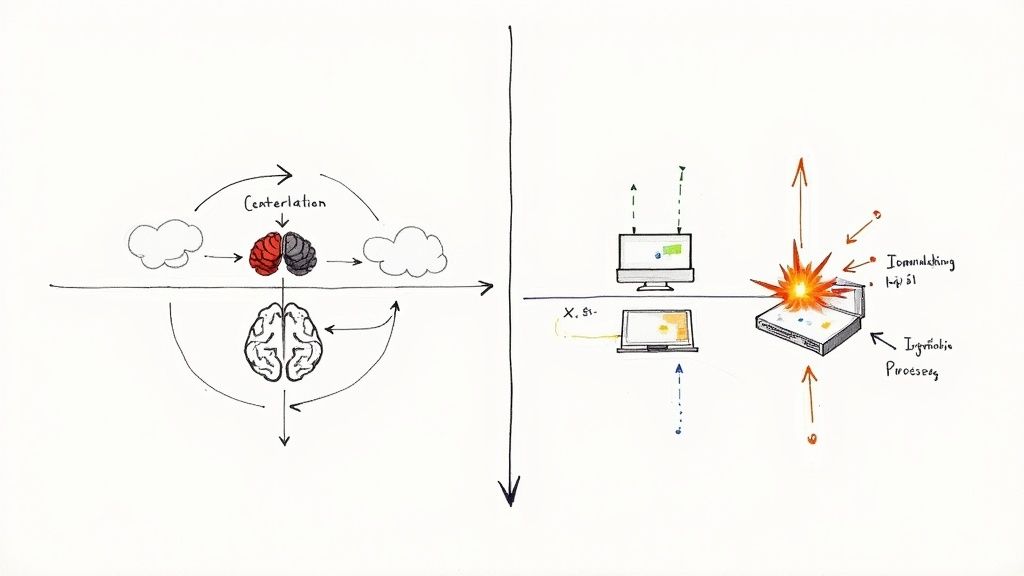
Fortifying Your IoT System From Device to Cloud
True IoT security isn't a single feature; it's a multi-layered strategy that protects your system at every point of vulnerability. Think of it like securing a fortress. You need strong outer walls, guarded gates, and secure rooms inside. When designing your ecosystem, it's crucial to understand and mitigate the unique IoT security challenges that come with connecting physical devices to the internet.
Here are the essential layers you must address:
-
Device Security: This is your first line of defense, right at the source. It starts with secure boot processes to ensure only authorized firmware can run on the device. Physical tampering detection and hardware security modules (HSMs) are also key to protecting devices from being physically compromised out in the field.
-
Network Security: Data is most vulnerable when it's on the move. All communication between devices, gateways, and the cloud must be encrypted using strong protocols like TLS (Transport Layer Security). Using private networks or VPNs adds another powerful layer of protection against anyone trying to eavesdrop.
-
Cloud Security: Once data reaches your cloud platform, it needs ironclad protection. This involves strict identity and access management (IAM) policies to control who can access what, regular security audits, and encrypting data both "at rest" (when it's in storage) and "in transit."
-
Application Security: The user-facing application itself can be an entry point for attackers. Implementing secure coding practices, requiring strong authentication, and regularly performing penetration testing are critical to keeping the application layer locked down.
Secure over-the-air (OTA) updates are also a fundamental piece of the puzzle. You need a reliable way to patch vulnerabilities and deploy new features to your entire fleet of devices without introducing new risks.
Designing for Massive Scale From Day One
Scalability isn't something you can bolt on later. A system designed for a hundred devices will absolutely crumble under the weight of a million. Building for scale requires intentional architectural decisions from the very beginning.
A scalable IoT architecture is like a well-designed highway system. It has the capacity to handle rush hour traffic without gridlock, with on-ramps and off-ramps that allow for smooth, efficient flow, no matter how many cars are on the road.
To achieve this, focus on a few key principles. First, choose communication protocols that are efficient and designed for low-power, large-scale networks, such as MQTT or CoAP. These protocols are lightweight and reduce data overhead, which is essential when you're dealing with millions of endpoints.
Next, build a resilient and elastic backend. Using cloud-native services like serverless functions and auto-scaling databases allows your infrastructure to automatically adjust to demand. This means you only pay for the resources you use, and your application won't crash during unexpected traffic spikes.
Finally, implement a robust device provisioning and management system. You need an automated way to onboard, monitor, and decommission devices securely and efficiently as your network expands.
Integrating AI to Create Intelligent IoT Applications
The true magic in internet of things applications development really ignites when you bring Artificial Intelligence into the mix. An IoT system without AI is like a nervous system that can feel but can't think. It gathers data—temperature, motion, pressure—but it can’t make sense of it, learn from it, or predict what comes next.
AI is the brain. It elevates your application from a passive data collector into a proactive, intelligent partner.
This is the shift that turns a simple factory sensor into a fortune teller, predicting equipment failures weeks before they happen. It’s what lets a wearable health monitor do more than just track a heart rate—it can spot subtle patterns that might signal an urgent health issue. AI digs through the massive streams of data from your devices, finds the hidden connections, and lets your application make smart decisions all on its own.
From Raw Data to Actionable Intelligence
The real goal here is to move past basic dashboards and alerts. AI models, especially machine learning, are the engines that get you there. You train them on your historical IoT data so they learn to recognize what's normal and, more importantly, what isn't.
Think about these powerful, real-world examples:
- Predictive Maintenance in Manufacturing: Instead of waiting for a critical machine to break down and shut down the whole production line, AI models analyze vibration, temperature, and performance data from IoT sensors. They spot tiny deviations that point to a future failure, so maintenance can be scheduled proactively. That can save millions in downtime.
- Personalized Healthcare Monitoring: A smartwatch or glucose monitor is constantly collecting health data. An AI algorithm running in the background can learn an individual’s unique health baseline. This allows it to provide personalized alerts and recommendations, shifting from generic advice to truly tailored health insights.
- Smart Agriculture: When you combine AI with IoT sensors in a field, you can do a lot more than just turn on the sprinklers. The system can analyze soil moisture, weather forecasts, and crop imagery to deliver the exact amount of water and fertilizer needed, optimizing resources and boosting crop yields by up to 50%.
These applications show how AI turns raw sensor readings into high-value, automated actions that have a direct impact on the bottom line.
Taming the Complexity of AI Integration
But let’s be realistic—deploying and managing AI models in an IoT environment isn't a simple plug-and-play affair. It adds a new layer of complexity that can get out of hand fast, especially as your network of devices and AI services expands. How do you update an AI model's instructions? How do you control its access to data? And how do you keep the operational costs from spiraling?
This is where a dedicated AI management system becomes a game-changer. For a deeper dive, our guide on how to leverage artificial intelligence effectively is a great place to start.
Managing AI in an IoT context is like conducting an orchestra. Each AI model is an instrument that needs to be perfectly tuned and coordinated. Without a conductor—a central management system—all you get is noise. With one, you get a masterpiece.
A solid administrative tool provides that essential control layer. It cuts through the chaos by bringing key functions into one place. Imagine having a single dashboard to manage everything:
- A Prompt Vault: A secure, central library to store, version, and manage the instructions (prompts) you give to your different AI models.
- A Parameter Manager: A control panel where you define exactly which internal databases and data sources your AI can access, keeping your information secure and sound.
- A Centralized Logging System: A complete log of every interaction across all your integrated AIs. This gives you total visibility for troubleshooting and performance tuning.
- A Cost Manager: A dashboard showing a real-time view of your total spend on AI services, which helps you avoid surprise bills and manage your budget.
This level of organized control is what separates a frustrating, expensive AI experiment from a scalable, smart, and profitable IoT application. It’s the key to building software that is not only intelligent today but also ready for whatever comes next.
Assembling Your Expert IoT Development Team
An ambitious vision for an internet of things applications development project is only as strong as the team you build to bring it to life. Unlike typical software projects, IoT initiatives demand a unique mix of specialists who are masters of both the physical and digital worlds. Getting this blend right is probably the single most important factor for success.
Your goal is to pull together a cross-functional team where every member is an expert in their domain but can still speak a common language of collaboration. This isn't about just hiring a few full-stack developers; it’s about recruiting a specialized unit that can build a seamless bridge from a real-world sensor all the way to a sophisticated cloud application.
The Core Roles on Your IoT Dream Team
A successful IoT product is like a symphony of different skills. You can't just have a brilliant hardware engineer or a great cloud architect working in a silo. Each role is completely dependent on the others to create a cohesive, functional system.
Here are the essential specialists you'll need on your team:
- Hardware Engineer: This is the person who lives and breathes the physical world. They’re responsible for designing the printed circuit boards (PCBs), picking the right sensors, and making sure the device is durable, power-efficient, and can be manufactured without breaking the bank.
- Embedded Software Developer: This developer writes the low-level code, or firmware, that runs directly on your IoT device. They work within tight memory and power constraints to make the hardware "smart," allowing it to gather data and talk to the outside world.
- Cloud Architect/Backend Developer: Once data leaves the device, it needs a home. This expert designs and builds the scalable cloud infrastructure that can securely ingest, process, and store information from potentially millions of devices.
- Data Scientist/AI Specialist: The data magician. This role is all about building the AI and machine learning models that sift through the collected data, uncover hidden patterns, and generate the actionable insights that create real business value.
- UX/UI Designer & Application Developer: This team creates the face of your entire system. They design the intuitive dashboards and mobile apps that let end-users interact with the IoT data and control their connected devices, ensuring the experience is seamless and valuable.
In-House vs. Outsourced: Which Is Right for You?
One of the first big decisions you'll make is whether to build this specialized team in-house or partner with an agency. Each path has its own distinct advantages, and the right choice really boils down to your company's long-term strategy, budget, and timeline.
An in-house team offers deep institutional knowledge and long-term alignment with your business goals. An outsourced partner provides immediate access to specialized expertise, faster time-to-market, and reduced hiring overhead.
Here's a quick breakdown to help you weigh your options:
| Factor | In-House Team | Partnering with an Agency |
|---|---|---|
| Speed to Market | Slower, as it requires a lengthy hiring and onboarding process. | Faster, as you gain immediate access to a pre-vetted, experienced team. |
| Cost | Higher upfront investment in salaries, benefits, and tools. | More predictable project-based costs, avoiding long-term payroll commitments. |
| Expertise | Requires finding and retaining talent across multiple niche disciplines. | Instant access to a wide range of specialized skills without the hiring risk. |
| Control & Focus | Full control, but can divert focus from your core business operations. | Less day-to-day management, allowing your team to focus on core competencies. |
Ultimately, many companies find a hybrid model works best. They might leverage an external partner to accelerate development and fill skill gaps while simultaneously building up an internal team to manage the product long-term. This approach combines speed and expertise with strategic internal ownership, creating a powerful foundation for your IoT initiative.
Common Questions About IoT Application Development
Starting an internet of things applications development project often feels like stepping into the unknown. It’s natural for business leaders and tech teams to have a lot of the same questions about the hurdles, costs, and timelines they’re facing. Let's clear the air and tackle some of the most common ones.
What Is the Biggest Challenge in IoT Application Development?
Honestly, the toughest nut to crack is usually a combination of security and interoperability.
Securing thousands, or even millions, of different devices is a massive undertaking. It requires a strategy that works on multiple levels, from locking down the hardware itself to encrypting every bit of data that flies between the device and the cloud. Just one weak spot can put the entire network at risk.
Then there’s interoperability. Getting devices from different manufacturers, often built on their own proprietary tech, to talk to each other is a major headache. Without a flexible system built on common, standardized protocols, you’ll find yourself boxed in, unable to scale or add new types of hardware down the road.
How Much Does It Cost to Develop an IoT Application?
There's no single price tag for an IoT application—the cost can swing wildly depending on complexity, the number of devices, and hardware needs. However, most projects tend to fall into one of three general buckets.
- Proof-of-Concept (PoC): A simple PoC to test a core idea with off-the-shelf hardware can land anywhere from $10,000 to $50,000.
- Minimum Viable Product (MVP): Building a commercial-grade app for a decent-sized deployment, complete with custom firmware and a solid cloud backend, typically runs between $100,000 and $500,000.
- Enterprise-Scale System: For large industrial projects that involve designing custom hardware from scratch, advanced AI, and deep integrations with existing enterprise systems, costs can easily climb past $1 million.
The biggest cost drivers are almost always custom hardware engineering, firmware development, recurring cloud platform fees, serious security implementation, and AI model development.
How Can AI Modernize an Existing IoT System?
AI is what turns an IoT system from a simple data collector into an intelligent, proactive partner. Instead of just showing you data on a dashboard, AI can analyze that information to predict when a machine is about to fail (predictive maintenance) or automatically fine-tune a building's energy use based on real-time activity. It adds a brain to the operation that delivers real business results.
The challenge isn’t just adding AI—it’s managing it effectively. A modernized IoT system needs a central nervous system to control its intelligence. This ensures your AI integrations are secure, cost-effective, and easy to scale over time.
This is where having a dedicated administrative toolkit is a game-changer. For example, a smart prompt management system lets you plug in various AI services with ease. It gives you a central vault to control and version AI instructions, a way to securely manage data access, and a cost manager to keep an eye on your total spend across all the different AI models you’re using. That level of control makes an AI-powered system not just smart, but manageable for the long haul.
What Is the Typical Timeline for Developing an IoT Application?
A typical IoT project isn’t a quick sprint; it’s more like a marathon run in phases. This approach is designed to reduce risk and make sure you're on the right track at every step. The timeline is heavily influenced by how complex the hardware and firmware are, not to mention any regulatory hoops you need to jump through.
A standard project lifecycle usually looks something like this:
- Proof of Concept (PoC): This initial stage, just to prove the core idea works, can often be wrapped up in 2-4 months.
- Minimum Viable Product (MVP): Getting an MVP with core features and a small batch of production-grade hardware ready typically takes 6-9 months.
- Full-Scale Production Launch: A full rollout with battle-tested security, proven scalability, and manufacturing all sorted out can take 12-18 months or even longer.
Each phase builds on the last. This ensures you’re investing in a solution that’s both technically solid and makes business sense before you commit to going all-in.
At Wonderment Apps, we specialize in turning complex IoT concepts into scalable, intelligent, and secure applications. Our expertise in AI modernization and UX-driven development ensures your project not only meets today's needs but is also built to adapt to tomorrow's challenges. Wonderment has developed a prompt management system that developers and entrepreneurs can plug into their existing app to modernize it for AI integration. This administrative tool includes a prompt vault with versioning, a parameter manager for internal database access, a logging system across all integrated AIs, and a cost manager to see cumulative spend. See how our toolkit can streamline your AI integration.